
This is a guest post from Vani Hari (a.k.a. The Food Babe) and New York Times Best Selling author. You can read more about her take on the food industry in her second book, Feeding You Lies!
Sugar is one of the most dangerous ingredients on the market. It's addictive, added to almost every processed food, and will make you overweight, depressed and sick if you eat too much. In fact, Americans eat close to 130 pounds of the stuff per person per year (4 times more than the recommended daily allowance), likely because it is so addictive.
That's why it's exciting to know there are alternative sweeteners made in nature, like "stevia," that don't wreak havoc on your health - or do they? That's what I went on a quest to find out. Here's what happened...

Want to Save this Recipe?
Enter your email below & we'll send it straight to your inbox. Plus you'll get great new recipes from us every week!
What Is Stevia?
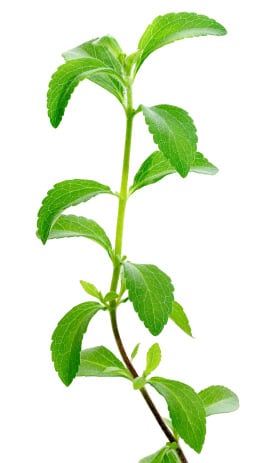
For those of you that are hearing about stevia for the first time, it is a plant that is typically grown in South America, and while its extract is 200 times sweeter than sugar, it does not raise blood insulin levels. That's what makes it so popular.
However in 1991 the FDA refused to approve this substance for use due to pressure from makers of artificial sweeteners like Sweet n' Low and Equal (a one billion dollar industry). But in 2008, the FDA approved the use of rebaudioside compounds that were derived from the stevia plant by Coca-Cola (Cargill) and PepsiCo - hmmm doesn't that sound suspicious?
Not until a major food company got involved did stevia become legal, and only after it had been highly processed using a patentable chemical-laden process...so processed that Truvia (Coca-Cola's branded product) goes through about 40 steps to process the extract from the leaf, relying on chemicals like acetone, methanol, ethanol, acetonitrile, and isopropanol. Some of these chemicals are known carcinogens (substances that cause cancer), and none of those ingredients sound like real food, do they?
The whole leaf stevia that you can grow in your backyard (and has been used for centuries in countries like Brazil and Paraguay) remains a non-approved food additive by the FDA.
However, rebaudioside A (the stevia extract) that was approved by the FDA has not been used for centuries and long term human health impacts have not been studied and are still unknown. The sweetener/sugar industry wields powerful influence over what is ultimately approved at the FDA, and this is just another example where they are influencing decisions that don't make sense.
How can a chemically derived extract be deemed safe in processed food and a plant from mother nature not?
What Kind Of Stevia To Avoid

The 40-step patented process used to make Truvia should make you want to steer clear of this stevia product alone, but there are two other concerning ingredients added (not only to Truvia but other stevia products as well).
First, erythritol is a naturally occurring sugar that is sometimes found in fruit, but food manufacturers don't actually use the natural stuff. Instead they start with genetically engineered corn and then go through a complex fermentation process to come up with chemically pure erythritol. Check out the manufacturing process below:


"Natural flavors" is another ingredient added to powdered and liquid stevia products, likely due to the fact that once the stevia leaf is processed it can develop a metallic taste. Manufactured natural flavor is contributing to what David Kessler (former head of the FDA) calls a “food carnival” in your mouth. This makes it difficult to stop eating or drinking because the flavors they have synthesized will trick your mind into wanting more and more.
When companies use manufactured flavor, they are literally “hijacking” your taste buds one-by-one; that's why I recommend putting products that contain "natural flavors" back on the shelf.


"Stevia in the Raw" sounds pure and natural, but when you look at the ingredients the first thing on the label is "dextrose" - so it's certainly not just stevia in the raw. And Pepsi Co's "Pure Via," also pictured above, isn't exactly pure either with this ingredient being first on the label, too. Dextrose is a sweetener that's also derived from genetically engineered corn and has a long complicated manufacturing process, just like erythritol.
Even certified organic stevia can have sneaky ingredients added, like this one above which has more organic agave inulin than the stevia extract itself. Agave inulin is a highly processed fiber derivative from the blue agave plant.
Also on the ingredient list is an item you are probably familiar with from those little packets sometimes found in boxed goods - silica (pictured). It is added to improve the flow of powdery substances and is the same ingredient that helps strengthen concrete and creates glass bottles and windowpanes. It may cause irritation of the digestive tract (if eaten) and irritation of the respiratory tract (if accidentally inhaled).

While it is non-toxic and probably won't kill you in small quantities, it's definitely not a real food ingredient I would cook with or that I want to be putting in my body.
How To Choose The Right Kind Of Stevia
Luckily there are ways to enjoy this sweet leaf closer to it's natural state... because let's be honest, the no-calorie artificial sweeteners out there are really dreadful, and no one should consume them (check this post for the low down on those). So here's what you can do:
- Buy a stevia plant for your garden (luckily it's totally legal!) or purchase the pure dried leaves online - you can grind up them up using a spice grinder (or use a mortar and pestle) for your own powdered stevia.
- When choosing products already sweetened with stevia, look for “whole leaf stevia” on the ingredient label. For example my favorite protein powder is made with “whole stevia leaf” instead of rebaudioside a or stevia extract.
- Add fresh or dried leaves directly to tea or drinks for natural sweetness (note the straight stevia leaves are only 30-40 times sweeter than sugar, vs. 200 times using the extract).
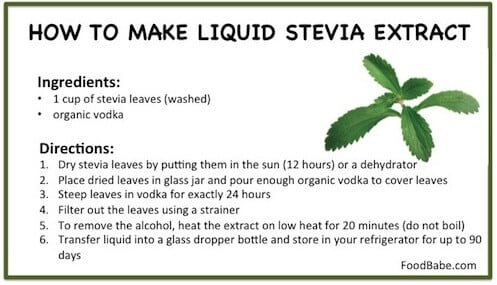
- Make your own liquid stevia extract (see graphic below for recipe).

- If you are not up for getting a stevia plant of your own or making your own extract, remember to look for a stevia extract that is 100% pure without added ingredients (Trader Joe's has a version in a small bottle).
And when all else fails, choose a suitable alternative and forget stevia altogether.
Lisa uses honey and pure maple syrup, and I personally prefer coconut palm sugar, since it is low glycemic (making it more diabetic friendly) and one of the most natural unprocessed forms of sugar available. It is naturally high in amino acids – has 10,000 times more potassium, 20 times more magnesium and 20 times more iron than conventional sugar. I use it all the time in my baking, from pound cake to muffins to a recent delicious cookie that is low in sugar - check out all those recipes here!
Comments have been closed on this article, which was written by Vani Hari. If you have a question or comment you can reach her at http://FoodBabe.com.


amyo6 says
I have purchased Stevia processed to bake equal measures to cane sugar. nononono...not a good taste to me.
Came across a plant at Trader Joe's one trip and have had it for almost a year now... I just use the leaves or a sprig, I don't really bake, in recipes that call for a bit of sugar, in water, salads, sauce, etc.
But the best is... craving something sweet, pop a little leaf or two
in my mouth and chew. I am good from 4pm, when it hits, until supper.
Marlene Dotterer says
I'm also curious about the coconut palm sugar. Any time a plant becomes "famous" among foodies or health-nuts (both of which I am), then growth of that plant quickly becomes unsustainable. This is a big reason why I rarely jump onto the latest "hot" food. But I did start using the coconut palm sugar. Do I need to stop?
Food Babe says
No I don't think you do. A lot of negative information about coconut palm sugar on the web is unfounded (and likely funded by the "other" sugar guys). I've met the CEOs from several different coconut palm sugar companies (questioning them hard) and I can tell you - Coconut Palm sugar is sustainable and the most nutritious form of sugar available. I've been using it for a few years in my baking and can feel a significant difference on the way I feel after eating items used with it.
Sierra says
What brand of coconut sugar do you use? I followed one of your links in another post (I think about the food expo you went to) and it just took me to amazon, where I was overwhelmed with hundreds of brands of coconut sugar....
Thanks!
Anita @ Losing Austin says
I've been avoiding it, but so glad to have more knowledge now- thanks! I'm also not using palm for those reasons in links above, so mostly stick with honey. But getting my own stevia plant is a great option.
Amy says
What is your take on SweetLeaf Stevia? It ingredients are: inulin soluble fiber and USDA certified organic sweetleaf stevia extract.
Jennifer says
I love their products, especially their flavored stevia drops (flavored with essential oils). The chocolate-raspberry stevia helped get me off chocolate. The English toffee flavor allowed me to use plain yogurt and the root beer flavor has gotten people off of soda.
Kari says
Thank you for posting this! I've been wondering the same thing, since these stevia products came out! I couldn't understand why or how a plant like this would be white as snow in the package if it hadn't been processed over and over again! I'll be sticking to the real thing!
Cheryl says
Thanks for another great article! It never ceases to amaze me what these huge corporations do to make things work out in their favor while ruining our health!! I'll be passing along the link to your article - keep up the good work!
Mallory says
Thank you for this information. It's so disheartening to see the stranglehold that these huge "food" corps have on our government. Even when you try to do the right thing for yourself, these companies can legally present misinformation. Thanks for your help! With that said, does anyone know of a good alternative to sweeten a grapefruit? They're my favorite and it looks like I'll be done with Stevia packets now!
Jill says
Try drizzling a little honey on your grapefruit, it's wonderful! Super tasty if you put it under the broiler for a couple of minutes. :)
Mallory says
Wonderful idea! Sounds good, thanks for the response!
ALEJANDRA says
SO BETWEEN THE STEVIA AND THE AGAVE, WHICH ONE IS BETTER ?
Smith says
Thanks a lot for the informative research and your time/effort to bring to us
Lisa says
I saw this article on coconut palm sugar that makes me question whether it is responsible to use this sugar: http://www.tropicaltraditions.com/coconut_palm_sugar.htm I'd love to hear your comments on this issue.
Melody Moxley says
I did some further reading on coconut palm sugar, and after reading this
http://www.tropicaltraditions.com/coconut_palm_sugar.htm
was leary of using it.
Lori says
Thank you for listing an alternative sweetener for diabetics.
Michelle says
I bought Trader Joe's Organic Liquid Stevia and the exact ingredients listed on the bottle are...De-Ionized Water, Organic Stevia Extract(Stevia Rebaudiana)(Leaf) and 11% Organic Alcohol
Erin VanDordrecht says
And stevia is excellent for the pancreas/blood sugar as well as the skin! Naturally anti-fungal/antibacterial/antiviral. We use it on wounds too! We love the real stuff!
Eileen says
Erin my 4 year old daughter is a Type 1 Diabetic. I have been using KAL Brand Pure Stevia in powdered and liquid form since her dx in November 2011. Do you have any links about the benefits of Stevia that you posted about. I think I just asked how to purchse the brand you referred to as well. Thanks.
Terry says
Did you check this out? It's what we've been using:
http://www.bodybuilding.com/store/now/steviaextract.html;jsessionid=08C8A95EB4DB161F59F2219572FCC5D1
Erin VanDordrecht says
Dr. Tei Fu Chen was responsible for successfully petitioning the FDA to lift the ban on stevia in 1995. He also was the first to develop an extraction method which did not involve chemicals back in 1984, using recipes obtained from Chinese Imperial manuscripts. You can still buy his liquid stevia, which is what we use. Apparently all "powdered" versions are adulterated, done so with a chlorine process. And most liquid ones as well use chemicals too.
Eileen says
Where do you purchase his brand from Erin?
Erin VanDordrecht says
Eileen, Sunrider is his company. He has two stevia liquids, one which still contains the chlorophyll (Sunectar) and one that does not and is clear and a bit sweeter (Sunnydew), both are amazing, non chemically extracted, stevia products. We use Sunectar in our home :)
jen says
http://shop.sunrider.com/Shop/Product_51.asp?dept_id=32&pf_id=5&Return=/shop/Display_Dept.asp?dept_id=7
Traci says
Like everyone else, I just checked my cabinet to see what I had. I have something called Sun Crystals, the ingredients: pure cane sugar, stevia. What do you think of this? (Honestly, I don't know how long it has been in the cabinet! It's never even been opened!)
Cheryl Stuart-Vail says
Even the real stevia gives me headaches as far as I can tell.
Jane Peters says
Yeah these food companies can't leave well enough alone. Thank you for your report! So is the natural plant completely safe?
Jill says
As safe as any other herb you would grow in your garden. :)
Lisa F says
I have been using Truvia in my cofee in the morning. I only have 1 cup (2 max) and do not drink sodas or anything else that contains artifical sweeteners and wonder if it is better to use sugar in small quantities or a sweetener like stevia in these situations.
Johanna says
use nu naturals liquid stevia it's super cheap at vitacost https://www.vitacostrewards.com/3HFbr6
Irene says
Great article but I was wondering about Silica. It is bad for us but you can buy it as a supplement?? http://www.jamiesonvitamins.com/2848
Can you explain this for us please?
Thanks!
Charlene says
Ooops, and I thought I was doing so well with my Stevia (Truvia among them) Guess not. Out it goes.
Sarah says
I have been using pure Stevia powder. Unfortunately, it is not sold in grocery stores. However, you can order it from Amazon.
http://www.amazon.com/Kal-Pure-Stevia-Extract-Powder/dp/B000VRSR84/ref=sr_1_1?ie=UTF8&qid=1366921012&sr=8-1&keywords=pure+stevia+powder
Joan says
I was able to find Kal Pure Stevia Extract Powder at my local health food store.
Eileen says
This is the brand that I have been using for my 4 year old Type 1 Diabetic child. I use the powder in cooking and in her green smoothies every morning. I also buy the same brands liquid form to put in her homemade lemonade and unsweetened almond milk. I then call it "sweet milk" and she loves it. I'm hoping this is a better form of stevia to be using. I personally don't like it as it has an odd after taste but in lemonade it is tolerable. I have started trying it in my iced tea and am starting to get used to it. Thanks for posting. I buy mine from Whole Foods.
Kelsey says
Ever heard of Stevita? It's a liquid Stevia sweetener and the only other ingredients are distiller water and grapefruit seed extract (a preservative). Granted its not organic, it does say Kosher on the bottle...any thoughts?
Alyssa (Everyday Maven) says
Great article! I was on the hunt for organic green stevia powder in my city (Seattle, WA) and couldn't find any but I did find this source to order it online. https://www.frontiercoop.com/products.php?ct=hchhaz&cn=Stevia+Herb
jen says
Thoughts? http://www.tropicaltraditions.com/coconut_palm_sugar.htm
Food Babe says
With all things, it’s important to know where you get your coconut sugar… I eat it in extreme moderation, not every day, so this is a sustainable approach on it’s own. Big Tree Farms is a very reputable brand, as well as Nutiva for Coconut Palm Sugar if you are looking for companies you can trust to practice business the right way without hurting farmers. Thanks for your concern!
Also – you may want to check this out to learn more – http://www.wildernessfamilynaturals.com/collection-of-coconut-sap.php
LP says
My only thought in trusting these companies that claim coconut sugar is sustainable is that they have everything to gain in telling you it is okay. Coconut sugar is one of the biggest food crazes out there right now. Tropical Traditions has everything to lose by posting their article and refusing to jump on board. And Nutiva, Big Tree Farms, and Wilderness Family Naturals have everything to gain by offering this product to consumers. I do appreciate Wilderness Family Naturals take on it, it is a direct address to the issue and they don't beat around the bush and brush over the topic like other companies do. Also, I would like to see a processing break down to see how they turn sap to sugar granules. I mean maple syrup is made from collecting sap, but sugar granules are not common. Why are they taking the processing further to make granular sugar. I am still very wary of coconut sugar and have read about it's high fructose content. Additionally, I have also read that to gain any nutritional benefit from the minerals, etc, one would have to eat A LOT of coconut sugar. It may be low glycemic, but sugar is sugar and I'm still out on the coconut sugar debate.
Heather H says
Thanks for this post though i do wish you had focused more on the extracts of the just the stevia leaf vs all the faux stevia blends.
I do want to point out that although coconut sugar may be a good alternative there is a real downside environmentally to coconut sugar that Tropical Traditions lays out nicely on their website.
http://www.tropicaltraditions.com/coconut_palm_sugar.htm
Food Babe says
Heather - this is misinformation, that I personally plan on addressing on a detailed post soon. Please see my other comments below about the article you posted.
Elizabeth says
Erythritol not Ethanol. Erythritol is also a vasodilator in the medical field.
Jeremy says
What's so difficult about using natural sugar in moderation? There are plenty of places to get minimally processed sugar, and then it's just a matter of self control.
amy says
thanks for this. i was just looking at stevia today but was confused by the different labels and what they meant. so i bought nothing until i could figure out what they were. this article was perfect timing for me
Christine says
Maybe I missed it? Why is there no mention of the Sweet Leaf brand of Stevia? That's my new favorite and it's all natural.
Jane says
Uh, you do know ethanol is the alcohol found in beer and wine? So, yeah that one does sound like food to to me. Makes it hard for me to take the rest of the article seriously - is this well-researched or fear-mongering?
Jason Leake with 100 Days of Real Food says
Hey Jane - I didn't write this article, but ethanol is not mentioned in it anywhere..can you please clarify your point?
Cindy says
In the "What is Stevia?" section - in the second to last sentence you will find it. And totally agree with both Jane and Manny.
Jason Leake with 100 Days of Real Food says
My bad, thanks!
manny says
I would have to agree with Jane. I wish bloggers like you that so many people put their trust in were a little bit more educated on the topics as well as providing some scientific background instead of just scaring people from different types of products. Referring to alcohols as chemicals is absolutely incorrect, which is covered in basic chemistry. Moreover Rebaudioside A was not developed by pepsi and coca cola. Reb A is a specific glycoside of the stevia leaf and is different than the patented version of Cargill which is called Rebiana. This article has way too many incorrect facts and does not serve as a good source of information.
Food Babe says
Manny - I stated the FDA approved compounds from rebaudioside... so I don't see what your concern is... I could have gone into far more detail, however this is a blog post (not a book) and I wanted to be mindful to the reader's interest and time.
Also - ethanol when metabolized by the liver can create acetaldehyde, which is a carcinogen. My intent is not to "scare" people with this information - rather I wanted to show there are ingredients used in the processing of stevia that are obviously not real food.
Michelle Ritchie | Delicious Karma says
Food Babe...could NOT agree with you more! Bottom line, this is a highly processed product that one could not possibly consider "real" food. It is a "fake" sugar, that, quite frankly, has an unpleasant bitter flavor. While sugar is not "good" for you, I believe its not to bad (unless you're diabetic or have other related health issues) to eat it when eating SMALL quantities of the "right" sugar...in other words, "real" sugar.
Jane says
"Also – ethanol when metabolized by the liver can create acetaldehyde, which is a carcinogen."
Food Babe, seriously, I mean this with all due respect, I think this is a very important issue and I share your passion for educating people about whole foods vs. processed. But I honestly believe you need to educate yourself about chemistry - maybe consider taking a chem class at your local community college. Your homemade stevia recipe calls for what? VODKA. That means the solvent in your extraction is ETHANOL which you then remove by evaporation, just like a food processing plant would do for a commercial stevia extract. If it's a dangerous liver carcinogen that no one should eat, why are you advocating its use for the home cook? You cannot blast the food corps. for killing us with ethanol and then turn around and tell us to use it - that's not fair or honest. You contradict yourself and weaken your argument. When people who know even a modest amount of science read these types of articles, it makes whole food activists look like food crazies and undermines all of our arguments.
Food Babe says
Jane - I think you are missing the point here - making your own stevia extract is FAR better than subjecting yourself to the other processing chemicals that Coca-Cola uses to manufacture Truvia. I was just stating the facts about ethanol - because Manny originally said ethanol was not a chemical. If ethanol was the only thing Coco-Cola was using it would not be that big of an issue - but instead they use a ton of other non-real food ingredients that people should be aware about.
Jane says
I understand your point completely. Eating whole leaf stevia is healthier than processed from a box. You miss my point. Saying it's loaded with chemicals like ethanol, which can be toxic, then turning around and posting a home recipe using ethanol is poor writing. If I told you I ate something for breakfast that was loaded with over 300 chemicals including quercitin, coumaric acid, farnesene as well as acetone (found in nail polish remover) and isopropanol (the rubbing alcohol the woman used to poisoned Starbucks OJ's) and amygdalin, which metabolizes in the body to hydrogen cyanide, would you want to eat some of it? All of those are compounds found in an apple (the cyanide in the seeds). Your point is valid (less processed is healthier) but not the "facts" you're using back you up so it makes critical readers question the rest of your research. Chemicals names are not scary. Some chemicals are bad for you, some are essential for your health. Science is not the enemy. Your "recipe" is in fact a very basic chemical extraction process but you don't consider it scary or dangerous or "bad".
Lee says
Well crap! I just bought a new box of Stevia in the Raw. I stopped using Truvia knowing it wasn't pure, but now this info! Oh well, I'll be looking for coconut palm sugar now. I'm 5 months pregnant and hope that coconut palm sugar will be the best healthy, safe option.
Melissa says
I ended up with a leaky gut and multiple food intolerances in part, I believe, from my excessive sugar consumption.
Now for the most part I avoid all sugar. If I use any, I use what you recommend at the end of the post, honey, maple syrup, and coconut sugar. I've seen many recipes for sugar substitutes like stevia, but I don't trust them. Now your post gives me even more reason to stay away from them. Thanks for the investigation.
Deb says
Wow. Throwing away my Truvia RIGHT NOW.
Denise Arneson says
Great information. Can you do this for Monk Fruit, pretty please?
Jess says
This is incredibly helpful. Thank you for sharing this info, as I was just in the process of swapping out all of my Splenda with Stevia. It looks like I'm better off with getting a plant and planting in my garden!
Food Babe says
Jess - Thanks for the warm feedback. It brings me so much joy to share the truth with you and others! Have fun in the garden :)
Jess says
I actually went to Trader Joe's last night and found the liquid stevia you recommended. I used it to sweeten my plain yogurt just a tad -- I like it better than the packets because it sweetens way more evenly. I didn't see any of the coconut palm sugar though -- where do you get yours? I'd love to try it!
Mona Cameron-Ball says
I'd love to not have to use sweetener at all, and I eliminated artificial sweeteners a few years ago, relying on honey and maple syrup. My one hold out is my morning coffee. Honey or maple syrup just don't cut it for me in coffee. Tea, yes. Coffee? No. So pure stevia it will be for me.
Claudia says
Can coconut palm sugar be used to sweeten coffee?
Food Babe says
Yes - it's great in coffee, almond milk and smoothies.