

Want to Save this Recipe?
Enter your email below & we'll send it straight to your inbox. Plus you'll get great new recipes from us every week!
Long-time readers know that I'm a huge fan of Whole Foods Market (WFM). The closest store is 20 minutes away, but I'm counting down the days until one opens just minutes away from me. I'm sure my husband is counting down the days in the opposite way, for fear of me spending all our paychecks there. :) Lucky for all of us, I have some strategies for saving money at the store. And please know this post is not at all sponsored - just for fun!
I recently put together "Part 1" of what I buy at Whole Foods Market, and below I'm covering the areas of the store I didn't include last time. Also, be sure to check out the recipe at the end of this post, as well as a free printable version of this list. It is super fast, super easy, and pretty economical to boot. The ingredients are all foods that you can get at (you guessed it) Whole Foods Market!
Bulk
I've come to find that buying in bulk is a love/hate thing. I personally love it, but if you have allergies in your family, cross-contamination may be a concern. If you haven't tried buying in bulk, I highly suggest it. Here are items I make sure to purchase:
| Bulk Items | Quantity | Price |
|---|---|---|
| Almond Butter It's not organic, but the price is reasonable. Also, their high-powered blender works better than mine, and I don't have any of the cleanup. | per lb. | $7.99 |
| Honey Our WFM has local wildflower honey. | per lb. | $4.99 |
| Dried Beans I always have pinto and black beans on hand. Buying dried beans is a big cost saver, and my family LOVES various homemade bean recipes. This price is for organic pinto beans; other bean prices vary. | per lb. | $2.69 (prices vary) |
| Dried Lentils Red, green, black, French, etc., many choices are available. | per lb. | $1.99 (prices vary) |
| Organic Rolled Oats Like the rest of the bulk items, get as much or as little as you need. | per lb. | $1.59 |
| Quinoa Red? Black? Tri-color? Whatever your fancy, you can definitely find quinoa to suit. | per lb. | $6.99 (tri-color) |
| Dried Mango This is a treat, but it is an organic dried mango that is available with no added sugar. And it is worth it. Yum. My kids eat it up, and so do I. The only negative is the price. We only buy a little tasting of it but absolutely love it. | per lb. | $13.99 |
| Raw Nuts My family goes through a LOT of nuts. So due to price, I can't always get raw organic nuts, which is why you'll see another option below. But if you can swing it here and there, these are great options to look at. | per lb. | prices vary |
Meat and Seafood
Lisa always touts buying local, so one thing I like about WFM is that you can definitely find some local options. You can also find in-house made sausages. And their staff is always (at least in my experience) very helpful and knowledgeable about their products. This is definitely not an all-inclusive list, as I know that stores will vary by region. But here are a few of the finds at my local store:
| Meat and Seafood Items | Quantity | Price |
|---|---|---|
| Wild Caught Atlantic White Shrimp Peeled and deveined, these babies are ready to cook up (after thawing, of course). | per bag | $22.99 |
| Local Hickory Smoked Bacon We generally look for the Applegate name but always appreciate a local option, as well. | per lb. | $8.99 |
| Local Pork Breakfast Patties | per lb. | $6.99 |
| Local and Grass Fed Cuts of Beef NY strip, skirt steak, London broil, sirloin steak, and flank steak are just a few of the offerings that I find at our WFM. Selections and prices will vary per cut. Again, I shop the sales and stock up on whatever's on sale. You'll often find a few of these in my freezer. | per lb. | prices vary |
Dairy/Eggs/Frozen
I don't have a ton to report in this area. But there are a few items that I look for religiously.
| Dairy/Eggs/Frozen Items | Quantity | Price |
|---|---|---|
| 365 Brand Frozen Vegetables If I'm not at WFM, I'll look for the Cascadian Farms label for organic frozen fruits and veggies. But WFM has a decent selection, as well, including a 1 lb. bag of organic frozen cauliflower (yum) for just $1.99. | per lb. | prices vary |
| Daiya "Cheese" My youngest daughter is dairy free, and I'd be lying to you if I didn't tell you that this is a big change from normal cheese. But Daiya is the best option that we have found, ingredient-wise. We buy the cheddar-style shreds. | 8 oz. | $4.99 |
| 365 Brand Organic Tofu Once in a blue moon I'll cook tofu. Believe it or not, my kids love it. This price is for the 365 Brand of extra firm tofu. | package | $1.99 |
| Eggs I always hunt for the Organic Valley brand when it comes to eggs, because I trust their values and farming principles. But WFM has a good selection in the case that is not OV. This price is for organic fresh brown eggs. | 1 doz. | $4.69 |
| Sour Cream Ditto on above. Either seek out Organic Valley or seek out the 365 brand, depending on your preferences. This price is for 365 brand. | 16 oz. | $2.69 |
| Purity Farms Organic Ghee Pasture raised and certified organic, this is an alternative to butter. | 7.5 oz. | $6.99 |
Prepared Foods
Hold on to that wallet! Prepared foods can look and smell so good, it's tempting to try a little bit of everything!
- Cakes/cupcakes - Yes, this is a treat, and yes they contain sugar. But cakes created at WFM don't contain food coloring. Instead, they are colored with natural dyes. Custom creations are available and the prices rival other grocery stores.
- Health Starts Here - Health Starts Here is a term used at WFM that indicates foods created without oils, sugars, or dairy. They have a number of prepared foods with this symbol on them. In fact, at our store, they have a 4/$4 deal where you can get a container of 4 of these items for, you guessed it, $4. Look for Health Starts Here recipes around the store also.
- Chicken Fried Tofu - Okay, this is a total rule breaker, but let me tell you that one time a few years ago, my kids had a taste of this and fell in love. Apparently they are not the only ones, since staff has told me that it's one of their most popular items. Please don't judge or comment on this one, as I know there is nothing redeeming about it. But once in a while, I'm okay with my kids getting it, and so are they. :)
Get Your Free Copy
Head over to our Free Membership Area to get instant access to a printable PDF copy of my Go-To Whole Foods Shopping List Part 2. You will also be subscribed to our weekly newsletter to be notified of new blog posts and recipes.
Recipe: Whole Wheat Pasta with Meat, Spinach, Tomatoes and Cheese
I promise you, it doesn't get any easier than this. This recipe has been a go-to for me for years. It's simple, quick, economical, and it's made with ingredients I generally have on hand. It's no wonder I go back to it!
Sometimes I make it with sausage, and sometimes I make it with ground beef. Feel free to add in 1 teaspoon of oregano if you use ground beef.
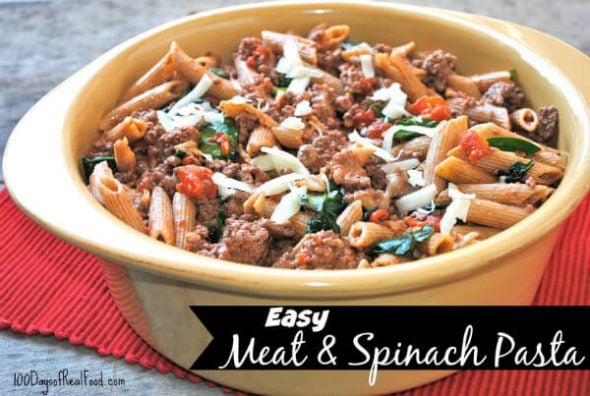

Meat and Spinach Pasta
Ingredients
- 4 cups whole-wheat pasta
- 1 pound sausage (or ground beef (local is usually available at Whole Foods Market))
- 2 cups mozzarella cheese (shredded)
- 2 handfuls spinach
- 1 can diced tomatoes
- 1 teaspoon oregano (if using ground beef)
- salt (if using ground beef)
Instructions
- Cook pasta according to directions on package; drain when finished cooking.
- While pasta is cooking, brown meat. Once meat is cooked through, drain.
- Mix in spinach with the meat. The heat will begin to wilt the spinach.
- Add in cheese and continue to stir to melt it.
- Add cooked pasta to the mix and combine.
- Add in tomatoes.


Ronda Kriz says
Please send me the Costco shopping lists 1 & 2
Thank you!
100 Days Admin says
Hi Ronda, when you signup/login at learn.100daysofrealfood.com you have instant access to all of our free real food resources. Please let us know if you have any questions or contact us a [email protected]. - Nicole
Stephanie says
This recipe was just ok for us. We like all of the ingredients but this was just a little too dry and bland for our palates.
Amy Green says
I made the recipe tonight, and the directions said to stir to melt the cheese, and it all fused with the meat to make one big glob (totally unlike the picture)! Also, I drained the tomatoes because the pic didn't look "saucy," but it seemed that maybe I shouldn't have. Could you give tips on what to do differently?
Kiran Dodeja Smith says
Hi Amy,
I'm not sure what happened. When I stir the cheese in, I mix it and continue to break it up with the spoon, Continue to mix with the warm pasta and it should all meld together. Yes, there may be some clumps of meat and cheese, but you can break them up with the back of your (cooking) spoon. I hope this helps?
Kiran
Debbie Handley says
I think food pricing varies around the country just as housing prices vary. Here in Annapolis, MD. my local Giant food store is more expensive in their prices on many, many items than Whole Foods. I stopped shopping there 3 years ago when I began my journey towards a healthier eating style, and your blog helped me very much with my journey.
I used to shop equally between Trader Joe's and Whole Foods, but since adopting a whole foods, plant based diet two years ago my grocery bills took a nose dive (when you aren't buying any meat or dairy) so now I can afford to do almost all of my shopping at Whole Foods. It really isn't "whole paycheck" at least not here like everyone says it is. There other day I bought a can of chopped organic tomatoes at Trader Joe's and they were 50 cents more than Whole Foods 365 version of the same thing. That may not seem a lot but when you are buying multiple cans for two weeks it adds up.
I buy a lot of Whole Foods own brand 365, a lot of produce (and it's very true the produce at Whole Foods does taste better) and stick to a strict budget. Eating healthy is extremely important to me. We don't have an Aldi or an Earth Fare here.
Renee Hester says
Also have a daughter dairy free. Can you tell me what other different products you buy ? Do you cook or bake with butter or buy a healthy alternative? We buy Earth Balance, but it has a ton of stuff in it and worry about it alot. Would love other suggestions you do, please?
Kiran says
Hi Renee,
Since writing this post, my daughter had various blood tests and is only GF, but not DF. So I don't have to get DF!! I am lactose intolerant, but I have been for 30 years so I just avoid it. I do buy Almond-Coconut milk for my kids (http://www.califiafarms.com/products/almondmilk/coconut-almondmilk). I know it's not *perfect*, but they do like it so I get it occasionally, and I will occasionally use it in my smoothies. I would also be leery of Earth Balance .... Not sure if this helps out?
Kiran
Joyce Ward says
I buy the wild caught frozen salmon at Whole Foods. If you consider the cost of salmon out at a restaurant its a bargain. For just my husband and I, its a 2x a month treat. Last week they had salmon on sale, so I stocked up. Whole Foods for quality fish is a no brainer. And I honestly don't know why anyone would buy sour cream when plain greek yogurt is just as good or not better and less expensive. I haven't purchased sour cream in years. Any recipe that calls for sour cream, I use greek yogurt. Even as an add on for tacos. There was even a greek yogurt based cream cheese product (not at Whole Foods) that was excellent. Just a few thoughts.
Emily says
Interesting re the almond butter. I went to get some on your recommendation & it was not $7.99/lb, it was $14.99/lb!! Yikes. Wonder why the huge difference??
Kiran says
Youch! Ugh - I'm so sorry. What I have seen with WFM is that prices can vary greatly from store to store, as can ongoing specials. I wish they were consistent!!
I hope you found something in it's place.
Karen says
Great list thanks for sharing. I love Whole Foods. I have one a half mile away from me, Trader Joe's across the street and Fairway one block up. Whole Foods is my favorite! I wanted to share for anyone that might not know about this wonderful organization Food Not Bombs has food shares once in a week in local areas. You can check their site if for locations. It all about sharing. I volunteer at my local food share once a week and once a month I share soaps I make. They distribute whole healthy foods to any one. All the food from the food share in my area comes from Whole Foods and Trader Joe's. All breads (often organic) fresh fruits, vegetables, baked goods and snacks, along with grocery items (many times organic eggs and milk), bath and body products. Optional and not necessary if you have anything to share household items, cloths the kids have outgrown or no longer where bring them down and share them. So not just food is shared many items along with toys, cloths, household items.
Nicola says
Hi, I find it odd you buy bacon it's not healthy at all. How does that get include? Just curious. Thank you.
Rhonda says
Thank you so much for this list!! I also printed your first list. It is so helpful to have everything all together that I can print out and take with me!!!
Lisa says
Thanks for this. I like WF as well for many thing in can't find anywhere else. We used to buy cascadian farms brand until I found out they are affiliated with one of the big food companies that are fighting Gmo labeling.
Dacia says
My Dad is an Organic Valley farmer! He has dairy cows and also laying hens. I am so proud to come from an organic family and love getting to raise my kids that way too!
Linda Votava says
Hi Dacia
I an an organic valley employee and I love, love organic valley! I am the purchasing coordinator and have been with organic valley for 13 years. I will be retiring from here in about 2 years. That will be one of the sadest days of my life. I have been an organic or clean eater for most of my life and so are my daughter, son-in-law and two grandsons.
Deb says
I wish you would check for the traitor brands when purchasing your products Cascadian Farms is also another organic company that spent money to stop your right to know if GMO's are in your food. I use to buy their frozen organic fruit for my smoothies but no more! I stopped buying these traitor brands most of which have been bought out by Big Business, like General Mills, Coke, Pepsi etc etc etc. They no longer will use my money to try and stop me from knowing if GMO's are in my food.
Lisa says
Deb - Thanks for your comment, but here on my blog the focus is the ingredients of the foods we eat (which often feels hard enough as it is) - not who owns the brand or is the parent company.
Kris says
I don't see the printable button.
Amy Taylor (comment moderator) says
Hi there. Try clicking on this: http://www.100daysofrealfood.com/2015/05/05/whole-foods-shopping-list-part-2/ and see if you find it. ;)
Kristin says
I love their 365 frozen veggies. If you buy in bulk (8 or 10?) you get a case discount. I specifically stock up on peas, but you can mix and match any frozen veggies at the same price point to get the case discount. I think the case discount applies to other items in the store as I got a discount on "If You Care" brand muffin liners (I think I bought 6). For local, meat, bakery and produce, I prefer to shop my farmer's market.
Denise says
Going to WFM Thursday (150 mile round trip) for biweekly shopping. Thank you so much for the list. Your homework saves me valuable time.
Kiran says
Great to hear, Denise. So glad it helps!
Robin says
I have much better luck with lower prices at Earth Fare. And I find they carry more local. I'm lucky to have both, but I haven't shopped at Whole Foods in over a year. Love my local Earth Fare--prices and employees!
Asha says
I do love Whole Foods, but find much better prices at Trader Joe's in my state.
Mary Lane says
Great list! My best friend works for a WF and my only complaint about the store (that I was surprised you mentioned) is that barely any of their own bakery items are produced in-house, but rather at one facility (I cannot remember where off hand) and shipped all over the country. I wish that instead of this, Whole Foods would exclusively support and offer bakery items made locally. There are no shortage of quality bakeries anywhere these days and I hate that they try and compete by offering products that they could easily make in-house or outsource to local bakers. When I am at WF and craving something sweet, I make sure to seek out the few items that were produced by local bakers and not the WF larger manufacturing facility. This is one area where I have always thought that WF falls short.
Kiran Dodeja Smith says
Thanks Mary! When I said custom creations, I meant more that they decorate to your desire. But you bring up a good point on the baking not happening in-house, which I was not aware of. Such a bummer! I do look for some locally created products there, but there is certainly room for growth in that area.
Amy says
Their cakes from the bakery are the BEST. If I ever have to buy a store-bought cake, I will only buy Whole Foods! It is the best alternative to homemade, that's for sure. Get a yellow cake with white icing it – trust me, you will not regret it.
Kiran Dodeja Smith says
I so agree, Amy! We just got one this weekend for my daughter's birthday. I love that they use natural colors in their icing. AND the cakes are also reasonable - double win! :)
Terri says
I have to say I have not warmed up to the WFM thing. The one closest to me is about 20 mins (not really bad) but I was so disappoitment at the ridiculous prices. Keep in mind I am in Canada and our food costs are (from what I am reading) are much higher than in the U.S. Let alone the town that the WFM is in is know for being "well to do" (I'm being polite here). I am thinking of making the trip across the border to save some pennies at stores like these. Anyone have any other suggestions for some good stores/markets to check out? I do love their selection of products but buying/feeding a family of four (2 adults, 9 year old and a 12 year old) I could not afford WFM in Canada. :(
Kiran Dodeja Smith says
Hi Terri,
Did you see the Part I? I absolutely agree that prices can be high if you do all of your shopping at the store, which is why I only buy select items there. Stick to the 365 brand and bulk, price-checking, of course, and I believe that it's doable. But as you say, I'm in the US, not Canada. As for other stores, Amy (our team member) has had great luck with Costco and Aldi has even added some organics to their offerings. Hoping some others will chime in, as well.
Happy shopping!
Kiran
Deepak Rao says
if you are buy 100 days of product at time then you get good discount and you can save money, firstly you make a shopping list. this is great blog thank you.
Aleicha says
$4.99 for honey oh my! It's $9.99 at my closet whole foods which is an hour away! But it's my guilty pleasure which I shop at regularly!
Kiran Dodeja Smith says
Oh my goodness! I'm always surprised at the difference in offerings/prices at the different stores. When I was in CA, one of the stores had $2 off of the hot bar every Wednesday, a deal that we don't do. I love that each store has different specials, but it would be nice if some were nationwide.
Mike says
I forgot to rate. :)
Mike says
I wish I had whole foods by me. :(
Angela @ Food Angel says
I'm so jealous that the almond butter at your store is only $7.99! It was over $10 the last time I visited ours (45 mins away)!! Also, the pasta recipe looks awesome! We make something very similar at our house- we love to add kalamata olives!