
Today, I am doing something completely out of character. I am not focusing on the list of ingredients and instead looking at how much sugar is in SOOO many products these days.
The Problem With Sugar
The problem with sugar is honestly not sugar itself, but the quantity in which it’s being consumed. Over the last few decades our consumption of sugar has skyrocketed to “nearly 130 pounds of added sugars per person, per year,” which is ⅓ pound (or ⅔ cup) per day! That’s as much as four times as what's recommended...keep this chart handy as you review the products below:
The American Heart Association’s recommended daily allowance of sugar:
- 3 teaspoons of added sugar for children
- 6 teaspoons of added sugar for women
- 9 teaspoons of added sugar for men
According to Mark Bittman, "Added sugar . . . is the tobacco of the twenty-first century" and “probably the most dangerous part of our current diet.” One of the biggest concerns is that many people don’t realize how much added sugar they’re actually consuming. You might think you’re in the clear if you simply avoid sweets, but added sugar lurks in some pretty unexpected places, including salad dressings, dried fruit, spaghetti sauces, breads, cereals, condiments, flavored yogurts, beverages, and even crackers.
Added Sugar vs. Naturally Occurring Sugar

Want to Save this Recipe?
Enter your email below & we'll send it straight to your inbox. Plus you'll get great new recipes from us every week!
Nature does a good job of packaging whole fruit with the right amount of sweetness and also the right amount of other nutrients (including fiber, which helps to slow absorption). So thanks to nature naturally occurring sugar that's found in whole foods is not to fear (whew!)...the much bigger problem is the white stuff! With this in mind, I tried to mostly select products for my little "Sugar Project" below that I believe are low in naturally occurring sugar so we can for sure know that the grams of sugar listed on the label are mainly referring to refined, added sugar (the stuff we need to cut back on). There are always exceptions to the rule though, which I explain below.
Why Artificial Sweeteners are No Better
Now if there's one thing I want to be sure of - I don't want anyone walking away from this post thinking they should go for the artificial sweeteners instead since they don't add up on the nutrition label. Just for the record, I'd MUCH rather eat "real" sugar over the artificial stuff any day. More on that here.

-
1. Frosted Mini Wheats
This product is one of those that could be healthy if it weren't coverd in a blanket of sugar. If you're feeding this to your children for breakfast, yes, they'll be consuming some much-needed whole grains, BUT they'll also almost max out on their recommended daily allowance of added sugar with just one serving. Next time go for the plain wheat cereal ...even if that means sprinkling a ¼ teaspoon of your own sugar on top (which would be a huge improvement)!

2. Fruit Snacks
I am so tired of seeing these treats labeled as "fruit." The main fruit these contain is fruit juice, which, referencing what I said above about naturally occurring sugars, has been stripped of all the good nutrients and fiber that nature intended to go with all the natural sugar. So, while I'd personally rather drink fruit juice than eat straight-up sugar, I believe it should still be consumed in moderation as well.

3. Granola Bars
This right here is inspiring a "health foods that aren't healthy" post. Granola bars tend to have a "healthy" reputation (and I love the homemade version where you can control the amount and what type of sugar is added), but be careful that you aren't maxing out your added sugar for the day with one bar!

4. Froot Loops
I am guessing most of you don't think of "Froot Loops" as a health food, but isn't it interesting that even with the first ingredient in this cereal being sugar that it contains just as much added sugar as those "healthy" granola bars shown just above? And I promise my point here is not for you to eat more Froot Loops!

5. Sprinkles
Once again, we all know this product isn't a health food either, BUT I was a little surprised that just in 2 tablespoons of sprinkles my children would easily exceed their recommended daily allowance of sugar. Let's remember this doesn't even consider the sugar used in the cake or the frosting. So the next time you want to add some colorful sprinkles to your child's dessert, I would just say be cognizant about not going overboard.

6. Gatorade
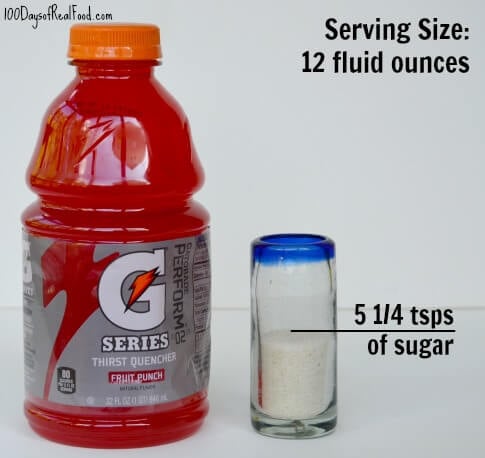
Here's another "health" food that's really not. Kids are downing this stuff left and right and as you can see here, it's FULL of sugar - not to mention it's loaded with artificial dyes and other questionable ingredients. I think it's also worth mentioning that the bottle pictured here contains 2 ½ servings, which means it contains more than 13 teaspoons of sugar in total - ack! I personally think water is a great thirst quencher after being active, but I know some more serious athletes feel like they need "more" than that. Homemade gatorade recipes can be found online, and coconut water is another popular alternative to consider and discuss with whomever told you to drink this stuff in the first place!
7. Snickers Bar
Snickers commercials like to suggest eating their candy as a "snack," but now we can see that if you're really craving a candy bar you should consider eating half of one and most definitely count it as a dessert instead!

8. Sprite
Obviously regular sodas are full of sugar. But I must admit I was taken aback with how much! 16 teaspoons in this 1 bottle? Yikes! But don't think reaching for the diet version is any better. Be sure and check out my post on artificial sweeteners to read more about that.

Were any of these surprising to you? I'd love to hear what you think in the comments below!
(PS - If you want to do a little "Sugar Project" of your own at home - my kids actually thought this was fun to do - download my free Sugar Conversion Chart to help you decide exactly how many teaspoons are in all those grams you see on the label.)


stephanie wilson says
None of the items listed shock me.
Natalie Darren says
FYI: Sugars are carbohydrates. Like all carbohydrates, they provide a source of energy in our diet. Sugar is a term that includes all sweet carbohydrates, although the term most often is used to describe sucrose or table sugar, a ‘double sugar’. The body breaks down carbohydrates into simple sugars such as glucose, that can be readily used in the body.
Too much sugar in the diet can contribute to health problems. So Experts recommend a moderate intake as about 10 per cent of the total energy intake per day.
Michele says
How are you "surprised" by the amount of sugar in Frosted Mini-Wheats? The first word in the name is FROSTING. Try the amount of sugar present in "healthy," "boring" cereals like raisin bran (19g in 3/4 cup I believe, add your skim milk and you're well over the amount of sugar anyone should consume in a day) and Kashi, as you pointed out with Clif bars and other granola-y grain crap marketed as health food. Stick with lean protein, veggies, legumes, and small amounts of fruit (1 serving/day) and fermented dairy (yogurt or cheese, no liquid dairy) and get sugar OUT of your life.
Stephanie says
2 tablespoons of sprinkles may be the serving size on the label, but that seems way too much for a single cupcake or sugar cookie. Unless you're letting your kid add the sprinkles himself, then it's easy to imagine him dumping that on. But yeah, sprinkles are almost pure sugar, so if you do use it, use it sparingly. I don't feel bad busting out the sprinkles once or twice a year.
foyupdate says
I'm at the end of my second pregnancy with gestational diabetes and because my doctor has me carefully counting carbs I know exactly how much sugar is in my food. And since I test my blood sugar four times a day I can see how foods that have the same amount of listed sugar on the label effect me differently depending on what kind of food it is.
I often find myself out and about during a time when I should be having a snack. While I am supposed to have around 15 grams of carbs in every snack, if I eat a protein bar I can only eat about half of it which is usually only 10 carbs or so. I should look into making my own homemade version. Thanks for the great idea. Even Lara bars with their claim to all organic, simple ingredients can be trouble for me.
I've been lucky and been able to control my gestational diabetes with diet and exercise. However, I am more at risk for type 2 diabetes and if eating wisely will help me from developing diabetes, I am in. This type of article is a good reminder to stay vigilant.
Elena @ Wholesome Style says
I can appreciate dried fruit for what it can offer in the form of nutrition, and I am careful to not overdue the sugar as a lifestyle. I made the (very uncharacteristic of me) mistake of buying a "reduced sugar" Craisins. I knew that the regular Craisins was just sugar and cranberries (I never buy them either), so I assumed it was just a lower sugar version and had an extra tart taste and thought I would give them a try. Of course, when I got home and read the ingredients label they had added all sorts of junk, including an artificial sweetener...because who can stand to eat something closer to its natural form?!? Apparently not us humans. :) Without fail, if I do not check the ingredients, I ALWAYS regret it.
Jennie says
Whole Foods sells a Craisin sweetened with apple juice and not regular sugar...
They are a bit more tart, but also way softer.
Rosanna says
I didn't realize how much sugar was in Gatorate. I love the visual comparisons. Truly eye opening!
Erin says
Just wanted to correct the sugar amount, It is:
1 tsp sugar = 4 grams of sugar listed on label
not 1 gram sugar = 4 teaspoons, which would be even crazier! I do find this help when using sugar at home too. Crazy how much sugar is in everything. Check out those yogurt labels! Although some of that is natural, you can compare the plain to flaved to see what a huge difference it is.
Lisa says
Erin here is a full conversion chart, which is linked at the bottom of my post: https://www.100daysofrealfood.com/wp-content/uploads/2014/05/Sugar-Conversion-Chart.pdf
Natalie says
I was doing a food survey and a fairly active teenage boy was drinking two of those Gatorade or similar every day. We looked it up and he was horrified about how much sugar was in them! He thought they were healthy.
Janelle Marshall says
I was surprised by the sugar count in a Clif Bar and fruit snacks. I will definitely start to look closely at the labels from now on. Thanks for sharing!
Cricket says
The Sprite info doesn't seem correct to me. Although the correction isn't much better. A 20oz Sprite has 64g of sugar, or 12.8 teaspoons.
I am trying very hard to control my family's and my sugar intake. The kids are not happy with me, but maybe they will be someday. One of the biggest changes is elimination HFCS. You can almost hear them eye-roll when I start reading labels in the grocery store! LOL!
Marlana says
Actually, Lisa was correct. One gram of sugar = 4 teaspoons. Hard to believe, but it really IS that much sugar. Crazy, huh?!?
Katelyn says
You have it backwards. 1 tsp = approx. 4.2 grams of sugar.
Marlana says
I totally had it written backwards! :-) But Lisa's math was correct. lol.
Heather says
Gatorade and drinks like that are formulated for althetes. They replete electrolytes lost during exercise and glucose needed for sustained energy (endurance athletes). They have a specific percentage/concentration of sugar that helps replete and maximize absorption. If you don't exercise for longer than 1 hour at a time, you don't need Gatorade, water is just fine. Other variables are how hot it is outside and how much you sweat.
Danielle B says
You are better off drinking chocolate milk over Gatorade.
Penny T. says
Also, coconut water is so much healthier than Gatorade and will replenish electrolytes. Gatorade is not healthy; not even really for athletes. The commercials lead us to believe otherwise and we see athletes drinking it but that's all "free" advertising. Coconut water and organic chocolate milk (although I am not a big proponent of dairy) are both better alternatives.
jules@lesssugarnaturally says
I remember hearing in a documentary (I think it was Sugar:The Bitter Truth) that Gatorade used to taste very bad until Pepsi bought it and reformulated the recipe They then marketed it to kids and started selling it in schools.
Nealy says
I love this post and was most surprised by the visual of the amount of sugar in soda! I went on a field trip with my kindergartener today and couldn't believe the kids' food - donuts, Gatorade, soda. The child I chaperoned had a Capri sun, Gatorade and Lunchable. It is great you are getting the word out as well as giving people ideas for healthier alternatives. Thank you!
Amy says
No, sadly I'm not surprised by any of these. What does surprise me, however, is when people refuse fruit, saying it has too much sugar. What about all that natural fiber to balance it out? I firmly believe that if it God created it, you can eat it with a peaceful heart and mind. I'm tired of people vilifying food groups!
Ashley says
My husband is a type 1 diabetic. I have been doing the real food challenge, but I'm worried about all of the real sugars found in honey and maple syrup for him. Anyone have the same type of situation and alternatives that doesn't make blood glucose spike?
Nicole M. says
Ashley I just read this post a few days ago and thought it might help for your husband. Stevia does not spike blood sugar and this post gives some ideas for most natural sources.
https://www.100daysofrealfood.com/2013/04/25/stevia-food-babe-investigates/
Jacqueline says
Try using stevia (whole leaf), as it doesn't affect blood sugars. Does your husband carb count and then dose his insulin accordingly? If so, I would say be cognizant of portion sizes and adjust his dose to suit the food. My sister in law has Type 1 diabetes as well and this is what she does.
Ashley says
Great! I just planted a garden. I think i will go today to get a couple stevia plants today:) Thanks so much!!!
Jennifer says
I am a type 1 diabetic and yes, stevia ABSOLUTELY spikes blood sugar. The key is moderation.
Lisa, Gatorade is on your list. Gatorade isn't for kids at all, and not because of the sugar content (which, I agree, is horrid). Gatorade and other "sport" drinks of its ilk contain far too many electrolytes for the standard child's body (read: not in competitive athletics) to handle. There are reported cases of kids actually becoming sick due to too many electrolytes.
Cassandra says
Yes, I agree, but kids drink it constantly - and it is handed out by parents who do the snack duty. Kids as young as 5 (t-ball) are drinking it regularly. I have four kids and am around kids all the time - it is as frequently in a kid's hands as a juice box is.
lindsay says
oh and I am not saying that I would ever buy those things otherwise for my family. But just wondering what your take is on those two specific items and all day events such as an Ironman triathlon, which could be up anywhere from 8hrs-13hrs in one day of continuous activity? ? ?
thanks
Cassandra says
I think the thing with Gatorade is that it is full of other stuff other than the sugar and salt and water that is suppose to be in a hydration drink. My little one had a tummy bug and I searched this site and found a recipe for homemade Gatorade - and if you google homemade Gatorade, there are a lot of other blogs/sites that have basic recipes for rehydration drinks. Same with Cliff bars/protein bars, but at least they don't have food dye in them and other artificial junk, like Gatorade does.
lindsay says
Aren't Gatorade and Clif bars known to be used for Athletes doing extreme sports. I know when my husband did Ironman Triathlons both of those things were handed out. Isnt that amount of sugar necessary for that type of athlete to regain energy and continue with endurance for an all day event, such as Ironman? I honestly have no idea that is why I am asking you! Thanks in Advance!
Lindsay
Anna says
The fruit snacks are what bother me! My girls call them treats, because to me that is what they are. Talk about mislabeling. I even found myself in an argument with a 4 year old about them. Smart I know. LOL! She had them and my girls wanted them and I said ok but that is the only treat then today. The 4 year old said "they are not a treat, they are a snack, candy is a treat". I corrected her and said if it tastes like a gummy candy, looks like a gummy and doesn't look like a real fruit...definitely a treat. She told her Mommy...not the best way to start a conversation!
laura says
Well, hopefully the mom looked at the label and thought about it. It's not as if you were telling someone else's child what she could eat. Good for you for starting that conversation!
Cassandra says
I have to hide the fruit snacks in the freezer - as they are a treat, too, although my kids refuse to believe that. They get about one package a week, because, well, they are in the freezer and I forget about them, too! I wish others would pay attention though, too - school parties, team snacks... ug. They are every where!
Karen says
I try to eat wholesome foods but convenience items are sometimes a necessary evil. I have found the free app Fooducate to be very helpful. You can search or scan the UPC and it gives you a grade for the item and why. It also tells you the grade range for a category. For example, protein bars, that Clif bar you mentions gets a "b" with "b+" being the top of the category. Overall, it isn't too bad in comparison to its peer products but it is sited for its high sugar content.
Tragic Sandwich says
My husband drinks soda, but neither our daughter nor I do--we don't care for it. That's the only one of these products that is in our kitchen. The only time I drink Gatorade is after a triathlon, which means I haven't had Gatorade in 5 years, or after a particularly prolonged stomach bug where I'm likely to be severely dehydrated (thankfully, that, too has been several years). It does sit better on my stomach than a lot of alternatives.
Our problem is that we eat too much dessert!
Maggie says
Oh, my family suffers from the dessert problem, too! It's really hard for me since I love to bake. I don't mind cooking, but I don't enjoy it nearly as much as I enjoy baking, which can become problematic at times.
Tanja says
I've also noticed the serving sizes of the sugary cereals have decreased from 1c to 3/4 c. I think they are trying to keep the grams of sugar under 10 by doing this?
Meg says
This may be posted already, but just in case, since it is often listed in grams...One teaspoon of granulated sugar equals 4 grams of sugar. I notice my "Kind" bar has "only 5 grams of sugar."
Lea says
None of these foods are a regular part of my family's diet (although we do have a jar of sprinkles in the cabinet that were recently used on a birthday cake), but for me the issue of sugars in these foods is partly a question of context. For example, I have taken Gatorade along as my beverage during marathons and on long mileage training days. In that context, the sugar and salt content is precisely why I do want it. Because I am quickly burning through lots of calories quickly and over an extended period of time and I want my body to have ready access to the sugar that the Gatorade provides. Yes, there are other brands with less artificial coloring. And, yes, I would make my own hydration drink for long distances when racing or training. But particularly when I have traveled to marathons away from my home community, grabbing Gatorade to drink during the race is easier.
Ditto Clif bars. That isn't my particular brand, but I do sometimes take Pro Bars along along in my canny pack to refuel on a long hike or when I am putting in lots of training miles race walking. When I do I am taking it in part because I want those calories, including from sugar, in a compact form.
That isn't to say that I don't also hike with raisins and pumpkin seeds and cheese and crackers. Or that I don't enjoy making my own granola bars. Because I do. And I do.
But I am OK with the sugar in Gatorade and in Clif bars when they are being occasionally consumed on extended walks or runs precisely because of they provide a compact way to get those calories from sugar. Neither are a snack I would eat at home or send in my kid's lunch box or bring on a casual outing to the park. And it's definitely worth paying attention to sugar content. But I don't make a point of avoiding absolutely all non-naturally occurring sugar.
Christina says
I am 29 and keep hearing more and more about sugar and I have recently thought, "I wonder if I need to start cutting things out?" Salad dressings (make my own), dried fruit (occasionally craisins), spaghetti sauces (make my own), breads (make my own unless it is sourdough), cereals (very rarely), condiments (not a big condiment person), flavored yogurts (nope), beverages (only water, fruit juice less than once a month), and even crackers. I do eat out, so I think that it is good to be aware of the sugar content but feel that if you are already avoiding processed foods you're probably doing alright. I can't remember the last time I bought ANY of those 8 items and half of them I have NEVER purchased. I have to stay away from maltodextrin and other sources of MSG, which I find just by coincidence helps me stay away from other problem ingredients too.
nancy says
not at all surprising, but these are foods I would not normally eat anyway. Just the look of them screams sugar.
Saucygal says
Much needed grains? No one living, breathing and walking the planet suffers from a grain deficiency. It doesn't exist. All grains are converted to sugar when eaten and digested. Grains are super processed, whether organic, whole grain or whatever. Even though natural sugar from fruit is way better than the processed white junk... a person still needs to be careful with their fruit consumption. Berries are the best and fruit should only be eaten in season.
Megan says
We have four kids who play a lot of sports, and would buy those sports drinks in bulk. Last summer one of our sons started getting light headed after long days at the ball park. After multiple doctors appointments and specialist trying to diagnose him with diabetes I had a mom inspired epiphany!! I cleared the house of those drinks.... and what do you know.... he is feeling much better. It's the advertising that kills me. The kids think they "need" it to perform at their best.
Kristy says
One I am always surprised about is the added sugar in a lot of dried fruit. Seriously?! Why would that need extra sugar? There is one brand (called "Peeled") that I buy at my grocery store that doesn't have any added sugar OR preservatives and to me it's 10x better than the other brands. I don't get it.
laura says
Like dried mango and dried cranberries? Yes, it's crazy! Fruit has plenty of natural sugars that become concentrated when dried - why would they add more?
Chavah says
My big food rant right now is Little Hugs (http://littlehug.com/nutrition-calculator). I asked the parents in my GS troop to bring no sugar added drinks for snacks. I also asked that they had no artificial sweeteners. These Little Hugs hide the artificial sweeteners in their packaging so that only those who know what to look for find that they exist. If you look at the link I included they are bragging about how low in sugar they are, but they are nothing but chemicals!
So, basically, I agree. I look for amounts of sugar, but you need to be careful. These days, sucrolose often hides in products and allows them to appear to be low in sugar.
Laura says
oh my god that is unbelievable! why/how are they allowed to state that when they use artificial sweeteners?
Tanja says
It's the same with those Roaring Waters by Capri Sun.
Erik says
Really none of these should surprise anybody who's paying attention to how the processed food industry loves to have us pay them to poison us with sugar while they keep their costs down.
Examples that I would find useful would be things like dried apricots and raisins, which of course we all think of as healthy alternatives. They might not have added or artificial sugar, but being dried out they do have concentrated sugar and should be eaten in moderation (although yum!).
Katie says
Good list; I think it's always good to remind people that "healthy" isn't always healthy. I think it would be helpful to post the grams of sugar in each so we can see how grams (the measurement used on nutrition labels) relate to tbsps.
Diane says
I was always under the impression that Ovaltine was a better choice of drink mix. So this morning I poured a little into my unsweetened almond milk, then looked at the the label. First ingredient is sugar and there is 9 grams of it in a 2 tablespoon serving. Yikes! Lots of ingredients that I have no idea what they are. I am dumping the last little bit that I have and won't be buying or drinking this ever again.
Noreen says
Gatorade was designed for elite athletes playing football for hours in hot temperatures. Lemon lime was the flavor. It contains electrolytes to prevent the effects of dehydration and sugar to give them some energy to finish the game and win. Very few people are elite athletes moving around with a high intensity for hours in the heat,
Lea says
Exactly!
laura says
It may have been designed that way, but it is not how it is marketed.
Melissa says
My husband and I recently started doing the 21 Day Sugar Detox and I've been surprised at how many of my even whole foods recipes included sugar, even if it was a natural sugar like honey. I do disagree a little bit though on the sugar found in fruit. Although it's naturally occurring and not so much to fear as you stated, I do find that people way over consume fruit and therefore their sugar intake is probably higher than they think even if it's not added. Another surprising area to find sugar is in supplements, hidden with other names besides "sugar!"
Michelle says
Hi Melissa,
How did you like the 21 Day Sugar Detox? I need help with my sugar addiction and I find I have little self control with the sweets.
Your review would be helpful!
Thank you,
Michelle
Melissa says
I LOVE it! We are almost finished with it and I fully admit that we did cheat for dinner at a wedding, but other than that we were all in and it has made a HUGE difference. Veggies taste sweeter, tart apples do the trick and I'm craving less and less. I also lost 8 pounds by the second week without changing my normal routine, so that's a nice bonus that I was't expecting! I've been recommending it to everybody!
Rebecca says
It's crazy how much sugar is in everything! Thanks for posting a link for a homemade Gatorade. I'm training for a marathon right now and I'm going to give it a try!
Do maple syrup, honey, and dates count as added sugar?
Mollie Clark says
Thanks for yet another eye opening post! After seeing the film Fed Up I am taking the 10 day no added sugar challenge (4 days and counting 😃) and am learning a lot. I have eaten only real food with honey/maple syrup as sweeteners for a few months now but the Fed Up challenge is definitely still plenty challenging. I would recommend the challenge to anyone who wants to see just how sugar obsessed our society is - just plan on eating a good amount of fruit everyday to satisfy your sweet tooth.
Dianne says
I'm amazed anyone would be surprised at how much sugar is in all of these! In fact, here was actually less than I expected, because these are products that are basically just big wads of sugar. Does ANYONE think there's anything healthy about ANY of these? If so, very, very few. Anyone who "likes" 100 days of real food, would never be so ignorant.
leslie @ definitely not martha says
For me, the most shocking is tomato sauce. If you don't read labels and reach for the most inexpensive spaghetti sauces, many of them have 9g of sugar in 1/2 cup of sauce. Yuck! Obviously, it's better to make your own, but there are a few brands out there with a short ingredient list (and no added sugar)....you just have to read the labels and ingredients lists.
Mel says
Leslie,
After I realized a while ago how much sugar is in jarred tomato sauce, I started making my own. Instead of adding sugar to it to balance the acidity of the tomatoes, I add the pulp from my juicer after I juice in the morning. The pulp has pulverized carrot, beet and kale. My tomato sauce is now very delicious and mildly sweet. Sure, there's still naturally occurring sugar in the sauce, but it is added with the fiber from the pulp. If you juice, I highly recommended making homemade sauce this way.
Amy Cornwell says
So enlightening! We don't buy pop or sports drinks, etc any more...but my daughter loves frosted mini wheats. Definitely something to think about. She also loves scrambled eggs so I guess I need to stop being so lazy ;)
Courtney @ Family Gone Healthy says
The amount of sugar in soda is crazy!! I am always most surprised by the amount of sugar that is in kids' yogurts.
Lisa says
I agree but since plain yogurt has naturally occurring sugar it's hard to tell exactly how much is added sugar (at least, at this time). I cannot WAIT for that label change!
Connie says
What about the naturally occurring sugar in milk? 12 grams per 8 oz cup of white milk. I've seen TV shows visually demonstrate the amount of sugar in chocolate milk and it was around 22 grams per serving. While chocolate milk has unnecessary added sugar (among other junk), isn't it a little misleading or being over exaggerated since 12 grams are naturally occurring? This is confusing to me. BTW--chocolate milk is a treat in our house reserved for going out to eat, etc.
Laura M says
Besides, chocolate is much more delicious sugar-free. When I started my new diet (because my overweight was giving me a bit of an elevated insuline) my nutricionist told me to drink diet cocoa ... That diet cocoa powder had artificial sweeteners and the cocoa I used to drink did not. My cocoa of choice only has cocoa! not crappy sugar nor crappy sweeteners.
Natasha says
I read recently that yoghurt has around 4.7 grams of naturally occuring sugar (or lactose, since that´s the kind of sugar) for every 100 grams. I think this works for any dairy product. So when you read the label, if there is more than 4.7/100 grams of sugar, there is added sugar. Hope that helps a little! :) This website is VERY useful when looking at the amount of sugar in products: http://iquitsugar.com/guide-for-reading-us-food-labels/
laura says
Look at a container of plain yogurt and compare it with the other yogurt -- that should take into account the naturally occurring sugars in milk.