
This is a guest post from Vani Hari (a.k.a. The Food Babe) and New York Times Best Selling author. You can read more about her take on the food industry in her second book, Feeding You Lies!
Thoughts of outrage, unfairness, disbelief, and ultimately grief consumed me while I was doing this investigation. A list of ingredients that are banned across the globe but still allowed for use here in the American food supply recently made news.
While I have written about some of those ingredients before, this list inspired me to look a little deeper and find out how pervasive this issue is for us. Could these banned ingredients be contributing to the higher mortality and disease rates here in the U.S.?
The health of Americans is downright grim according to a report just released by the Institute of Medicine and the National Research Council. It declares "Americans are sicker and die younger than other people in wealthy nations." The United States spends 2.5 times more on health care than any other nation, however, when compared with 16 other nations we come in dead last in terms of health and life expectancy for men and near the bottom for women.
Here is the breakdown for you:
- More than two thirds of United States citizens are overweight – 33% being obese.
- 32% of children are either obese or overweight.
- 43% of Americans are projected to be obese in 10 years.
- After smoking, obesity is America’s biggest cause of premature death and is linked to 70% of heart disease and 80% of diabetes cases.
- And 41% of Americans are projected to get cancer in their lifetime!
These reports and statistics scream the word HELP!
Recently, I spent some time down in Mississippi volunteering in the most obese county in the nation. I found that while social and economic factors do play a part in this epidemic, the main culprit was the lack of nutrition education.
The victims of obesity are likely the same victims of systematic brainwashing from Big Food marketers, relying on diet soda or low fat products or looking only at calories on product labels. Basically, they are doing what the food industry has been teaching them about losing weight versus finding out the truth about real food.
And that's the problem - the food industry is the one leading our conversation in this country about food and nutrition, educating the mass public about what to eat and what not to eat. Coca-Cola recently even went as far as creating a special campaign to combat obesity - yes you read that right - a sugar filled soda company trying to stop obesity. (You can read my reaction to that here).
Unfortunately, the doctors in this country are not exactly leading the discussion either, since nutrition is not currently a focus in medical school. And the government has their hands tied by big food industry and chemical company lobbyists that basically control what the FDA approves, deems safe for human consumption, and our overall food policy.
So who is going to finally tell us the truth about our food?
The food industry does not want us to pay attention to the ingredients nor do they care about the negative effects from eating them. They certainly don't care about the astronomical medical bills that are a direct result of us eating the inferior food they are creating.
The HELP we need starts here. We as a collective nation must stop this trajectory of sickness and rising health care costs, by understanding the ingredients we are putting into our bodies. We must challenge the U.S. food industry to discontinue the use of banned ingredients that are not allowed elsewhere in the world. We deserve to have the same quality food without potential toxins.
Food is medicine, and plain and simple, if our food is sick (filled with GMO’s, chemicals, additives, artificial ingredients, and/or carcinogens), collectively we as a country are going to continue to be sick.
Using banned ingredients that other countries have determined unsafe for human consumption has become a pandemic in this country. To prove this point, I found the best and easiest place to look for evidence was just across "the pond" in the United Kingdom, where they enjoy some of the same types of products we do - but with totally different ingredient lists.
It is appalling to witness the examples I am about to share with you. The U.S. food corporations are unnecessarily feeding us chemicals - while leaving out almost all questionable ingredients in our friends' products overseas. The point is the food industry has already formulated safer, better products, but they are voluntarily only selling inferior versions of these products here in America. The evidence of this runs the gamut from fast food places to boxed cake mix to cereal to candy and even oatmeal - you can't escape it.

Want to Save this Recipe?
Enter your email below & we'll send it straight to your inbox. Plus you'll get great new recipes from us every week!
Some of the key American brands that are participating in this deception are McDonald's, Pringles (owned by Kellogg's), Pizza Hut and Quaker (owned by Pepsi), Betty Crocker (owned by General Mills), Starburst (owned by M&M/Mars), and Ritz Crackers (owned by Kraft). In the examples below, red text indicates potentially harmful ingredients and/or ingredients likely to contain GMOs.


Having a pre-made box of flour, baking soda and sugar all ready to go saves time for some people when it comes to making a cake, but does saving time have to come at the expense of chemically derived and potentially toxic ingredients?
The United States version of Betty Crocker Red Velvet cake not only has artificial colors linked to hyperactivity in children, food cravings, and obesity, but it also has partially hydrogenated oils (a.k.a. trans fat). Trans fat has been shown to be deadly even in small amounts. “Previous trials have linked even a 40-calorie-per-day increase in trans fat intake to a 23% higher risk of heart disease.” This could easily be the amount of trans fat in one serving of Betty Crocker icing alone.
Sodium benzoate is an ingredient that Coca-Cola actually removed in their Diet Coke product overseas, but you'll still find it in their product Sprite, cake mixes and loads of other products across the USA. The Mayo Clinic reported that this preservative increases hyperactivity in children. Also, when sodium benzoate combines with ascorbic acid (vitamin C), it can form benzene, a carcinogen that damages DNA in cells and accelerates aging.
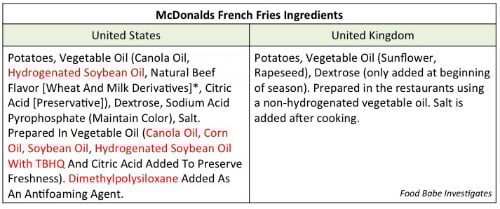
Fast Food giants like McDonald's and Pizza Hut are just as guilty as General Mills' Betty Crocker.
Look closely at the ingredients in McDonald's french fries above. Do you see how the french fries in the U.K. version are basically just potatoes, vegetable oil, a little sugar and salt? How can McDonald's make french fries with such an uncomplicated list of ingredients all over Europe, but not over here?
Why do McDonald's french fries in the U.S. have to have TBHQ, trans fat and "anti-foaming" agents? Correct me if I'm wrong, but the last time I checked - I didn't think Americans liked foam with their fries either!
The anti-foaming agent - dimethylpolysiloxane - is a type of silicone used in caulks and sealants and as a filler for breast implants. It's also the key ingredient in silly putty.
Thanks FDA for allowing companies to put silly putty in our french fries. Seriously - this is out of control.

McDonalds Strawberry Sauce in the United States includes high fructose corn syrup, red #40 and sodium benzoate, while the citizens of the U.K. get off scot-free. Instead, they get 37% real strawberries in their product and no additional flavoring or harmful preservatives.

Pizza Hut does a huge disservice to us (and their workers) by using Azodicarbonamide in their garlic cheese bread. This ingredient is banned as a food additive in the U.K., Europe, and Australia, and if you get caught using it in Singapore you can get up to 15 years in prison and be fined $450,000.
The U.K. has recognized this ingredient as a potential cause of asthma if inhaled, and advises against its use in people who have sensitivity to food dye allergies and other common allergies in food, because azodicarbonamide can exacerbate the symptoms.
However, Pizza Hut and many other fast food chains like Subway and Starbucks use this ingredient in their U.S. bread products.
Natural and artificial flavors and hidden MSG (in the form of autolyzed yeast extract, in this case) are commonly found throughout products in America but not elsewhere. Junk food companies intentionally add this combination of ingredients to create sensory overload by exciting your brain cells to remember the food you are eating and make less nutritious ingredients taste better to you.
I'm not saying that the food industry has completely eliminated these same tricks abroad - but when you look at the U.K. version of garlic cheese bread, the ingredients look pretty basic. Many of the ingredients you could use at home to make garlic bread. I've never found TBHQ in the baking aisle at the grocery store, have you?
TBHQ, by the way, is a preservative derived from petroleum and used in perfumes, resins, varnishes and oil field chemicals. Laboratory studies have linked TBHQ to stomach tumors. This preservative is also used by Chick-Fil-A in their famous chicken sandwiches.

Reviewing the ingredients in Pringles really got me worked up....ever wonder why you can't stop eating chips after having just one? MSG is the culprit - and in the U.S. version of Pringles, it's added twice! Once in its known name and again in a hidden source, called "yeast extract."
This begs the question "Why are Americans so addicted to processed food?!" The food industry has designed it that way on purpose to line their pockets with profits, at the expense of our health.

The U.K. Ritz Crackers ingredient list resembles items that you'd find in every household around the country - but the United States version goes the extra mile to include trans fat, HFCS and natural flavor. Natural flavor can be also be a hidden form of MSG, which, again, is an additive that will likely make you eat more than you would otherwise.

In the United States, Quaker Oats has several different flavors of oatmeal that contain different fruit flavored, artificially dyed pieces of dehydrated apple but that don't actually contain any of the fruit shown on the package. But in the U.K. - they don't even attempt to sell that garbage. They instead have a product called "Oats so Simple" that actually has REAL strawberries in it - light years ahead of our version that includes trans fat, artificial food coloring, and artificial flavors.

There's only one difference in Rice Krispies between the U.S. and U.K. version - but it's a big difference. It's one ingredient that is banned virtually in every other country, except here in the United States. That ingredient is called BHT (butylated hydroxytoluene) or BHA (butylated hydroxyanisole) and is a very common preservative used rampantly throughout packaged food in the U.S.
Test studies published by the IPCS (International Program for Chemical Safety) "show tissue inflammation, enlargement, and/or growths in 100%, and cancer in 35% of [animal] subjects" as reported in this article. How can the U.S. allow this chemical in our food - much less in cereal aimed and targeted at our kids?

And speaking of targeting our kids - food companies have found a way to naturally color candy all over Europe, but our candy here is still full of artificial substances made from petroleum and GMO sugar. Looking at the ingredients in Starburst Fruit Chews provides a great example of this disgrace.
I saved the most startling fact for last. One very cautionary set of ingredients that are included in almost all of the American products but not the U.K. products are GMO's, in the form of either corn or soy.
There have been no long term human studies on GMOs and preliminary studies on animals show horrific consequences. For instance, a study showed GMOs caused toxic and allergic reactions, sick, sterile, and dead livestock, and damage to virtually every organ studied in lab animals.
Another study revealed that female rats fed GMO soy for 15 months showed significant health issues in their uterus and reproductive cycle, compared to rats fed organic soy or those raised without soy. A 2009 French Study concluded that Glyphosate (used on GMO soy) can kill the cells in the outer layer of the human placenta, the organ that connects the mother to her fetus, providing nutrients and oxygen and emptying waste products.
A Russian study conducted on hamsters that were fed GMO soy diets for two years over three generations found that by the third generation, most of the hamsters lost the ability to have babies, showed slower growth, and suffered a higher mortality rate.


In the U.K. food companies are required by law to list if a certain ingredient is derived from a genetically modified or genetically engineered material on the label. Out of all the products I researched, I couldn't find one product with this label. (See example from GMO-Compass and BBC above of what it would look like if I did.)
This was very telling considering that not only have food companies taken out all sorts of hazardous chemical ingredients abroad - but they also have willingly reformulated their products without GMOs.
Food corporations in the U.S. claim reformulating their products to remove harmful ingredients or changing labels would be too expensive - but they've already done just that in Europe and in many other countries. Their governments listened to the outrage of their people and took the safety of their citizens' health above everything else.
Is it too much to ask the same for us in the United States of America? How much do our sickness, obesity, and mortality rates have to worsen before they respond to us?
I will leave you with this note: Lisa and I are very disturbed about the shameful hypocrisy allowed to happen with our food supply here in the U.S. In fact we are feeling very compelled to do something about it. Stay tuned, because we are going to need every one of you to help when we are ready. In the meantime, I hope you'll come check me out at Food Babe and also share this article (you can use the green ShareThis button below).
March 5th Update: Lisa and I have started a petition - please sign and share it now. Together we can make a change.
Comments have been closed on this article, which was written by Vani Hari. If you have a question or comment you can reach her at http://FoodBabe.com.


