
This is a guest post from Vani Hari (a.k.a. The Food Babe) and New York Times Best Selling author. You can read more about her take on the food industry in her second book, Feeding You Lies!
Thoughts of outrage, unfairness, disbelief, and ultimately grief consumed me while I was doing this investigation. A list of ingredients that are banned across the globe but still allowed for use here in the American food supply recently made news.
While I have written about some of those ingredients before, this list inspired me to look a little deeper and find out how pervasive this issue is for us. Could these banned ingredients be contributing to the higher mortality and disease rates here in the U.S.?
The health of Americans is downright grim according to a report just released by the Institute of Medicine and the National Research Council. It declares "Americans are sicker and die younger than other people in wealthy nations." The United States spends 2.5 times more on health care than any other nation, however, when compared with 16 other nations we come in dead last in terms of health and life expectancy for men and near the bottom for women.
Here is the breakdown for you:
- More than two thirds of United States citizens are overweight – 33% being obese.
- 32% of children are either obese or overweight.
- 43% of Americans are projected to be obese in 10 years.
- After smoking, obesity is America’s biggest cause of premature death and is linked to 70% of heart disease and 80% of diabetes cases.
- And 41% of Americans are projected to get cancer in their lifetime!
These reports and statistics scream the word HELP!
Recently, I spent some time down in Mississippi volunteering in the most obese county in the nation. I found that while social and economic factors do play a part in this epidemic, the main culprit was the lack of nutrition education.
The victims of obesity are likely the same victims of systematic brainwashing from Big Food marketers, relying on diet soda or low fat products or looking only at calories on product labels. Basically, they are doing what the food industry has been teaching them about losing weight versus finding out the truth about real food.
And that's the problem - the food industry is the one leading our conversation in this country about food and nutrition, educating the mass public about what to eat and what not to eat. Coca-Cola recently even went as far as creating a special campaign to combat obesity - yes you read that right - a sugar filled soda company trying to stop obesity. (You can read my reaction to that here).
Unfortunately, the doctors in this country are not exactly leading the discussion either, since nutrition is not currently a focus in medical school. And the government has their hands tied by big food industry and chemical company lobbyists that basically control what the FDA approves, deems safe for human consumption, and our overall food policy.
So who is going to finally tell us the truth about our food?
The food industry does not want us to pay attention to the ingredients nor do they care about the negative effects from eating them. They certainly don't care about the astronomical medical bills that are a direct result of us eating the inferior food they are creating.
The HELP we need starts here. We as a collective nation must stop this trajectory of sickness and rising health care costs, by understanding the ingredients we are putting into our bodies. We must challenge the U.S. food industry to discontinue the use of banned ingredients that are not allowed elsewhere in the world. We deserve to have the same quality food without potential toxins.
Food is medicine, and plain and simple, if our food is sick (filled with GMO’s, chemicals, additives, artificial ingredients, and/or carcinogens), collectively we as a country are going to continue to be sick.
Using banned ingredients that other countries have determined unsafe for human consumption has become a pandemic in this country. To prove this point, I found the best and easiest place to look for evidence was just across "the pond" in the United Kingdom, where they enjoy some of the same types of products we do - but with totally different ingredient lists.
It is appalling to witness the examples I am about to share with you. The U.S. food corporations are unnecessarily feeding us chemicals - while leaving out almost all questionable ingredients in our friends' products overseas. The point is the food industry has already formulated safer, better products, but they are voluntarily only selling inferior versions of these products here in America. The evidence of this runs the gamut from fast food places to boxed cake mix to cereal to candy and even oatmeal - you can't escape it.

Want to Save this Recipe?
Enter your email below & we'll send it straight to your inbox. Plus you'll get great new recipes from us every week!
Some of the key American brands that are participating in this deception are McDonald's, Pringles (owned by Kellogg's), Pizza Hut and Quaker (owned by Pepsi), Betty Crocker (owned by General Mills), Starburst (owned by M&M/Mars), and Ritz Crackers (owned by Kraft). In the examples below, red text indicates potentially harmful ingredients and/or ingredients likely to contain GMOs.


Having a pre-made box of flour, baking soda and sugar all ready to go saves time for some people when it comes to making a cake, but does saving time have to come at the expense of chemically derived and potentially toxic ingredients?
The United States version of Betty Crocker Red Velvet cake not only has artificial colors linked to hyperactivity in children, food cravings, and obesity, but it also has partially hydrogenated oils (a.k.a. trans fat). Trans fat has been shown to be deadly even in small amounts. “Previous trials have linked even a 40-calorie-per-day increase in trans fat intake to a 23% higher risk of heart disease.” This could easily be the amount of trans fat in one serving of Betty Crocker icing alone.
Sodium benzoate is an ingredient that Coca-Cola actually removed in their Diet Coke product overseas, but you'll still find it in their product Sprite, cake mixes and loads of other products across the USA. The Mayo Clinic reported that this preservative increases hyperactivity in children. Also, when sodium benzoate combines with ascorbic acid (vitamin C), it can form benzene, a carcinogen that damages DNA in cells and accelerates aging.
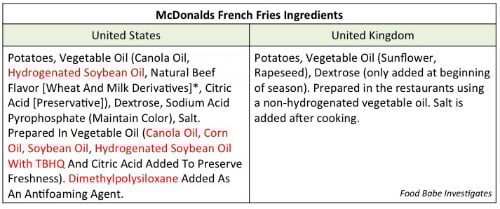
Fast Food giants like McDonald's and Pizza Hut are just as guilty as General Mills' Betty Crocker.
Look closely at the ingredients in McDonald's french fries above. Do you see how the french fries in the U.K. version are basically just potatoes, vegetable oil, a little sugar and salt? How can McDonald's make french fries with such an uncomplicated list of ingredients all over Europe, but not over here?
Why do McDonald's french fries in the U.S. have to have TBHQ, trans fat and "anti-foaming" agents? Correct me if I'm wrong, but the last time I checked - I didn't think Americans liked foam with their fries either!
The anti-foaming agent - dimethylpolysiloxane - is a type of silicone used in caulks and sealants and as a filler for breast implants. It's also the key ingredient in silly putty.
Thanks FDA for allowing companies to put silly putty in our french fries. Seriously - this is out of control.

McDonalds Strawberry Sauce in the United States includes high fructose corn syrup, red #40 and sodium benzoate, while the citizens of the U.K. get off scot-free. Instead, they get 37% real strawberries in their product and no additional flavoring or harmful preservatives.

Pizza Hut does a huge disservice to us (and their workers) by using Azodicarbonamide in their garlic cheese bread. This ingredient is banned as a food additive in the U.K., Europe, and Australia, and if you get caught using it in Singapore you can get up to 15 years in prison and be fined $450,000.
The U.K. has recognized this ingredient as a potential cause of asthma if inhaled, and advises against its use in people who have sensitivity to food dye allergies and other common allergies in food, because azodicarbonamide can exacerbate the symptoms.
However, Pizza Hut and many other fast food chains like Subway and Starbucks use this ingredient in their U.S. bread products.
Natural and artificial flavors and hidden MSG (in the form of autolyzed yeast extract, in this case) are commonly found throughout products in America but not elsewhere. Junk food companies intentionally add this combination of ingredients to create sensory overload by exciting your brain cells to remember the food you are eating and make less nutritious ingredients taste better to you.
I'm not saying that the food industry has completely eliminated these same tricks abroad - but when you look at the U.K. version of garlic cheese bread, the ingredients look pretty basic. Many of the ingredients you could use at home to make garlic bread. I've never found TBHQ in the baking aisle at the grocery store, have you?
TBHQ, by the way, is a preservative derived from petroleum and used in perfumes, resins, varnishes and oil field chemicals. Laboratory studies have linked TBHQ to stomach tumors. This preservative is also used by Chick-Fil-A in their famous chicken sandwiches.

Reviewing the ingredients in Pringles really got me worked up....ever wonder why you can't stop eating chips after having just one? MSG is the culprit - and in the U.S. version of Pringles, it's added twice! Once in its known name and again in a hidden source, called "yeast extract."
This begs the question "Why are Americans so addicted to processed food?!" The food industry has designed it that way on purpose to line their pockets with profits, at the expense of our health.

The U.K. Ritz Crackers ingredient list resembles items that you'd find in every household around the country - but the United States version goes the extra mile to include trans fat, HFCS and natural flavor. Natural flavor can be also be a hidden form of MSG, which, again, is an additive that will likely make you eat more than you would otherwise.

In the United States, Quaker Oats has several different flavors of oatmeal that contain different fruit flavored, artificially dyed pieces of dehydrated apple but that don't actually contain any of the fruit shown on the package. But in the U.K. - they don't even attempt to sell that garbage. They instead have a product called "Oats so Simple" that actually has REAL strawberries in it - light years ahead of our version that includes trans fat, artificial food coloring, and artificial flavors.

There's only one difference in Rice Krispies between the U.S. and U.K. version - but it's a big difference. It's one ingredient that is banned virtually in every other country, except here in the United States. That ingredient is called BHT (butylated hydroxytoluene) or BHA (butylated hydroxyanisole) and is a very common preservative used rampantly throughout packaged food in the U.S.
Test studies published by the IPCS (International Program for Chemical Safety) "show tissue inflammation, enlargement, and/or growths in 100%, and cancer in 35% of [animal] subjects" as reported in this article. How can the U.S. allow this chemical in our food - much less in cereal aimed and targeted at our kids?

And speaking of targeting our kids - food companies have found a way to naturally color candy all over Europe, but our candy here is still full of artificial substances made from petroleum and GMO sugar. Looking at the ingredients in Starburst Fruit Chews provides a great example of this disgrace.
I saved the most startling fact for last. One very cautionary set of ingredients that are included in almost all of the American products but not the U.K. products are GMO's, in the form of either corn or soy.
There have been no long term human studies on GMOs and preliminary studies on animals show horrific consequences. For instance, a study showed GMOs caused toxic and allergic reactions, sick, sterile, and dead livestock, and damage to virtually every organ studied in lab animals.
Another study revealed that female rats fed GMO soy for 15 months showed significant health issues in their uterus and reproductive cycle, compared to rats fed organic soy or those raised without soy. A 2009 French Study concluded that Glyphosate (used on GMO soy) can kill the cells in the outer layer of the human placenta, the organ that connects the mother to her fetus, providing nutrients and oxygen and emptying waste products.
A Russian study conducted on hamsters that were fed GMO soy diets for two years over three generations found that by the third generation, most of the hamsters lost the ability to have babies, showed slower growth, and suffered a higher mortality rate.


In the U.K. food companies are required by law to list if a certain ingredient is derived from a genetically modified or genetically engineered material on the label. Out of all the products I researched, I couldn't find one product with this label. (See example from GMO-Compass and BBC above of what it would look like if I did.)
This was very telling considering that not only have food companies taken out all sorts of hazardous chemical ingredients abroad - but they also have willingly reformulated their products without GMOs.
Food corporations in the U.S. claim reformulating their products to remove harmful ingredients or changing labels would be too expensive - but they've already done just that in Europe and in many other countries. Their governments listened to the outrage of their people and took the safety of their citizens' health above everything else.
Is it too much to ask the same for us in the United States of America? How much do our sickness, obesity, and mortality rates have to worsen before they respond to us?
I will leave you with this note: Lisa and I are very disturbed about the shameful hypocrisy allowed to happen with our food supply here in the U.S. In fact we are feeling very compelled to do something about it. Stay tuned, because we are going to need every one of you to help when we are ready. In the meantime, I hope you'll come check me out at Food Babe and also share this article (you can use the green ShareThis button below).
March 5th Update: Lisa and I have started a petition - please sign and share it now. Together we can make a change.
Comments have been closed on this article, which was written by Vani Hari. If you have a question or comment you can reach her at http://FoodBabe.com.


Kathy says
Thanks for the informative article! I live in Canada, and I was wondering if you knew if the products shipped to us are the same as what Americans are eating or does Canada have bans on certain ingredients as well. I have just recently started research GMO's in Canada and it is very difficult to find information that is not related to American reports. Do you have any links that could help me out?
Lisa says
I also live in Canada and would like to know the same thing.
Kelly Jo says
Amen! Great research will be sharing,
Rick Patchen says
Thank you for bringing this up to thousands of uninformed individuals. I still can't stop of thinking of why or government allows this. I know money is at the heart of it, but the cost is way too high. I am so sad over this, and the pathetic response, or lack there of, by our government. Keep up the great work! It will take a lot of people with good hearts to change this.
Lumpyone says
Quoting Rick Patchen "I still can’t stop of thinking of why or government allows this"
Because we has Americans allow it. You want it to change, get out there and start working on changing it instead of sitting hear reading someone else doing the work for you.
amanda says
i hear organic food is sneaky too
Nosti says
And the g̶o̶v̶e̶r̶n̶m̶e̶n̶t̶ h̶a̶s̶ politicians have their hands t̶i̶e̶d̶ ̶ greased by big food industry and...
There. Fixed it for ya!
Debbie says
I agree with info in article. Having an autoimmune issue and chronic hives of unknown etiology I have noticed that may of those items in red are triggers and try to avoid. one of my biggest grips is with the artificial dyes ESP red#40...this seems to be one of the biggest problems especially with kids and the makers of the number 1 antihistamine we give for allergic reactions BENADRYL contains red #40! How smart is that? Not to mention most medicines also...cough meds, cold meds, etc
Linda M. Jose says
I am absolutely appalled after reading this article. I've passed it on to friends and family to hopefully help educate them as well. If enough American consumers complain and fight this fight, we can change the system for future generations. I'm definitely on board to help.
Kim says
It is comforting to hear so many in support of these points, although the problem goes deeper than simply not buying the products. Not buying this crap should help, I already notice more labels indicating 'no HFCS' these days,(altho the no-trans-fat label is JOKE) but the problem is so much bigger- the food in the middle of the grocery store is CHEAPER, and just because MY family can afford to buy whole foods, doesn't mean the rest of the U.S. can (or are even educated in the matter). We do need governmental action.
On a side note, I am living in Austria for the next 3 mos, should be interesting to see what is on the labels. I don't have pringles or cake mix etc etc on my shelves to compare with Vani's findings...but I do hope her labels as seen above are truthful, so we can stand with her in her convictions.
Sabrina Scott says
Incredible article...thanks so much for sharing.
I wrote a related-post last week about companies removing GMOs from European-distributed foods, but your article is much more in-depth and thorough!
Re-posted your article on my blog, and will share it on all my social media accounts. We need to get the word to out people that we are only hurting ourselves, and need to demand changes!
Jan says
Have known this all my life - thanks to my mother! Growing up in England also made us all aware that US prepared foods were all 'artificial', as well as 'super enriched' etc. etc. Bake from scratch, or cook from scratch - what time are you saving by buying these so-called ready to cook foods - 5 minutes?
Lisa McCoy says
Wonderful article....keep fighting the good fight! It is so worth it for our children and our society's health. So many ignorant and apathetic people out there. People just dont have the inclination or time to investigate these truths, so we need to just gently keep pushing until the collective conscience of our society wraps their minds around the truth. It wont be easy :)
Jena says
your article details are accurate- I appreciate the information. The one thing you wrote that I COMPLETELY disagree with is the statement "victims of obesity". no one is holding a gun to their heads to make them eat Pringles and bake cakes with harmful ingredients and eat in major excess - there needs to be SOME accountability here!! why does some one grow to 500 or 700 # when I have maintained weight at ~145# since I was 15? because I exercise eat in moderation and follow the very publicized government recommendations for exercise and the basic food pyramid. how does this happen to 41% of Americans when poverty is not a factor for that % of population?? responsibility accountability are lacking!
Deby says
I agree we should not be eating much of what we are eating, but where are your citations? I am skeptical of scare tactics from an entity that earns money. Imprisonment in China for using a banned ingredient? Forgive me, there is not a lot of credibility citing what a communist country has banned for consumption.
Food Babe says
Actually - it was Singpore. All of my citations are linked directly into the article - see the different colored text and underlined words.
realfoodindia says
Great article. India faces the same situation -- obesity rates are soaring and the corporatization of our once wholesome food supply isn't helping.
Larissa Ekonoja says
Thanks for the article and the product comparison. It's really enlightening! I might recommend keeping Europe under a careful magnifying glass as well. For instance, glucose-fructose syrup in European labelling is equivalent to high-frucose corn syrup in the US. HFCS uses 55% fructose, while glucose-fructose syrup is defined as over 50% fructose. The difference is rather insignificant; glucose-fructose syrup is most often derived from wheat here in Europe. This means that Rice Krispies in the UK include the equivalent of HFCS - and Ritz crackers as well.
We have seen a major improvement over the last 3 years in ingredients here (in Sweden) and I'm honestly surprised to see the US labels haven't followed the same trend!
JLC says
Although there are many valid points in the article, to say that we shouldn't consume this "particular ingredient" because it is in silly puddy or caulk is extremely missleading.
This is your quote "Thanks FDA for allowing companies to put silly putty in our french fries. Seriously – this is out of control"
I could say don't consume salt (sodium cloride) because it is in shampoos, soaps and many other things we use daily and would never dream of putting into my body.
"Thanks for putting that VO5 on my steak waiter"?
jaime says
You make it sound like corporations should be more ethical in their business practices. Actually, if ethics cost money, corporations are legally barred from being ethical. They are required by law to maximize shareholder value. It's a systemic and structural issue. Yes, if consumers demand it, ethics can make financial sense. But marketing is designed to keep consumers coming back for the cheapest crap they can get away with.
Shelly says
I couldn't even read the whole thing because I became so enraged a little passed the beginning of your researched article here. Go figure how the government doesn't care for our health and is just it it for the money. I'm going to send this article around. I wish a bunch more people would open restaurants that have whole foods. I've been trying to cut out processed foods and this only makes me feel more intense about it - yikes!
Carl says
I'm totally on your side when it comes to being anti-lobby...our system of government definitely has some flaws that could be fixed. And our diets in the US are absolutely miserable...with the numbers you cite at the beginning, obviously something needs to change. However, there are a lot of issues in your analysis that kind of turn me off from the whole article.
1. In your first ingredient list, corn syrup is highlighted. Corn syrup is a mixture of sugars, mostly glucose and fructose, that aren't more harmful than other sugars.
2. In the same ingredient list, you highlight corn starch and modified corn starch, but don't highlight them in the UK version next to it. Not only is this inconsistent, but corn starches are not harmful at all. They're probably in a large number of homemade dishes most people cook.
3. The UK ingredients list "flavouring" in various places. That sounds just as dangerous to me as "artificial flavor".
4. Dimethylpolysiloxane (PDMS), the anti-foaming agent present in fries, is generally inert and non-toxic. Just because something is in silly putty doesn't make it dangerous.
5. I'm not sure where the idea that MSG is bad for you started, but it's not any worse than other compounds containing sodium (like regular salt). There has been tons of research on it, with none pointing to any acute toxicity. Also, where is the evidence that MSG makes you eat more of something than you would? Is that similar to how other delicious things like butter and sugar make you eat more of something?
In writing articles like this, it would make more sense to me to focus on the chemicals that are not well studied or are known to actually be dangerous, like BHT and BHA.
Jason Leake with 100 Days of Real Food says
Carl - In regard to your points 1 and 2, those ingredients were listed in red because they are likely to contain GMOs in the US. As stated in the article, "In the examples below, red text indicates potentially harmful ingredients and/or ingredients likely to contain GMOs."
Carl says
Fair. Thanks Jason:)
Silvia says
You make some very good points in this article, but its worth remembering that in the UK, food manufacturers are still allowed to use non-specific words like, 'emulsifiers' 'raising agents' 'flavorings' and 'treatment agents' which US manufacturers are not allowed to use.
This doesn't necessarily mean the UK versions aren't better, it just means producers have more latitude to play around with these types of ingredients.
I try, as much as possible to stick to the five-ingredient rule. If something has more than five ingredients and you cant identify any of them, it is not food!
Love your website. Thanks!
Penny says
I didn't realize that Coca-Cola and McDonald's made people consume their products! The horror! Soon we will all weigh 4 bills and have 90 different types of cancer because we are FORCED to eat fast food and drink soda! GMOs are the devil! Long live organic food!
Except for you left out the part that there is no way that we can feed the world organically. Once you figure that out, let the rest of us know so we can go to work on it.
Anne says
Way to miss the point.
This was not a call for organic only. This is a wake-up call about toxic additives to food that are proven to be dangerous and due to restrictions in other countries it is clear they are not needed to make the food taste good. I thought the examples of changed recipes for the European/UK market were very interesting.
If it wasn't still profitable and possible with the resources we have they'd have pulled out of those countries instead of changing recipes/formulas - like McDonald pulled out of Trinidad or Walmart pulled out of Germany
TB says
Thanks for doing the research and sharing it with us! Interesting to see the same products and how their ingredient lists differ overseas.
Megan says
Thank you, thank you, thank you! Thank you for your research. I've heard some of these things before but living in rural Kansas (where hardly anyone is educated or concerned about current nutrition issues...) sometimes I find myself forgetting how important this all is. Luckily for us (yes I'm going to count it as a blessing!) we have severe food allergies in our family. So therefore, everything we put in our mouth is straight from my oven. No packaged or premade food allowed here. It's articles like this that remind me what a BLESSING that is and helps me remember I'm not "missing out" all the time, I'm actually keeping my family safe and healthy!!!
Food Babe says
You are so very welcome Megan.
John Halderman says
Bottom line is this shows who is in charge here in the US, the large corps., it's all about higher profits. The value of money over human value.
Another example of this, many years ago I took a course in making alcohol fuel, which is easy to do and comes from renewable crops. I was told that Brazil required this to be the only fuel used in automobiles, which I also learned needs just a slight design change from using gasoline. Alcohol, not gasahol or ethenol, but straight alcohol. is cleaner and has more energy efficiency. Guess what, the major auto makers easily complied. It's the petroleum industry that controls our fuel, and it's the big food corps that control our food supply, all for money over human interest.
On the bright side, more people are seeing these disparities in every area of life and beginning to push for change.
In Oneness we thrive, in separation we destroy. :))
JR says
Well...if I wasn't already upset with my Gov't...this draws the line. The side by side against the UK ingredients was a slap in the face!! I've said for several years now that I think cancer is from our food. My grandparents were organic before it was "cool". They both lived into their 90's...because they canned the vegetables from their garden AND the meat raised on their land. And that type of canning doesn't mean what you get at Food Lion. Old age took them, not some horrible cancer or obesity. I don't blame my parents or myself for "easy food", but I want to change! Maybe it can stave off cancer, or perhaps simply add a few years to my life. Please let me know any additional findings. Thank you!
Food Babe says
JR... I couldn't put my finger on it before... but now I can! Well said - i.e. slap in the face!
Kevin North says
LANDMARK ARTICLE! Here's why... usually it's "consumer complains about food additives", "company asserts they're safe", so who is right? The debate is endless.
BUT HERE we have the VERY SAME company having 2 different versions of the same product. Why should they be different? Now the company has some explaining to do. And better yet, if GMOs are 100% legal in the UK, why is the company NOT using them there if they're perfectly fine using them in the US?
No debate is needed! You've done a great job of just REPORTING THE FACTS. Facts that most people don't know. Just report the facts, and we can then be informed to make our own conclusions & decisions!
My wife was discouraged... she said that the article was great but it's "only on a tiny blog" and "no one is going to read it." Well, let's not just sit here and be content with that. Let's tell EVERYONE! Post it, pin it, tweet it! Let the truth be known!
I even made a banner ad for my website to draw even more visitors here. If anyone else wants to copy it to their own website or make a similar ad feel free to do so! http://www.mycoldwater.com/premium/banner_foodbabe.gif Have the banner ad direct people to this blog post.
Thanks again, and keep spreading the truth! Don't give up!
Cass Beck says
This has had me fuming all day. I would be thrilled to help in any way I can to do something. I'm so tired of just sitting areound while these people slowly kill us and our CHILDREN. I'm just disgusted
James Kane says
Thank you for this very informative article. I never knew these things were happening. Makes me want to open an UK grocery store in the US.
Kelley says
I am so frustrated and very sad to read this. Please let us know how we can help...we need to change this!! I want to just cry when I think of the junk that my children are getting in these foods...not necessarily at home but at school, other friends/family, etc... My worry is that with the attitude of most of our country that they wont care!
Kelly says
I have to be extremely careful when choosing products here in the states due to serious sensitivities to chemicals in processing. I noticed that while on vacation in both Europe and Mexico, that I just didn't have the same problem. This really speaks to why!
Thank you.
David says
In an era where information is packaged in twitter-sized mcnuggets, its frustrating to see so *much* discourse wrapping so much hyperbole. "Potentially dangerous?" "XYZ is "linked" to disease ABC?" "Its banned in one place, so of *course* it should be banned in the U.S.?" "Thing x can cause this, which can cause y, which may cause z?"
And all of this is wrapped up in arguably the most infuriating and misleading form of statistical junk journalism around: changes in relative risk. From your article above :"“Previous trials have linked even a 40-calorie-per-day increase in trans fat intake to a 23% higher risk of heart disease.†This could easily be the amount of trans fat in one serving of Betty Crocker icing alone." A 23% higher risk of heart disease is a change *relative risk*. What's my change in *absolute risk*? You don't post that. You should. And shame on you for *not* posting it. I can increase my chances of winning a lottery by 100% by buying two tickets instead of just one, but my odds are still astronomical, right? That's the fallacy and hysteria of reporting only relative risk, and its a tactic often used to promote an agenda absent facts. Its the classic ad-hominem, emotional appeal tactic. Individuals with some education in statistics recognize this. If you do, you selectively and willingly ignore it; if you don't, you should educate yourself about what you're reporting. I challenge you to find the *absolute* risk changes and report them as boldly.
We desperately need good, *fact based* education on food issues. This blog serves that end not at all. It merely contributes to hysteria and hyperbole.
Jason Leake with 100 Days of Real Food says
David – I am the editor of 100 Days of Real Food and am not speaking for Vani, who is the author of the article. Thanks for your thoughtful comment. In general, I have to agree with you that citing changes in relative risk is a weak argument. To your other point, one has to be very careful in overstating claims, which is why you’ll find language like “xyz is linked to abc†and so forth on our blog. I am totally fine with readers doubting what they read here (and encourage them to educate themselves from multiple sources), but if we are able to pull back the curtain just enough to cast doubt and spark further research, then mission accomplished in my eyes.
It's also worth pointing out that the vast majority of studies on processed foods, GMOs, and food additives are industry funded and therefore heavily biased. You have to follow the money and in some cases quality independent research is hard to come by. But when you read book after book (as I do) citing study after study (many imperfect), consider anecdotal evidence from different sources (including personal experience) and look at the money and incentive behind hiding the truth, it becomes clear to me that my family and I are at FAR less risk eating real food and not participating in food industry experiments. I don’t need a smoking gun to make that decision.
I also understand that our bodies and their interaction with food are incredibly complex. I am a huge fan of science (I am a mechanical engineer by degree) but the expectation that we can strip down food to it’s base components, rearrange it to our liking and put it back together without screwing something up in the process is just preposterous to me. But it does make food/ag/chemical/pharma companies a ton of money. Fortunately nature and time have provided case studies for real food for us.
Your statement that this blog "merely contributes to hysteria and hyperbole" is flat out incorrect. We have received literally hundreds of emails and comments from parents thanking us for opening their eyes and motivating them to make changes in their eating habits. Some of the first hand accounts of changes in children's behavior have brought tears to my eyes. And to hear so many talk of reduction in ailments, weight loss, reduced dependance on prescription drugs and so on indicates we are making a difference. Spreading the word about cutting out processed food is our mission. We may not be perfect, but we are getting the job done and looking to better ourselves every step of the way.
Critical Reader says
Dear Jason,
I have to agree with David. Not your site in total, but this article written by Food Babe (and virtually everything else I've read from Food Babe) contributes "to hysteria and hyperbole". Food Babe's articles are poorly researched and often contain flat-out lies.
Examples:
Food Babe writes, that this article (http://www.biolsci.org/v05p0706.pdf) "showed GMOs caused toxic and allergic reactions, sick, sterile, and dead livestock, and damage to virtually every organ studied in lab animals". I searched the paper for the keywords "allergy", "sterile", "dead" and can't find any of them. Food Babe is lying.
Coming to the core message of her article. Yes it is true, that food companies are using different formulations for different countries. Industry is producing according to the needs of their customers and within that it is trying to keep production costs as low as possible. And as most US Americans are highly indifferent about additives, producers use more additives in the US than in for instance Europe. But for fairnesses sake, you may not forget that there are different food labeling regulations and, as so often, Food Babe was too lazy to research that important part. When preservatives, anti-oxidants, anti-foaming agents etc. are used during food production, they do not necessarily have to be listed on the ingredient list. They only have to be listed, when they function as a "food additive", but not when they are mere "processing aids" (for further explanation please use google). US and European food regulations do not always agree on how to classify a certain chemical. BHT added to packages requires a labeling in the US, but not in Europe, because it is considered a processing aid. Therefore you can't make a point that "Rice Krispies" in Europe are less loaded with chemicals than the US counterpart (most likely also the UK version contains BHT as it is a widely used chemical).
Food Babe goes on with "It(BHT)'s one ingredient that is banned virtually in every other country, except here in the United States". That would be news to me. One glance at UK's list of food additives (http://www.ukfoodguide.net/enumeric.htm) and the underlying European regulation (http://eur-lex.europa.eu/LexUriServ/LexUriServ.do?uri=OJ:L:2011:295:FULL:EN:PDF) shows that BHT and BHA are allowed throughout Europe. Food Babe then summarizes that article (http://www.inchem.org/documents/jecfa/jecmono/v18je05.htm): "show inflammation, enlargement, and/or growths in 100%, and cancer in 35% of animal subjects." And again, I went through the article, but I can't find those conclusions anywhere. I assume, that Food Babe did not read that article herself as her text is copied word by word from there: http://voices.yahoo.com/are-bha-bht-preservatives-our-food-making-6074176.html?cat=5 (I safe myself a comment about plagiarism).
Another thing to keep in mind, food additives can be introduced through ingredients but do not require a labeling in Europe, because they do not execute a function anymore in the final product. As an example, Dimethylpolysiloxan (DMPS) used as an antifoaming agent in frying oils does not possess a function in the final fries and hence does not require labeling in Europe. So, how are you supposed to know if DMPS was used in UK fries?
When comparing ingredient lists form different countries, you have to be very careful not to compare apples and oranges - and Food Babe did an absolutely lousy job on that. She missed even the most basic aspects of different labeling requirements. And Jason and Lisa, you are doing a lousy job in editing. How can it be, that over and over again poorly researched articles with obvious fleas and flat-out lies are published on your platform? I am not criticizing the site in total, but this article and the critique can be extended to all "Food Babe investigates.." writings.
Concerning labeling regulations of additives, I actually consider the US regulations far superior to the European regulations. Also, fast food chains like McDonalds are way more open about their ingredients. You can even download the ingredient lists of their entire products in one pdf file. They do not provide list like that on the European market because they are scared that they won't be able to sell their stuff in the current form anymore (they same reason why the US is fighting GMO labeling). Besides labeling of GMOs, US Americans are provided with plenty of information (more then we Europeans receive), so it is time to take advantage of that information. Stop blaming your government and "big food" for your obesity and health problems - go and vote with your dollars.
Jason Leake with 100 Days of Real Food says
Critical Reader – Thanks for sharing your thoughts on this. While not a complete response, I do want to clear up one thing regarding the insinuation of plagiarism. Vani’s original draft did include a link to the article at http://voices.yahoo.com/are-bha-bht-preservatives-our-food-making-6074176.html, but not to the study referenced within. During editing I added the link to the study but erroneously replaced the link to the article (I should have included both). The post has been updated to include both links. I actually did skim the study during editing and found the results below, which verify the claim.
**********
The first squamous cell carcinoma was found in a male rat in the
high-dose level group at week 59 and in a female in the high-dose
group at week 82. Two males and one female in the high-dose group had
metastases to the lymph node, and one female in the high-dose group
had an invasive lesion of the liver.
Effective
No. of rats Changes in forestomach (%)
(Rats
Sex Group surviving Squamous
more than Hyperplasia Papilloma cell
41 weeks) carcinoma
Male Control 51 0 0 0
Low 50 13 (26%) 1 (2.0%) 0
High 52 52 (100%) 52 (100%) 18 (34.6%)
Female Control 51 0 0 0
Low 51 10 (19.6%) 1 (2.0%) 0
High 51 50 (98%) 49 (96.1%) 15 (29.6%)
The incidence of tumours in other organs was not significantly
different between test and control animals.
Critical Reader says
Food Babe writes:
"It’s one ingredient that is banned virtually in every other country, except here in the United States. That ingredient is called BHT (butylated hydroxytoluene) or BHA (butylated hydroxyanisole) and is a very common preservative used rampantly throughout packaged food in the U.S. Test studies published by the IPCS (International Program for Chemical Safety) “show tissue inflammation, enlargement, and/or growths in 100%, and cancer in 35% of [animal] subjects†as reported in this article. How can the U.S. allow this chemical in our food – much less in cereal aimed and targeted at our kids?"
The other article writes:
"BHT (butylated hydroxytoluene) and BHA (butylated hydroxyanisole), very common preservatives, banned in nearly every country worldwide (except in the U.S.), are used in nearly every packaged food in the U.S. Test studies published by the IPCS (International Program for Chemical Safety, URL below) show tissue inflammation, enlargement, and/or growths in 100%, and cancer in 35% of subjects. Why does the U.S. allow this?"
Comparing the two texts above, I'd call it plagiarism …
As to the reported results, we both know that firstly, Food Babe did not look at any original data or scientific review and just blindly copied a one-sentence summary of a review and secondly, that one sentence is a dramatic cherry-picking of results. What the one-sentence summary does not include: 1. there is a dose-effect and carcinogenicity was detected only at high concentrations (lowest effect level is 230 mg/kg/day, as a comparison human exposure is less than 0.1 mg/kg/day), 2. negative effects were seen in the fore-stomach, which humans don't have, so carcinogenicity might be restricted to rodents, and 3. the same organization (JECFA) recommended continued use of BHA in 1996. (Reference: A safety assessment of BHA and BHT reviewed of William et al. (1999) Food & Chemical Toxicology 37:1027-1038).
Searching Pubmed for the BHA/BHT+toxicity/cancer gives more than 300 hits in any combination. There are plenty of original papers and also scientific reviews. But Food Babe ignored the "real" literature, decided to borrow somewhere else and embarrassingly copied a major mistake (BHT/BHA is not banned in Europe). What actually really stroke me, googeling for "BHT banned in Europe" gave a lot of hits, which frequently trace back to homepage's like yours and Food Babe's - bloggers who are trying to warn and educate about the deceptive activities of Big Food/Agro/Pharma/etc. Hilariously, similar German-writing blogs are also referring to numerous countries in which BHT is banned and only we Europeans are the dumb ones out there ;-)
For Food Babe's articles, less would have been more. Nobody expects her to review every toxicological study of all the additives available and nobody expects her to explain all the evils of our food supply. The articles are getting over-loaded with plump statements and pseudo-scientific comments, but substance and depth are frequently missing. It could have been a good article, if Food Babe focused on the main point (ingredients in UK vs. US for the same products) and did that properly, i.e. researched the labeling requirements and the different expressions for the same compounds.
Julie says
Thanks for the hard work. I am so furious at what I just read!! Can't wait to know what you guys come up with!
Heather says
This article actually made me cry. I love that you used the word grief to describe your reaction to what you uncovered. I feel that even if I make the right food choices that I may still be harming my family with what I am not told. With what companies are purposely hiding from us. I don't want my child to become ill, nor do I want my child to be without me as a mother because I was literally, slowly poisoned by the food I eat. The corrupt system we have needs to end. It's definitely time to demand change.
Food Babe says
Heather - wipe those tears and get fired up. We are going to fight back. I hope you'll join us when we are ready.
Tanya says
I feel just like the writer grief...whenever I see children eating McDonald's I feel sad. I don't want for people to think I am a food snob far from it bc I will make homemade brownies but I just want for all of us to get healthy or 'real' food in us versus chemicals! We don't even know what real food taste like! I saw on a TV cooking show folks preferred box brownies versus homemade with a real good quality chocolate! Astounded! Sadly, it is ALLLLLLLLLLLLLLLLLLLL about money! Getting rich!
Reagan says
I work at a doctor's office, and there is basically no conversation about healthy diet. The doctor even pops open a Diet Coke every once in a while and I tell him that little can is the reason he has so many patients. I try to keep a mindset of simplicity. Raw foods, no additives, out of the garden, etc. In our house vegetables are necessary. We rely heavily on local food produce companies that deliver produce from the farmer's market to our doorstep every week. (Golocalproduce.com for those in the Raleigh, NC area). This is a wonderful blog, great work, and please let us know how we can help you trumpet this mission.
Delirious says
I am living in China, and every day I am reminded of how poorly Americans eat. Here in China the main food is rice and vegetables. There is a little meat added, but vegetables are the main course. They do use a lot of oil in their cooking, but that is the main fat in their diet. You rarely see an obese, or even fat Chinese.
Mary says
I will email, post and share, and speak about this to all who will listen...thank you for sharing.....I have always prepared meals from scratch...but once in awhile I have done the prepkg. ..never again...from now on It will be made from scratch or not at all..No processed foods in any shape or form...no matter what.
Food Babe says
Thank you Mary for sharing and spreading the word.
Pippa says
Sorry..a quick follow up to my last post...
I do not know the vailidty of this article or the extent of the truth behind the facts stated or the doctors quoted. But I do know that issues involving the junk in the most marketed brands of food is just that"junk" and if there is a grain of truth behind all of this written in the link above then it should be enough to warrant not only more research into the effects of these additives and sweeteners but also to hopefully scare enough people into cleaner eating practices. Truth be told I do not trust a lot of what I read on the web anymore, for the primary reason that sources and facts become muddled.but I do think that having a resource such as you and food babe are a great help in determining some of the truths and slicing past the fog of marketing.
Faith says
I believe we are responible for what we ingest and feed our children. I will never blame the government for false advertising or making me fat. I have five children and a limited food budget. Eat a plant based diet and 3 or less ingredient foods, or at least foods you know what all the ingredients are. Eat processed foods in moderation and exercise daily. Be proactive!
Pippa says
Hiya, not sure if you have ever read this article or the exchange below the original. I find myself never knowing who to trust in explosive debate topics such as this, but do know that we avoid artificial sweeteners in our house because I feel that there is just too much going into these products to be good for you. The gist is that this is an interesting and scary article regardless of the level of truth and sweeters and additives should not be taken lightly. http://health.centreforce.com/health/aspartame.html
You are doing a great job with your site, i read often and have implemented a lot Of things from here into our already mostly slow-food prominent home(truth: there are still a few guilt pleasures that we are holding on to) and it is great to see a site well written and informative- keep up the good work!