
Want to Save this Recipe?
Enter your email below & we'll send it straight to your inbox. Plus you'll get great new recipes from us every week!
Have you ever noticed how the big brand organic milks have a much later expiration date than some of the other regular milk options? I’m talking weeks later.
While organic milks may seem “fresher” than conventional milk since they are (thankfully) free of chemical pesticides, synthetic fertilizers, growth hormones, antibiotics and GMOs, the later date it is actually because a different pasteurization technique has been used.
I briefly touched on this topic in a post I wrote a couple years ago about what kind of milk we drink (and why), and today I’m excited to dive into this topic a little deeper.
A big thanks to Organic Valley for agreeing to answer all my questions about the mysterious process of pasteurization for this month’s sponsored post. I spent over an hour picking the brain of their very experienced Milk and Cream Brand Manager, which, as a side note, also gave me a chance to ask him why the heavy cream of theirs I can find at my store has carrageenan in it – a burning question I know many of us have!
For starters, let’s quickly cover what it means when milk is pasteurized in the first place - I know I barely even spoke the word “pasteurization” before I started wondering where my food came from!
Not to be confused with homogenization, pasteurization is when the raw milk that comes straight from the cow is heated to kill bacteria (both good and bad) to help prevent food poisoning from the bad bacteria and to also extend the life of the milk. There’s a lot of controversy over how safe raw milk is to drink, and since it’s actually illegal for human consumption here in NC (where we live) I prefer to stay out of that debate! And so, pasteurized milk it is for us.
Pasteurization Technologies
Here’s the breakdown of what I learned about some common pasteurization methods…
| Pasteurization Process | Labeled As | Temperature | Duration | Expiration Before Opening | Expiration After Opening |
|---|---|---|---|---|---|
| High Temperature Short Time (HTST) | Pasteurized | 161°F | 15 seconds | About 16 - 21 days | About 5 days |
| Ultra High Temperature (UHT) | Ultra Pasteurized (UP) | 280°F | 2 seconds | About 70 days | About 5 days |
| Ultra High Temperature (UHT) | Aseptic Milk* | 280°F | 2 seconds | Up to 6 months* | About 5 days |
| Vat Pasteurization usually reserved for higher butter fat items |
Vat Pasteurized | 145°F | 30 minutes | About 2 to 2 ½ weeks | About 5 days |
*I was surprised to learn that shelf-stable aseptic milk goes through the exact same process as the UP milk, but in a completely sterile environment and then added to sterile packaging (therefore eliminating any bacteria in the air or packaging). So the main difference between aseptic milk and the refrigerated stuff is the packaging! It's commonly found in Europe since refrigeration throughout the supply chain and dairy cases are not as common, and it is also often sold in single-serve milk boxes here in the US (which I find incredibly convenient when we're traveling or camping).
Is Ultra-Pasteurized Milk Bad?
I’ve long said I prefer my cow's milk to be pasteurized at the lowest temperature allowed in order to preserve as much of the good bacteria as possible. But, as it turns out, heat treatment (at any level) by definition kills up to 99.9% of the bacteria in milk! So when you put it like that you realize the difference between the pasteurization options, such as HTST versus UHT, is pretty minimal.
Now, this doesn’t mean I am going to suddenly change my ways, but when we travel I can often only find the UP milk so let’s just say going forward I won’t feel bad at all about making that purchase.
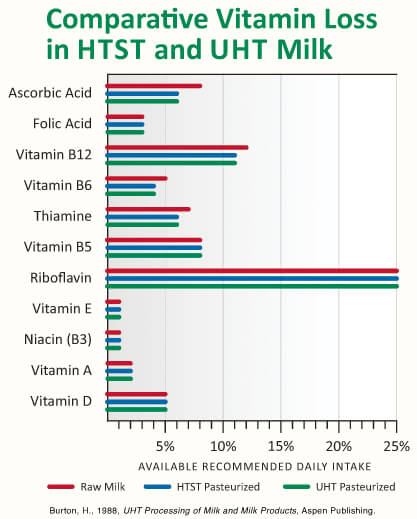
Considering nutrition, this chart does show a difference between raw milk and the pasteurized milk, but (as I mentioned) not so much between the two different methods of pasteurization that are being compared.
Why Offer Ultra-Pasteurization?
The fact of the matter is more retailers are willing to take on and offer organic milk if they feel confident they can sell their cases before they spoil. There is obviously a BIG difference between 21 days and 70 days when it comes to selling through a case of milk (see chart above), and since I am a huge proponent of organic products being available for purchase no matter where you live and shop I think this all makes a lot of sense.
Plus some consumers even prefer their milk to be ultra high temperature pasteurized knowing it will last longer in their fridge before they decide to open it. So, given those points, Organic Valley happily produces and sells milk that’s gone through UHT processing and HTST processing.
Cream and Milk Options
So, as I mentioned above, I had to ask my contact at Organic Valley why they put carrageenan in their cream (an additive that some find questionable). Little did I know they actually offer two different cream options - one with it and one without! And I'm so glad I asked this question because it led to discussion about how there are so many different milk and cream options out there and how your grocer won't know what you prefer if you don't take the time to ask for it.
As it turns out the Organic Valley cream that's UP needs the carrageenan to act as a stabilizer since the higher temperature makes the product want to separate, but it's not as much of an issue with HTST so it doesn't need to be added. If your grocer only offers one and you prefer the other, you know what to do! :) But remember the HTST won't have as long of a shelf-life so they'd have to be confident they could sell through their stock before it spoils.
Same goes for your milk when it comes to all the options out there - do you prefer grass-fed, non-homogenized, HTST, etc. and can't find it? Then it's time to have that chat with your grocery store (and maybe ask your friends to put in a similar request) because all these options do exist. Check out this list of what Organic Valley offers to help you know what to ask for. I didn't know I should ask for the different cream because I didn't even realize they made it until I had this conversation!
Milk Labels We Can Trust
Just like the rest of the food industry many dairy producers like to throw around labels on their packaging that aren't regulated therefore they're hard to believe. I think the bottom line here is if it's coming from a company we can trust then there might be some truth to the non-regulated terms.
Regulated Terms
- USDA Organic
- Pasteurized
- Homogenized
- Type of Milk: Whole, 2%, etc.
- Grade A
- Nutrition Facts
- Ingredients
- Excellent Source Of...
So just like the word "natural" in other areas of the grocery store, this means unregulated terms like "grass-fed" and "pasture-raised" - especially on a conventional product - can (unfortunately) mean just about anything. But, if it's coming from a company that you trust, it can hold more weight.
For example, dairy products that are USDA Organic certified are expected to come from animals with a minimum of 30% grass/pasture in their diet, BUT Organic Valley has decided to go above and beyond that rule and ensure their products instead meet a 60% minimum standard (over the course of a year). I've worked with Organic Valley for a while now and even visited one of their farms with my family - for reasons like this I do think it's a company we can trust.
I hope this was helpful and would love to hear your thoughts about this topic in the comments!


Leave a Reply