
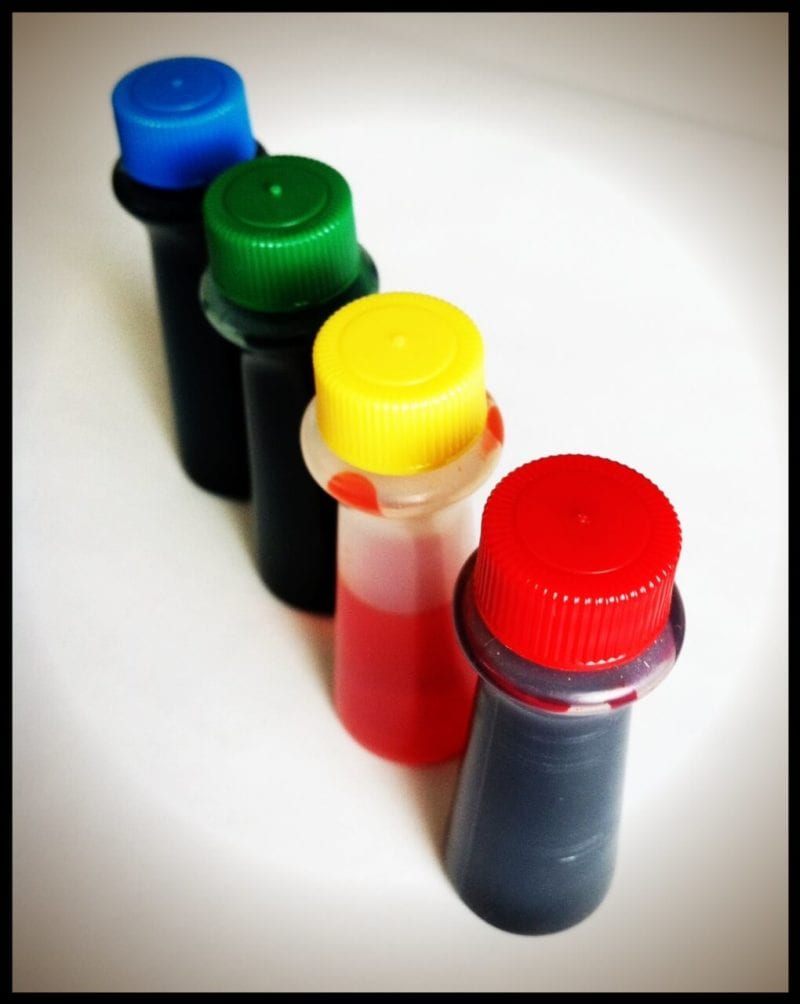
Artificial food dye, synthetic food dye, food coloring, FD&C Red No. 40, FD&C Blue No. 1, or Tartrazine (a.k.a. Yellow No. 5)… whatever name it’s listed under, it is all pretty much the same stuff. And as I’ve said on this site before I have no problem occasionally digging into yummy homemade baked goods made with plenty of chocolate, sugar, or whatever else we’re craving, but what I NEVER want to “treat” myself (or my children) to is a dose of chemicals derived from petroleum.
Yep, no typos there…that’s what artificial food dye is made from (it used to be derived from coal tar - so we haven't improved much!) and unfortunately the 15 million pounds of food dye used in the U.S. per year (5 times more than in 1955) is in much more than just colorful icing these days. Dyes, made from the same petroleum that fuels our vehicles, is turning up in an insane amount of packaged foods including Kraft Macaroni and Cheese, Minute Maid Lemonade, Lunchables, Fruit Roll Ups, Cheetos, and even “Light and Fit” Yoplait Yogurt.
And the crazy thing is these food manufacturers tell us right there on the ingredient label that artificial food colorings (and sometimes “artificial flavoring”) have been added…but most consumers don’t seem to be fazed by it.
Want to Save this Recipe?
Enter your email below & we'll send it straight to your inbox. Plus you'll get great new recipes from us every week!
Upon discovering what this (seemingly harmless and common) additive is made from I had to tell my daughters. I explained how it’s in thousands of products including birthday party cupcakes, salad dressing, cough syrup, and even daddy’s mouthwash. Rightfully so my 1st grader looked at me a little shocked and went on to say, “Can we write a letter to the president?”
Now I love how that girl thinks, but at the same time it broke my heart that my innocent child thought that’s all it would take. If we just told the president that food manufacturers were feeding us petroleum based chemicals disguised as brightly colored food dyes he surely wouldn’t allow it anymore. And while I am not very good at politics myself what I’d like to be good at is educating and influencing all of you to vote with your dollars. I truly believe that if consumers stop purchasing artificially dyed and flavored foods we can make an impact.
If enough of us speak up the big food companies will listen to consumer demand. And I know this for a fact because that’s exactly what’s happened in other countries outside of the U.S (check out #3 below).…we are apparently just behind the curve on this one.
7 Reasons I Hate Artificial Food Dyes
1. They are made in a lab with chemicals derived from petroleum, a crude oil product, which also happens to be used in gasoline, diesel fuel, asphalt, and tar.
NPR.org: “Artificial food dyes are made from petroleum and approved for use by the FDA to enhance the color of processed foods.”
2. They’ve been linked to long-term health problems such as cancer. If you’re a child of the ‘80s (like me) do you remember that rumor about red M&Ms causing cancer? Maybe it wasn’t just a rumor after all.
CSPInet.org: “The three most widely used dyes, Red 40, Yellow 5, and Yellow 6, are contaminated with known carcinogens, says CSPI. Another dye, Red 3, has been acknowledged for years by the Food and Drug Administration to be a carcinogen, yet is still in the food supply.” FYI – According to Wikipedia, “A carcinogen is any substance … that is an agent directly involved in causing cancer.” !!!
CBSnews.com: “There's no good reason not to ban Red 3, something then-acting FDA commissioner Mark Novitch tried to do in 1984, saying the dye ‘has clearly been shown to induce cancer’ and was ‘of greatest public health concern.’ … Other dyes, namely Blue 1, Red 40, Yellow 5, and Yellow 6, are known to cause allergic reactions in some people and have shown signs of causing cancer in lab animals. Of course, this isn't the same thing as leading to cancer in humans, but it argues for limiting intake, especially among children, who are getting the biggest dose of food colorings from a gazillion brightly colored, fun-looking foods.”
3. Did you know that food products containing artificial dye are required to have a warning label in the U.K.? The label states that the food "may have an adverse effect on activity and attention in children." So speaking of M&Ms, they aren’t so brightly colored in some countries outside of the U.S. because manufacturers would rather do away with the artificial dye than have to put a warning label on their products.
Mercola.com: “This is why if you eat a Nutri-Grain strawberry cereal bar in the United States, it will contain Red 40, Yellow 6 and Blue 1. But that same bar in the UK contains only the natural colorings beetroot red, annatto and paprika extract. In fact, the UK branches of Wal-Mart, Kraft, Coca-Cola and Mars have removed artificial colors, sodium benzoate and aspartame from their product lines as a result of consumer demand and government recommendations. In the United States, however, the Food and Drug Administration (FDA) continues to allow these toxic ingredients in countless popular foods, including those marketed directly to children.”
CBSnews.com: Many Grocery Manufacturers Association members (like Pepsi, Kraft and General Mills) “have switched to natural colorings in their products in the U.K., where warning labels are required, but they're not doing that here for the most part. That's because no one's making them do it, and switching would cost a lot of money.”
4. Synthetic food dyes have been shown to cause an increase in hyperactivity in children as well as a negative impact on their ability to learn.
Washingtonpost.com:"Artificial food dyes (in combination with a common preservative) could make even children with no known behavioral problems hyperactive and inattentive."
CSPInet.org: "The science shows that kids' behavior improves when these artificial colorings are removed from their diets and worsens when they’re added to the their diets." and "While not all children seem to be sensitive to these chemicals, it's hard to justify their continued use in foods—especially those foods heavily marketed to young children."
Mercola.com: “According to scientific studies, these dyes are causing behavioral problems and disrupting children's attention.”
5. They add absolutely no value to the foods we are eating, but do in-fact pose quite a few serious risks.
FDA.gov: “Without color additives, colas wouldn't be brown, margarine wouldn't be yellow and mint ice cream wouldn't be green. Color additives are now recognized as an important part of practically all processed foods we eat.”
Huffingtonpost.com: "These dyes have no purpose whatsoever other than to sell junk food."
CSPInet.org: “These synthetic chemicals do absolutely nothing to improve the nutritional quality or safety of foods, but trigger behavior problems in children and, possibly, cancer in anybody. The Food and Drug Administration should ban dyes, which would force industry to color foods with real food ingredients, not toxic petrochemicals.”
6. They trick your senses…just like other artificial additives including sweeteners.
In Defense of Food: “One of the problems with the products of food science is that, as Joan Gussow has pointed out, they lie to your body; their artificial colors and flavors and synthetic sweeteners and novel fats confound the senses we rely on to assess new foods and prepare our bodies to deal with them. Foods that lie leave us with little choice but to eat by the numbers, consulting labels rather than our senses.”
7. They are contributing to the obesity epidemic by attracting children (and adults) to highly processed food, which in many cases is being eaten instead of fresh whole foods.
Washingtonpost.com: "Beyond the behavioral problems and cancer risks, the greatest hazard that dyes pose for children may also be the most obvious: They draw kids away from nutritious foods and toward brightly colored processed products that are high in calories but low in nutrients, such as fruit-flavored drinks and snack foods. Those types of foods are a major force in America's obesity epidemic."
Disclosure: My children do occasionally eat foods containing artificial dye because it's provided to them by teachers, other parents, and friends, but it's not something we spend our own money on anymore.


Kathryn says
This is a really wonderful, informative post. We've been dye free since 2005 when we realized it caused our youngest migraines. The Feingold Association (linked in another comment) has helped make it very simple.
Corner Garden Sue says
I came here from a link on FB. When I first heard on the news about the hyperactive effect of food colorings, I quit eating M&Ms, and found my leg kicking at night was reduced. (I have periodic limb movement disorder.) A lot of the cereals I like also have, "color added" on the labels. I can get by with eating some of those, but did not realize how they are made.
Thanks for informing us.
Dr C says
Sundrops are an M&M alternative using natural food colors.
Find it as Whole Foods, EarthFare or other health food stores and co-ops.
Katrina Sandigo says
If you are really interested in starting a petition, even if it's just to get attention for the cause in general, use change.org! It is a great site, not to mention free, that helped to convince Bank Of America drop its debt card fee and many other great things. : )
Amanda says
Sorry if I missed it but with Easter coming up what do you use for egg dye?
100 Days of Real Food says
We personally dye cheap eggs that we don't eat (just hide).
jennifer says
We started watching food closely 6 years ago When my daughter started having migraines. Everytime she got sick it came up in bright Colors. Thus a good enough reason for us to cut out most food dyes.
jenn says
As I'm reading this I was thinking what I can do with the tradition of dying Easter eggs and then it hit me. I'm just going to let them decorate them with stickers, my kids love stickers and it will be less of a mess for me. :)
Bronwyn says
Loved this article; thanks for all the research! I love your blog and your commitment to feeding your family wholesome foods!
A few years ago I made my own Easter Egg dyes, and blogged the results here: http://cleangreenstart.wordpress.com/2010/03/28/natural-egg-dyes/
Several comments note that dye free cold medicine is difficult to find. I have found the brand Zarbees which is now sold in mainstream drugstores like Walgreens. The cough syrup is mainly dark honey, with a few natural additives like malic acid (totally natural) and has not only no dyes, but no sugar (and tastes great). It works. I also look for dye free motrin/advil in children's formulas, which is a little hard to find but is available. I like having these as separate medications, so I can dose each appropriately, or only one if needed.
Laurell barton says
I typed this on my phone, so please forgive typos.
The fda has recently looked into a study done on food coloring also. It was the same
Study that the uk used. Out was by Bateman, it liked at 277 preschool children and the effect afc had on behavior. The study showed that the children were more hyperactive following the ingestion off afc. The fda rejected the ban as of recently, but it is not out of the question for consumers to change their minds. I have recently done a study on this for my college nutririon class. Food coloring is in way too many products, and is found ast levels in food that is not even allowed in studies.
missy @ it's almost naptime says
My children don't eat it at all because if one in particular does, he turns into a hitting, spitting, speech delayed, defiant brat right before my eyes.
The Feingold Diet has changed our lives.
http://www.Feingold.org
Catherine says
We don't eat it in our home either (or anywhere else) for the exact same reason. It hits my 9 yr old daughter the hardest - she literally turns into a shrieking, violent and out of control monster before my eyes (seriously scary). Through elimination we found out our whole family is sensitive to it on one level or another. Living in Europe where I believe it is now banned would be much easier!
Carla says
It's amazing that other countries are able to step up and take responsibility for what goes in their bodies but over here we are so focused on getting things done quickly that we continue to eat whatever.
Julie E says
So interesting; Are there dye-free sports drinks? I don't have a Gatorade on hand to check ingredients, but my girls, who play a lot of volleyball, do drink some Gatorade. I would love an alternative (they drink tons of water), but sometimes a sports drink is a nice change... thanks!!
100 Days of Real Food says
There are definitely dyes in some of the Gatorades. Do you have a store like Earth Fare, Whole Foods, or Trader Joe's...they would have the most dye-free sports drink options.
Robin says
There are now a few flavors of Gatorade and other such drinks that are now dye-free. Don't know which ones because I haven't bought them, but I have seen them in the stores. That doesn't mean however that they don't have other artificial ingredients. I hear a lot of people are using coconut water in place of sports drinks because it contains the electrolytes naturally. Don't know what it tastes like, haven't tried this either b/c it looks pretty expensive, but it looks like you can order it by the case on Amazon's subscribe and save to help with the cost.
Marie says
Thank you for this post. I thought I knew about all the bad stuff in food but I was wrong! I had no idea how bad food dyes were! And first thing I did was share my knowledge with everyone around me.And I have to say my gov't saddens me:(
Cady says
Thank you for this, it was just the push I needed to toss the dyes out of my house and have a friend pick up the India Tree version for me. I am thinking of Easter Eggs and glad to know this year the locally grown, pastured, organic eggs won't be coated in a carcinogenic petroleum product that might make my 2 year old hyper. Whew. I needed this push!
Bronwyn says
You can make your own food dyes; I did it a few years ago with my children and blogged the results: http://cleangreenstart.wordpress.com/2010/03/28/natural-egg-dyes/
Mollys mum says
Hey girl - great research. I have been researching vaccines and the horror. The CDC, pharmaceutical companies and government are ALL corrupt. Have you read the ingredients in them???? I put some stuff on my blog a while back. No $$$$ in healthy people.
jai says
Thanks for this! My child had an allergic reaction to yellow food dye a few years ago. It has been just recently since my husband & I decided to go on a whole foods diet. The only thing we buy premade is pasta, all the rest I make from scratch including grinding my own ww flour, as soon as I can get ahold of a pasta maker I will make that myself too! Thanks for the informative article, I have 7 new sub-reasons to stick with the food basics our Lord gave us!!
Holly Murphy says
So I just got an email newsletter from dr. coldwell. He reports the most amazing things and I keep promising myself I will followup but dont. Tonight thr newsletter claimed, among other things, the carmel coloring pepsi and coke uses is a carcinogen. .fda knee. Anyone?
Christina @ Spoonfed says
Holly: Yes, the caramel coloring in soft drinks and many other foods is made from a chemical, not from sugar/cream/etc. like you'd use at home. And I believe Coke and Pepsi recently announced they'd be changing that ingredient in order to avoid a cancer warning label now mandated by California law. Which is why dye warning labels would be so effective, too. Manufacturers know a warning label like that is the kiss of death, so they're forced to change ingredients.
Rebecca says
Ha, Christina have you found the many rainbow recipes on Pinterest? It makes me nauseous to look at them but I am pinning "Foods We Avoid" to help others. Some folks are quite proud of their rainbow finds and get rather defensive about feeding their kids the junk, when I re-pin them under my less enthusiastically-named pinboards. Explaining my and my child's sensitivity to dyes falls on deaf rainbow ears.
Christina @ Spoonfed says
Rebecca: Yes, people get very defensive about this stuff. (Dyes and everything else.) But it does sink in, even if subconsciously at first. And that's what I'm after -- getting people to rethink their assumptions and think critically about the food they're eating and feeding their kids.
Christina @ Spoonfed says
As someone mentioned, the FDA held hearings last year to assess whether foods with artificial colors should get warning labels. As part of that, there were a few petitions circulated (and others have been circulated in the past). But, in the end, the FDA decided to do nothing, in part because, as one panelist said: "If we put a label that long on every chemical and ingredient that hasn’t been adequately studied, you wouldn’t see the package anymore.â€
Which of course is ridiculous. And telling. As I wrote after the hearings: "So the people making the rules (or advising the people who make the rules) won’t OK warning labels, because the dye-behavior research is inconclusive. Yet they’ll allow food ingredients where the research is… inconclusive."
Lisa linked to that whole analysis on Facebook, but I'll include it here, too: http://spoonfedblog.net/2011/04/22/a-dye-free-future-we-decide/ In it, I explore why the United States continues to allow risky additives in our food supply. I provide links to many studies and background on the issue. And I offer resources to help people avoid artificial colors and voice their concerns.
Also, some folks asked about using/making natural dyes. I have two posts that might help.
This one details my experience using India Tree natural dyes, and also includes lots of tips from readers for making homemade dyes: http://spoonfedblog.net/2011/01/22/the-color-of-trouble/
And this one (from today, actually!) is about the ubiquitous rainbow cakes and how you can make them using natural dyes instead: http://spoonfedblog.net/2012/03/14/i-am-so-over-the-rainbow-cake/
Sorry for the long comment, and all these links. I can really get going on this topic. And hopefully it's helpful.
And thank you, Lisa, for bringing the issue to an even broader audience!
Cheryl says
We are responsible for our own health and wellness. Looking to the government? That's a joke! We as consumers have the power to change things. Continue to get the word out there and don't rely on the government.
Rebecca says
For Leah- DIY dye recipes: http://shine.yahoo.com/spring-celebrations/8-ways-organic-diy-food-coloring-220600943.html
Heather says
Thank you for sharing this info. I'm now looking at lables for dyes and was shocked that it was in my kids toothpaste!
Fairbank Literary says
Wonderful and helpful post, Lisa!
Holly Murphy says
so sad...tell your daughter that she could write a letter to the president, but he would have to get approval to respond from his Monsanto representative and their attorneys, :o(
I love your blog. I read a book by Robin Obrien last summer...took my 11 children off packaged food, started buying organic and never looked back. Now I wonder why we never heard this. I see people whining that she should have known better...is she naive. Um, I thought I was informed, I knew it wasn't great for us, but I had no idea. I pinned your information...going to go right now and encourage people to read the comments, too!!
Leah says
Do you have a link of recipes for natural dyes? I want to make my daughter cookies for her birthday, but am really second guessing the use of "over the counter" dyes. Are dyes on labels pretty obvious to read? I just want to make sure I am not overlooking if a product has dye in it or not. Thanks for all you do to keep us informed!!
100 Days of Real Food says
There are natural India Tree dyes available at Whole Foods or online (http://tinyurl.com/6vezwdx)...or just stick to using colors that you make with food like berries, kiwi, mango, etc.
Amanda says
Glad to see that so many moms out there are concerned and willing to do something to make a change. It saddens me to know that our government(I live in Canada)knows how harmful these chemicals are and are still allowing them. But, I also believe that manufacturers bear some responsibility in this too. Why don't they take the initiative to eliminate these chemicals and make their products safer?
What shocked me the most is that kids are at the greatest risk. Making mom's aware is a great start! We have the biggest influence on our families food choices.
Love your blog, read it everyday! Making Zucchini Muffins today.
Rebecca says
Here’s a statement from the American Academy of Pediatrics from 2008, confirming what moms all over the world already know (print this for your doc):
“Despite increasing data supporting the efficacy of stimulants in preschoolers with attention deficit hyperactivity disorder (ADHD) parents and providers understandably seek safe and effective interventions that require no prescription. A recent meta-analysis of 15 trials concludes that there is “accumulating evidence that neurobehavioral toxicity may characterize a variety of widely distributed chemicals.†[Schab DW, et al. J Dev Behav Pediatr. 2004;25:423–434] Some children may be more sensitive to the effects of these chemicals, and the authors suggest there is a need to better identify responders. In real life, practitioners faced with hyperactive preschoolers have a reasonable option to offer parents. For the child without a medical, emotional, or environmental etiology of ADHD behaviors, a trial of a preservative-free, food coloring–free diet is a reasonable intervention.†– Alison Schonwald, MD, FAAP, of the Developmental Medicine Center at Children’s Hospital in Boston (published in the February 2008 issue of the AAP Grand Rounds).
And the Editors’ Note which follows states:
“Although quite complicated, this was a carefully conducted study in which the investigators went to great lengths to eliminate bias and to rigorously measure outcomes. The results are hard to follow and somewhat inconsistent. For many of the assessments there were small but statistically significant differences of measured behaviors in children who consumed the food additives compared with those who did not. In each case increased hyperactive behaviors were associated with consuming the additives. For those comparisons in which no statistically significant differences were found, there was a trend for more hyperactive behaviors associated with the food additive drink in virtually every assessment. Thus, the overall findings of the study are clear and require that even we skeptics, who have long doubted parental claims of the effects of various foods on the behavior of their children, admit we might have been wrong.â€
Rebecca says
Go to PubMed and type in these studies:
Swanson and Kinsbourne (Science), 1980
Egger (The Lancet), 1985
Kaplan (Pediatrics), 1989
Carter (Archives of Diseases in Childhood), 1993
Boris (Annals of Allergy), 1994
Rowe and Rowe (Journal of Pediatrics), 1994
McCann (The Lancet), 2007
Also try:
Lancaster, 1999
Tanaka 1993, 1996, 2001, 2005; Vorhees 1983
Rosenkranz 1990; Sweeney 1994; Tsuda 2001; Sasaki 2002
Aboel-Zahab 1997
Tia says
Great article! Thanks so much for putting it out here! This is an issue that I am so passionate about! I strive always to keep anything artificial out of my body, and the little bodies in my family! It can be a challenge some days, but so worth it!
Rebecca says
Here is a link to the meta-analysis of double blind placebo controlled trials regarding artificial food coloring: http://cspinet.org/new/pdf/schab.pdf
Rebecca says
I believe CSPI has petitioned the government.
Larisa says
Feingold along with CSPI spoke before an FDA panel last spring & they almost voted for warning labels 6-8 (I think), but ended up only saying that more research was needed before they acted on anything. It was very disappointing.
Rebecca says
One of my readers suggested a petition too, Jamie. Will look into that.
100 Days of Real Food says
I love the idea of a petition, but I think it might be unrealistic to ask the U.S. to ban dyes. I like the idea of the warning label (esp. b/c it's already being done overseas), which at the same time would influence companies to use natural dyes instead of slapping on the big warning label.
Mary says
Keep me posted on this, and if a petition or anything gets started on this, count me in. I am not only concerned for myself, but also for my innocent 1-1/2 and 4-1/2 year old grandchildren.
Jamie says
Does anyone know if there's a change.org petition for influencing the FDA to ban dyes? I searched and didn't find anything.
Elizabeth says
In reading the following, it makes me wonder if we really can get away from it UNLESS we go organic (which for some isn't easy or a viable option)
Limited use
The following dyes are only allowed by the FDA for specific limited applications:
Orange B (red shade) - allowed only for use in hot dog and sausage casings.
Citrus Red 2 (orange shade) - allowed only for use to color orange peels.
[edit] Delisted/Disallowed
FD&C Red No. 2 – Amaranth
FD&C Red No. 4[11][12]
FD&C Red No. 32‎ was used to color Florida oranges.[6][11]
FD&C Orange Number 1 was one of the first water soluble dyes to be commercialized, and one of seven original food dyes allowed under the Pure Food and Drug Act of June 30, 1906.[6][11]
FD&C Orange No. 2‎ was used to color Florida oranges.[6]
FD&C Yellow No. 1, 2, 3, and 4[11]
FD&C Violet No. 1[11]
Kristin says
For candy, I try to buy my girls straight chocolate for holidays. Cost Plus has a nice selection of imported foil wrapped chocolates in cute shapes, santas, snowman, teddy bears, etc. Also, regular old hershey's is dye, HFCS free. I bought my girls the foil wrapped eggs for easter. As for jelly beans, I found a variety that got good reviews(dye hfcs free), Surf Sweet, at naturalcandystore.com that thankfully is also sold at my local whole foods. Though the jelly belly "Snapple" jelly beans are also dye free (contain HFCS) and available at more mainstream stores. I sent my Dad a polite email about what easter candy is acceptable. I also plan to have acceptable candy on hand to swap with the candy my girls get containing dyes. Does anyone know of natural dyes (for tinting frosting) that are usable for multiple years? The ones I saw where quite expensive and only good for 6 months.
BrookeB says
Regular Hershey's and some other mainstream, inexpensive chocolate contain artificial vanilla called vanillin. It is a byproduct of paper mills -- sludge from these factories. For many children, it causes the same reactions as synthetic dyes. So just be careful and watch for that!
Rebecca says
Yes we avoid fake favors too because my daughter has meltdowns and gets overwhelmed by the tiniest thing soon after consuming it.
Elizabeth says
As if it isn't bad enough...COAL TAR?!?!?!?!?! (taken from http://www.wisegeek.com)
Food coloring indicated in health problems are the following:
1) FD & C Yellow No. 5 contains tartrazine. People who have aspirin sensitivity may not tolerate it and it may be especially a bad choice for people who have frequent asthma. Tartrazine is derived from coal tar, which has led to concerns for all people who consume it.
2) FD & C Red No. 3 contains erythrosine, another coal tar based compound. There is suspicion that this colorant may be carcinogenic. Rat studies showed development of thyroid tumors when high doses of erythrosine were administered.
Rebecca says
Lisa I tried to post a list of scientific studies and a quote from the AAP...are you guys able to see it? I posted twice, last night and just now. It says it's awaiting moderation. Should I try again? Don't wanna fill up your thread with duplicates. Can you help? Thanks!
100 Days of Real Food says
My comments get stuck in "pending" if there are 2 or more links (to avoid spammers), but I just approved your comment and upped it to 3 or more links so that won't happen as much...
Rebecca says
Ah ok makes sense, thank you. :-)
Rebecca says
I compiled tips and tricks from over 30 places online, for ways to affordably eat natural and organic foods - please read my post called "One Moveable Feast: Serve Up Organic Meals Without Blowing Your Budget": http://www.diefooddye.com/2011/11/21/one-moveable-feast/
I am hoping to help make it easier for all to enjoy quality food.
RevAllyson says
Sarah and others (I apologize, I've read all the messages but don't have time this morning to go back and pick for all the names), I think I might be able to give you a bit of a different viewpoint. First, Johns Hopkins has done a study on how food dyes and HFCS affect children. I am terribly sorry that I don't have the link to it (I'm not sure it's online) but if you call them you might be able to get the info you're seeking. That said, let me relate a couple of things.
First, I am on an anti-depressant. It's not a strong one, and it's one of the older ones. I take the lowest dose: 20mg. The pill that I take each evening is 1/8 of an inch across. That's the smallest pill that we're allowed to manufacture, because smaller ones are harder to handle. Most of my pill is filler (and it states that on the info sheet that comes with it). Now, 20mg is a tiny, minuscule dose. That is a very effective dose for me, and changes my attitudes and behaviors *dramatically* (if you doubt it, ask my family LOL). Now think about how much food dye it takes to color anything... frosting, if you like, as that's a common item we've talked about. My pill would fit about 100 times in the average amount of frosting on a cupcake. What is the "active dose" of food dye that bothers a child? My guess (though this is just a guess) is that it would range in the high milligram range... still more than enough to fill out the cupcake frosting several times over.
Second, we ARE conducting scientific experiments with our children. We formed a hypothesis: I think that HFCS and food dye is causing my child to behave oddly. We then created a controlled scenario: removing all HFCS and dye from the diet. We observed the response to that control: the child became calm and focused, and was able to interact in 'normal' fashion with other children his age. We repeated the experiment, because it's important to see that results are repeatable: HFCS and dye were individually added back into the child's diet, and the results recorded. We came up with a theory: HFCS and food dye have negative reactions on this child.
The experiment goes much further, though, because it doesn't just involve me and my child... It involves all the children mentioned on here, and thousands more across the country, plus hundreds of thousands in other countries.
This note wasn't to any one person, but was just meant to address the various issues that I've seen go by. Our son is a twin, six years old, and is high functioning autistic. On an all natural diet he pretty much blends in with the other kids. Add in HFCS and he sits and stares at his hand, rocks back and forth, and goes into unaccountable screaming fits. At the end of it he crawls into your lap and tells you, "My brain is broken again..." He hates it. He knows how to read and is hyper intelligent - he reads the labels on EVERYTHING and avoids HFCS like the plague, because it "breaks his brain." If a six year old can figure it out... well...
Kylie says
Thank you for laying it out there as an experiment; that's exactly how we went about identifying our son's food dye sensitivity as well. Your son sounds like a great kid and I'm so glad you've found a way to help him feel his best!
Jenifer says
Wow. Amazing post RevAllyson. Kudos.
Rebecca says
For skincare (Aisha asked), try http://www.100percentpure.com for totally additive free skincare, makeup, etc. They use veg and fruit coloring only.
And I smiled when I saw that other kids wanted to urgently write to the President about this, as that was my daughter’s first reaction, too! She is a very strong and savvy 7 year old and has no problem telling folks that artificial additives are bad and why.
For Adam, Please go to the PubMed site and type in these studies and years:
Swanson and Kinsbourne (Science), 1980
Egger (The Lancet), 1985
Kaplan (Pediatrics), 1989
Carter (Archives of Diseases in Childhood), 1993
Boris (Annals of Allergy), 1994
Rowe and Rowe (Journal of Pediatrics), 1994
McCann (The Lancet), 2007
Also try:
Lancaster, 1999
Tanaka 1993, 1996, 2001, 2005; Vorhees 1983
Rosenkranz 1990; Sweeney 1994; Tsuda 2001; Sasaki 2002
Aboel-Zahab 1997
Next please see these studies: http://www.feingold.org/Research/adhd.html
Most powerful is this… Here’s a statement from the American Academy of Pediatrics from 2008, confirming what moms all over the world already know (print this for your doc):
“Despite increasing data supporting the efficacy of stimulants in preschoolers with attention deficit hyperactivity disorder (ADHD) parents and providers understandably seek safe and effective interventions that require no prescription. A recent meta-analysis of 15 trials concludes that there is “accumulating evidence that neurobehavioral toxicity may characterize a variety of widely distributed chemicals.†[Schab DW, et al. J Dev Behav Pediatr. 2004;25:423–434] Some children may be more sensitive to the effects of these chemicals, and the authors suggest there is a need to better identify responders. In real life, practitioners faced with hyperactive preschoolers have a reasonable option to offer parents. For the child without a medical, emotional, or environmental etiology of ADHD behaviors, a trial of a preservative-free, food coloring–free diet is a reasonable intervention.†– Alison Schonwald, MD, FAAP, of the Developmental Medicine Center at Children’s Hospital in Boston (published in the February 2008 issue of the AAP Grand Rounds).
And the Editors’ Note which follows states:
“Although quite complicated, this was a carefully conducted study in which the investigators went to great lengths to eliminate bias and to rigorously measure outcomes. The results are hard to follow and somewhat inconsistent. For many of the assessments there were small but statistically significant differences of measured behaviors in children who consumed the food additives compared with those who did not. In each case increased hyperactive behaviors were associated with consuming the additives. For those comparisons in which no statistically significant differences were found, there was a trend for more hyperactive behaviors associated with the food additive drink in virtually every assessment. Thus, the overall findings of the study are clear and require that even we skeptics, who have long doubted parental claims of the effects of various foods on the behavior of their children, admit we might have been wrong.â€
I am really heartened to read all the comments above. The momentum this movement is gaining is POWER.
Rebecca says
The good news for low income families is that more and more Farmers Markets are giving double value for food stamps to purchase fresh foods. Ironically, the food stamp program was originated as a way to utilize farms' surplus, getting fresh food to those who can't afford much. We see how that has changed over the years. And more and more "food deserts" are being supplemented with good folks bringing the Farmers Markets to them via bus. Read this great blog post on Civil Eats called "How To Stay A Foodie Family On Food Stamps": http://civileats.com/2011/08/30/how-to-stay-a-foodie-family-on-food-stamps/
Kylie says
That's great, Rebecca!
Sarah says
Although I appreciate what you have written and agree with your premise, I think you could be more persuassive if you would link to original source documents. A news report does not make something necessarily true. When I read "Washingtonpost.com:â€Artificial food dyes (in combination with a common preservative) could make even children with no known behavioral problems hyperactive and inattentive, †I want to know the following: What study or paper is the Washington Post basing its analysis. Because those same papers told us that dyes were perfectly safe at one point or another. If you want to persuade your legislator, go to the source, not just some article written by a reporter who interviewed a scientist who may or may not have direct knowledge of the study.