
It's no secret that I like to send warm soup (or leftovers) to school with my girls in insulated Thermos food jars. I've actually made a habit of doing this on Wednesdays because I like to have one night per week when I don't have to be "creative" with packing school lunches.
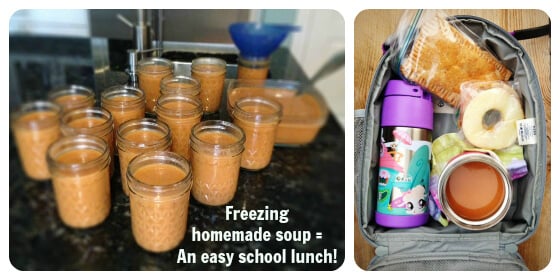
I make big batches of their favorite soups in advance, freeze them in individual jelly jars (leaving room at the top for the soup to expand), and then "voila!" lunch is pretty much done one day a week for weeks to come.
Want to Save this Recipe?
Enter your email below & we'll send it straight to your inbox. Plus you'll get great new recipes from us every week!
Not All Thermos Jars are Created Equal
So you can imagine my surprise when one Wednesday I had lunch with my daughters at school and asked to take a bite of each of their soups. Some readers have told me their insulated containers keep their kids' food piping hot and others have said it's so cold their kids won't even eat it. So I decided to see for myself how warm the food actually was by lunchtime (about 5 hours after packing it in the morning).
Their lunch periods are only 20 minutes apart and the first daughter's soup was fairly warm - even warm enough for a cold-natured person like me that prefers things pretty hot (soup, mochas, showers...you name it). Then I sat with my other daughter less than a half hour later and realized her soup was MUCH colder (she still ate it anyway - good girl LOL)!
But, from the outside their food jars looked identical...same brand, same Hello Kitty logo, etc. and after packing them at the same time using the same method/soup I just knew something was not right.
So I of course turned to my engineer husband who conducted a very scientific, controlled test to make sure the dramatic difference in temperature wasn't just my imagination...and this is what he says about it:

"First I inspected the food jars and even though they looked the same on the outside I found there was actually a difference on the inside. For one, the vacuum seal (beneath the bottom cover) on the colder jar looked inferior, and two, the shape of the bottom of the container looked like it would facilitate more heat transfer, which is not what you want when you're trying to keep the heat in the container.
But to prove this theory I ran a simple test using one cup of boiling water (212 degrees) in each. Thermos brand food jars claim to keep food warm for five hours and after four hours the water in the 'bad' food jar (pictured on the left) was at 85 degrees, whereas the water in the 'good' jar (pictured on the right) was at 120 degrees...35 degrees is quite a difference!
I'm not sure if the vacuum seal was in fact broken or if this was just a knockoff/poor design, but regardless after calling the Thermos Company they sent me a new jar for free in exchange for me mailing them the 'bad' food jar at my own expense. Now we can be certain that both of our kids are consistently getting warm soup (or leftovers) at school!" - Jason Leake
Is "Pre-Heating" Food Jars with Boiling Water Worth It?
I've been told by dozens of readers that "heating up" Thermos jars with boiling water prior to adding the soup/food would keep it warmer longer. This theory does sound plausible so I started doing it myself hoping it would help!
But, being the skeptic my husband is, from day one he said he did not think the boiling water would make much of a difference for our application. He also didn't like having to go through this extra step in the morning when he helped me get the girls off to school. :)
So once again my husband's engineering background kicked in and he conducted another scientific test to determine if pre-heating the Thermoses made a difference or not:
"To test my hypothesis I got two identical food jars and labeled one as "pre-heated." I filled that jar with boiling water, let it sit for 7 minutes, and then dumped out the hot water. I then immediately filled both jars (one pre-heated and one not) with exactly one cup of boiling water and closed the lids tightly.
After 4 hours I removed the tops and measured the water temperatures with our kitchen thermometer. The pre-heated one was only half a degree warmer...not even enough to notice!
So I'd say the pre-heating is not worth the extra time, at least for this scenario. That being said, insulated container manufacturers do recommend it for optimal performance, so perhaps it is worthwhile if you live in a very cold environment." - Jason Leake
Our Advice
We think that good quality, insulated food jars and drink bottles can be incredibly useful when it comes to transporting and keeping your "real food" meals and beverages warm (or cold). In fact, at the pool one day I found myself drinking water out of my children's Thermos bottles because their water was still icy cold while the water in my non-insulated steel bottle had turned lukewarm. I now have an "adult" Thermos bottle that I love and seriously take almost everywhere (in the car, on the plane, etc.).
So we highly recommend them, but when it comes to selecting a food jar, if possible, try to avoid the "bad" style shown on the left in the picture above. Also when it comes to adding food to the jars remember you can skip the pre-heating (i.e. boiling water) step. Simply warm up your food, add it to the food jar, put on the lid, and you should be good to go for about 5 hours.
There's one other tip in regard to the lid though...I've found that I have to screw on the lid all the way and then slightly unscrew it (by maybe a quarter of a turn) to make it easier for my children to open it by themselves at school. After you loosen the lid, simply hold the jar sideways and make sure no food leaks out in order to test the seal.
Please share with us in the comments what your experience has been with using insulated food jars!


TL says
Hi, I was curious if you've tried using your funtainer thermos for anything other than soup? I was told by a friend that she puts chicken nuggets in her kids' funtainer and they're still a good temperature at lunch time. So I bought one (the same as your link), but I put hot macaroni in my son's and he said it was cold when he ate it. So I experimented with just one mini pizza I made, and it too was cold. I even tried preheating it before hand. Any advice? I don't want to send chicken or other meats in there if it will be at a bad temperature for over 2 hours... Thanks.
Amy Taylor (comment moderator) says
Hello. I've found that outside of soup, the items that stay warm are ones that are densly packed such as pasta with sauce or mac and cheese.
Alejandra says
Maybe is the container, as this article says. I bought new thermos containers and tried them for my husband, he said that it was pretty good, not super hot, but not warm either. I make sure to pack the food pretty hot.
Hope this helps
Sally says
You are very right about loosening the final twist on the cap when packing in the lunch bag. My theory is that the heated food acts as a vacuum and makes the seal too tight for hands to twist off (even mine!)
melly says
here's my experience, Sally. i use mason jars with canning lids for my daily coffee, in crocheted or knitted covers. (they don't have to stay hot long. just long enough for me to get TO my daughter's dance class, or to the library, so i can sit and enjoy it.) if the delay is long enough, i can hear and see the canning lid pop. cooling food does indeed create a vacuum. with my canning lids, i just take a coin and pop them up. with a one-piece screw on lid, it's much harder, especially if they were screwed on tightly to begin with. :(
Jenny says
I just bought a Pottery Barn kids hot cold container. The description says Leak proof. It arrived with a big tag saying "not leak proof". The company confirmed that it is not leak proof for liquids and said that they will work on changing the description online. I'm disappointed, as I hoped to send homemade soup to school with my new kindergartener... any leak proof containers you can recommend?
Amy Taylor (comment moderator) says
Hi there. You can find all of Lisa's favorites here: https://www.100daysofrealfood.com/2012/08/24/my-favorite-school-lunch-supplies/ and https://www.100daysofrealfood.com/?s=the+lunch+box+rumors.
Jenny says
Thanks so much!
Elissa says
We regularly use thermos style insulated containers for our girls' lunches for things like egg and rice or leftovers. I have been thinking about whether it was worth paying a bit more for something that would keep the food hotter for longer. But, when I hear the stories of how the containers are literally thrown around at school, dropped out of bags, rolled around, etc, I think we will stick with the tough survivors for a while longer!
Amanda says
How do you pack the warm thermos alongside anything that needs an ice pack?
Amy Taylor (comment moderator) says
Hi Amanda. We've not noticed that thermos temp to be affected by ice packs on the outside. I sometimes put a cloth napkin between the two but I don't know that it matters. :)
Annie says
If you haven't already heard of them or seen them on the shelf yet The brand Hydroflask makes awesome thermos water bottles and for soups as well. Hydroflask.com these are much better than thermos brand! My son had some leftover rice that I had heated that morning and at 3 pm it was still slight warm! Check these out. Great product. Also you can put a smoothie in the water bottles and it stays frozen.
They guarantee cold liquids up to 24 hrs and hot liquids or food up to 12 hours. Check out their website http://www.hydroflask.com
Olesja says
What thermos conte inner do you use and where can I buy it? Thank you. I could not find that info in the article
Amy Taylor (comment moderator) says
Hi there. You can find it here: https://www.100daysofrealfood.com/2012/08/24/my-favorite-school-lunch-supplies/.
Kate says
I've been having trouble opening the thermos around lunchtime when I started the morning with piping hot food. Is it just me or do others have this issue? It's as if the vacuum seal is even tighter as it cools down. If you also experience this, do you have any tips?
Amy Taylor (comment moderator) says
Hi Kate. Yes, that is normal. As is cools, it creates more of a vacuum. I find that it helps to not screw the lid on too tight. :)
Smita says
Does anyone know where I can get a flatter insulated box for things like roll-ups or sandwiches?
Patti says
I've been looking & haven't seen anything. I'd love to find one too so it's easier to fit the Thermos in my son's lunchbox & still have room for other food items. I've seen some that have handles so you can carry them separately, but he's only five & in addition to his lunchbox (which I put all of his lunch in including his milk), I'm also supposed to send him to school with a morning snack, an afternoon snack & a drink for snack time . The more separated it all is, the more likely something will get lost or he'll get confused about what to eat when. In other words, there is real value for me in having a Thermos that is flatter & smaller that I can put in his lunchbox & still have space to put other food & a drink in there.
Christine Oldham says
Great info. Where can we buy the GOOD thermos bottles for drinks and soups/hot food?
Amy Taylor (comment moderator) says
Hi there. Just click on the links provided in the post. You'll see "food jars" in green indicated a link. :)
Jackie says
We use the old fashioned STANLEY brand at our house. I remember my Dad used these to take along hot coffee on the road. :) Along with my daughters, I use these as well to take my lunches to work because I am on the road everyday and have no way other than stopping at a convenience store to use their microwave. Which I don't like to do. These are a little more pricy but completely worth it! I have eaten my lunch very late in the day and my food is still very warm. They also have a lifetime warranty on their products!
Leia says
Has anyone heard about the plastic material called "tritan" used in thermos and other bpa free plastic products and how it's said to be EVEN MORE toxic than BPA? http://www.motherjones.com/environment/2014/03/tritan-certichem-eastman-bpa-free-plastic-safe?page=2
Now I'm wondering if ANYTHING is really safe anymore:(
Jessica says
Target sells one that is by Alladin brand and it is shaped like a soup bowl with a handle. It has a nice wide opening so I even put chicken nuggets in it. Have you seen that one? I'd love to see a review on it.
Carol says
You have to do the preheating with boiling water experiment with soup- not boiling water again.
Brooke says
So interesting! I kept wondering why my Kindergartner claimed his hot lunch was always cold, and my 3rd grader's was still warm. It's most definitely that his Thermos was the 'bad' one, bought only recently. My older child's is a few years old. Thanks for the tip, hope to replace it with the flat bottomed kind.
Amber says
If you put the thermos with hot food in it in the lunch bag with cold packs for the other food, does the hot food stay warm?
Amy Taylor (comment moderator) says
Hi Amber. It does. :)
Rebecca says
I read recently that preheating the thermos with boiling water is an important step to "sterilize" the thermos prior to filling it which makes it much less likely that bacteria can grow inside the thermos even if it falls within the "danger zone" of 40 degrees to 140 degrees. What are your thoughts Lisa?
Amy Taylor (comment moderator) says
Hi Rebecca. Boiling water is not going hurt anything. I don't mean to conflict with Jason's science... however, I confess to being a boiler :) mostly for sterilization but my kids' food is still hot at lunchtime. ~Amy
Marcia says
My son started prek and is allergic to peanuts and corn. He knows not to eat it. He doesn't like sandwhiches and always eats hot foods so I thought the best would be for him to eat school lunch. I notified the teacher and they have a wall where they write each child's name and what food allergies they have. Well today he was given corn. He knew not to eat it. He's still adjusting to the new setting so he didn't say anything. I'm upset that it was given to him. Anyway, I now struggle with finding something where I can send him leftovers and will keep it warm. Thank you for this post. Going to check it out this weekend.
Sharon Stephenson says
Wow, good to know that I can skip the pre-heating!
Cara Norris says
Hydro flask (hydroflask.com) also makes an awesome water bottle. It'll keep ice water icy for several hours when closed tightly and won't sweat. I deplore a sweaty water bottle! I can only guess that their food jars would be awesome insulators as well. I have also had fine luck with thermos brand containers but it's nice to have a choice!
Erica says
I ordered the Thermos food jar online and unfortunately received one with a domed bottom :/ It still works for my daughters lunch. She eats approximately 4 hours after I place the soup/hot food in the container.
Jamie says
Thanks so much for this post (no matter how old - still relevant)! Bought containers at Target today and there are a mix of flat and domed bottoms. Glad I read this the other day to know which to get! Thank You!
Kerri says
I realize this is an old post but I wanted to let you know that I received two dome bottomed Thermos food jars from the Amazon link at the beginning of the post. I suspect that much like I have seen on the shelves at the big box stores, there is a mix of domed bottoms and flat bottoms (side by side on the shelves!)and it is luck of the draw which you receive from Amazon.
Nada Manley says
This is sooo sooo helpful! I am so happy I can skip the preheating step. And I had no idea that there was any difference between one Thermos container and another. I can't wait to try mine out. My husband is an engineer and also a skeptic, so I could totally relate to that. LOL. Thanks for the great info!
Nicole says
Are you able to put the canning jar of soup in the thermos or do you pour the soup directly into the thermos? Thanks!
Assistant to 100 Days (Amy) says
Hi Nicole. We pour the soup into the thermos after it (the soup) is heated. ~Amy
Gwenda says
Very interesting post. Love the engineering approach! It certainly challenges the vague claims of keeps cold/hot for "hours and hours". For sending milk to school, I use myColdCup, which keeps drinks fridge cold for 6 hrs. I invented myColdCup when I couldn't find anything on the market to keep milk cold enough. As a mother/engineer myself, I have tested it many times with the kitchen thermometer!
Assistant to 100 Days (Amy) says
Hi Meg. I would choose stainless over aluminum and the new glass bottles covered in rubber are a great alternatives to plastic. ~Amy
Meg says
Any advice on safety of the material of a water bottle (not necessarily insulated)? Casual sports industry seems to push aluminum water bottles but water starts to taste metallic...am I putting something in my body that I'd be better off not? Should I switch to glass water bottles?
Kathleen O'Neill says
VERY helpful and I am way past kindergarten! Thank you!