
This is a guest post from Vani Hari (a.k.a. The Food Babe) and New York Times Best Selling author. You can read more about her take on the food industry in her second book, Feeding You Lies!
Thoughts of outrage, unfairness, disbelief, and ultimately grief consumed me while I was doing this investigation. A list of ingredients that are banned across the globe but still allowed for use here in the American food supply recently made news.
While I have written about some of those ingredients before, this list inspired me to look a little deeper and find out how pervasive this issue is for us. Could these banned ingredients be contributing to the higher mortality and disease rates here in the U.S.?
The health of Americans is downright grim according to a report just released by the Institute of Medicine and the National Research Council. It declares "Americans are sicker and die younger than other people in wealthy nations." The United States spends 2.5 times more on health care than any other nation, however, when compared with 16 other nations we come in dead last in terms of health and life expectancy for men and near the bottom for women.
Here is the breakdown for you:
- More than two thirds of United States citizens are overweight – 33% being obese.
- 32% of children are either obese or overweight.
- 43% of Americans are projected to be obese in 10 years.
- After smoking, obesity is America’s biggest cause of premature death and is linked to 70% of heart disease and 80% of diabetes cases.
- And 41% of Americans are projected to get cancer in their lifetime!
These reports and statistics scream the word HELP!
Recently, I spent some time down in Mississippi volunteering in the most obese county in the nation. I found that while social and economic factors do play a part in this epidemic, the main culprit was the lack of nutrition education.
The victims of obesity are likely the same victims of systematic brainwashing from Big Food marketers, relying on diet soda or low fat products or looking only at calories on product labels. Basically, they are doing what the food industry has been teaching them about losing weight versus finding out the truth about real food.
And that's the problem - the food industry is the one leading our conversation in this country about food and nutrition, educating the mass public about what to eat and what not to eat. Coca-Cola recently even went as far as creating a special campaign to combat obesity - yes you read that right - a sugar filled soda company trying to stop obesity. (You can read my reaction to that here).
Unfortunately, the doctors in this country are not exactly leading the discussion either, since nutrition is not currently a focus in medical school. And the government has their hands tied by big food industry and chemical company lobbyists that basically control what the FDA approves, deems safe for human consumption, and our overall food policy.
So who is going to finally tell us the truth about our food?
The food industry does not want us to pay attention to the ingredients nor do they care about the negative effects from eating them. They certainly don't care about the astronomical medical bills that are a direct result of us eating the inferior food they are creating.
The HELP we need starts here. We as a collective nation must stop this trajectory of sickness and rising health care costs, by understanding the ingredients we are putting into our bodies. We must challenge the U.S. food industry to discontinue the use of banned ingredients that are not allowed elsewhere in the world. We deserve to have the same quality food without potential toxins.
Food is medicine, and plain and simple, if our food is sick (filled with GMO’s, chemicals, additives, artificial ingredients, and/or carcinogens), collectively we as a country are going to continue to be sick.
Using banned ingredients that other countries have determined unsafe for human consumption has become a pandemic in this country. To prove this point, I found the best and easiest place to look for evidence was just across "the pond" in the United Kingdom, where they enjoy some of the same types of products we do - but with totally different ingredient lists.
It is appalling to witness the examples I am about to share with you. The U.S. food corporations are unnecessarily feeding us chemicals - while leaving out almost all questionable ingredients in our friends' products overseas. The point is the food industry has already formulated safer, better products, but they are voluntarily only selling inferior versions of these products here in America. The evidence of this runs the gamut from fast food places to boxed cake mix to cereal to candy and even oatmeal - you can't escape it.

Want to Save this Recipe?
Enter your email below & we'll send it straight to your inbox. Plus you'll get great new recipes from us every week!
Some of the key American brands that are participating in this deception are McDonald's, Pringles (owned by Kellogg's), Pizza Hut and Quaker (owned by Pepsi), Betty Crocker (owned by General Mills), Starburst (owned by M&M/Mars), and Ritz Crackers (owned by Kraft). In the examples below, red text indicates potentially harmful ingredients and/or ingredients likely to contain GMOs.


Having a pre-made box of flour, baking soda and sugar all ready to go saves time for some people when it comes to making a cake, but does saving time have to come at the expense of chemically derived and potentially toxic ingredients?
The United States version of Betty Crocker Red Velvet cake not only has artificial colors linked to hyperactivity in children, food cravings, and obesity, but it also has partially hydrogenated oils (a.k.a. trans fat). Trans fat has been shown to be deadly even in small amounts. “Previous trials have linked even a 40-calorie-per-day increase in trans fat intake to a 23% higher risk of heart disease.” This could easily be the amount of trans fat in one serving of Betty Crocker icing alone.
Sodium benzoate is an ingredient that Coca-Cola actually removed in their Diet Coke product overseas, but you'll still find it in their product Sprite, cake mixes and loads of other products across the USA. The Mayo Clinic reported that this preservative increases hyperactivity in children. Also, when sodium benzoate combines with ascorbic acid (vitamin C), it can form benzene, a carcinogen that damages DNA in cells and accelerates aging.
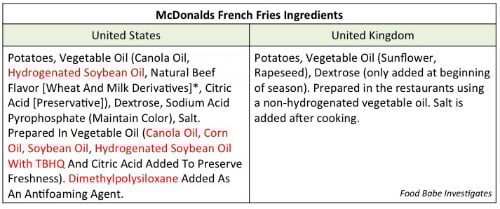
Fast Food giants like McDonald's and Pizza Hut are just as guilty as General Mills' Betty Crocker.
Look closely at the ingredients in McDonald's french fries above. Do you see how the french fries in the U.K. version are basically just potatoes, vegetable oil, a little sugar and salt? How can McDonald's make french fries with such an uncomplicated list of ingredients all over Europe, but not over here?
Why do McDonald's french fries in the U.S. have to have TBHQ, trans fat and "anti-foaming" agents? Correct me if I'm wrong, but the last time I checked - I didn't think Americans liked foam with their fries either!
The anti-foaming agent - dimethylpolysiloxane - is a type of silicone used in caulks and sealants and as a filler for breast implants. It's also the key ingredient in silly putty.
Thanks FDA for allowing companies to put silly putty in our french fries. Seriously - this is out of control.

McDonalds Strawberry Sauce in the United States includes high fructose corn syrup, red #40 and sodium benzoate, while the citizens of the U.K. get off scot-free. Instead, they get 37% real strawberries in their product and no additional flavoring or harmful preservatives.

Pizza Hut does a huge disservice to us (and their workers) by using Azodicarbonamide in their garlic cheese bread. This ingredient is banned as a food additive in the U.K., Europe, and Australia, and if you get caught using it in Singapore you can get up to 15 years in prison and be fined $450,000.
The U.K. has recognized this ingredient as a potential cause of asthma if inhaled, and advises against its use in people who have sensitivity to food dye allergies and other common allergies in food, because azodicarbonamide can exacerbate the symptoms.
However, Pizza Hut and many other fast food chains like Subway and Starbucks use this ingredient in their U.S. bread products.
Natural and artificial flavors and hidden MSG (in the form of autolyzed yeast extract, in this case) are commonly found throughout products in America but not elsewhere. Junk food companies intentionally add this combination of ingredients to create sensory overload by exciting your brain cells to remember the food you are eating and make less nutritious ingredients taste better to you.
I'm not saying that the food industry has completely eliminated these same tricks abroad - but when you look at the U.K. version of garlic cheese bread, the ingredients look pretty basic. Many of the ingredients you could use at home to make garlic bread. I've never found TBHQ in the baking aisle at the grocery store, have you?
TBHQ, by the way, is a preservative derived from petroleum and used in perfumes, resins, varnishes and oil field chemicals. Laboratory studies have linked TBHQ to stomach tumors. This preservative is also used by Chick-Fil-A in their famous chicken sandwiches.

Reviewing the ingredients in Pringles really got me worked up....ever wonder why you can't stop eating chips after having just one? MSG is the culprit - and in the U.S. version of Pringles, it's added twice! Once in its known name and again in a hidden source, called "yeast extract."
This begs the question "Why are Americans so addicted to processed food?!" The food industry has designed it that way on purpose to line their pockets with profits, at the expense of our health.

The U.K. Ritz Crackers ingredient list resembles items that you'd find in every household around the country - but the United States version goes the extra mile to include trans fat, HFCS and natural flavor. Natural flavor can be also be a hidden form of MSG, which, again, is an additive that will likely make you eat more than you would otherwise.

In the United States, Quaker Oats has several different flavors of oatmeal that contain different fruit flavored, artificially dyed pieces of dehydrated apple but that don't actually contain any of the fruit shown on the package. But in the U.K. - they don't even attempt to sell that garbage. They instead have a product called "Oats so Simple" that actually has REAL strawberries in it - light years ahead of our version that includes trans fat, artificial food coloring, and artificial flavors.

There's only one difference in Rice Krispies between the U.S. and U.K. version - but it's a big difference. It's one ingredient that is banned virtually in every other country, except here in the United States. That ingredient is called BHT (butylated hydroxytoluene) or BHA (butylated hydroxyanisole) and is a very common preservative used rampantly throughout packaged food in the U.S.
Test studies published by the IPCS (International Program for Chemical Safety) "show tissue inflammation, enlargement, and/or growths in 100%, and cancer in 35% of [animal] subjects" as reported in this article. How can the U.S. allow this chemical in our food - much less in cereal aimed and targeted at our kids?

And speaking of targeting our kids - food companies have found a way to naturally color candy all over Europe, but our candy here is still full of artificial substances made from petroleum and GMO sugar. Looking at the ingredients in Starburst Fruit Chews provides a great example of this disgrace.
I saved the most startling fact for last. One very cautionary set of ingredients that are included in almost all of the American products but not the U.K. products are GMO's, in the form of either corn or soy.
There have been no long term human studies on GMOs and preliminary studies on animals show horrific consequences. For instance, a study showed GMOs caused toxic and allergic reactions, sick, sterile, and dead livestock, and damage to virtually every organ studied in lab animals.
Another study revealed that female rats fed GMO soy for 15 months showed significant health issues in their uterus and reproductive cycle, compared to rats fed organic soy or those raised without soy. A 2009 French Study concluded that Glyphosate (used on GMO soy) can kill the cells in the outer layer of the human placenta, the organ that connects the mother to her fetus, providing nutrients and oxygen and emptying waste products.
A Russian study conducted on hamsters that were fed GMO soy diets for two years over three generations found that by the third generation, most of the hamsters lost the ability to have babies, showed slower growth, and suffered a higher mortality rate.


In the U.K. food companies are required by law to list if a certain ingredient is derived from a genetically modified or genetically engineered material on the label. Out of all the products I researched, I couldn't find one product with this label. (See example from GMO-Compass and BBC above of what it would look like if I did.)
This was very telling considering that not only have food companies taken out all sorts of hazardous chemical ingredients abroad - but they also have willingly reformulated their products without GMOs.
Food corporations in the U.S. claim reformulating their products to remove harmful ingredients or changing labels would be too expensive - but they've already done just that in Europe and in many other countries. Their governments listened to the outrage of their people and took the safety of their citizens' health above everything else.
Is it too much to ask the same for us in the United States of America? How much do our sickness, obesity, and mortality rates have to worsen before they respond to us?
I will leave you with this note: Lisa and I are very disturbed about the shameful hypocrisy allowed to happen with our food supply here in the U.S. In fact we are feeling very compelled to do something about it. Stay tuned, because we are going to need every one of you to help when we are ready. In the meantime, I hope you'll come check me out at Food Babe and also share this article (you can use the green ShareThis button below).
March 5th Update: Lisa and I have started a petition - please sign and share it now. Together we can make a change.
Comments have been closed on this article, which was written by Vani Hari. If you have a question or comment you can reach her at http://FoodBabe.com.


Aasim says
Thanks Food Babe.
Very in depth and beneficial :D
Louisa says
Oh My god! I had no idea! We come to America all the time (LOVE :) ) my friend is a Californian and her and her husband are always taking the chronic pee out of me for reading all the ingredients of everything for my little boy. Last time we came I actually bought our own breakfast cereal and snacks for him because I couldn't stand the ribbing and eye rolling !
This is enough to keep me awake at night, cooo!
I am incredibly bonkers about my sons diet, chemicals are an absolute nono, I get totally cheesed off when I find out there's hidden sugars in foods that I've eaten, I'd rather have eaten something boring so I can have a blooming chocolate!
I'm really shocked, your government always seemed to be more interested in your welfare and opinion's as a whole, if you think it's worth it I'll sign the petition as a yearly visitor for the last 20 years :)
Wayne keays says
Monsanto, dow, dupont and other chemical companies responsible for gmo killer foods should be charged, fined and executives jailed.
FDA needs to be completely overhauled, given a mandate to protect the public and the power needed to keep food industry in line. FDA approving the sale of MSG products hidden under other names is pathetic. These names and brands using them should go viral.
Macdonalds, and all fast food giants selling food with msg,carcinogens or gmo product should publicly disgraced and their senior management replaced.
These results are shocking and appalling!
Zola says
I don't believe our FDA or our government would allow this BHT to be used in our foods if they BELIEVED it to be harmful or would kill us. I know for a fact that PORK is a killer. People still eat it.
I don't eat any meat any more, wasn't raised to eat pork.Only ,beef,chicken ,fish ,turkey sometime. I like chewing gum the kind that doesn't stick to your teeth.I just foung out that it has this BHT in.I want to know if chewing one stick a day will kill you.
Thank you.
Carolina says
Great post, the truth as always winning. What is happening is very bad and sad. We need educate more on this and promote healthy living lifestyles more aggressively. The time has come not to stay but shout!
Samantha says
Thanks! I've known about GMOs, but these facts are really sad. I know the majority of western Europe either bans or requires labelling of GMOs.
Lynne says
It's amazing how different/healthy the non-US food tastes. According to an article I read on how many Americans have passports http://www.theexpeditioner.com/2010/02/17/how-many-americans-have-a-passport-2/ (46%, so less than half of America is even able to go to another country and NJ, MA, NY, AK and CT are the top 5 states). My point is.. Do the other 50-54% even know to care? I've been to other countries and wondered why things taste different.... Many people simply don't even know there is another way and they don't have a computer or don't get on it every day to google something... They don't go to the library... Not only does the government do what it wants with our food, it hasn't impressed me on creating bright intelligent future leaders.
I saw something in passing about Iceland? Reclaiming their country? until the people are ready to get the power back, thing will probably get worse before they get better.
I'm not usually such a bummer but I it seems every day I get more disappointed in the state of our country. Thank you for being a positive contribution <3
Topher says
If you'd like to know the main reason those countries have banned harmful food additives, it's because THEY TAKE CARE OF THEIR PEOPLE. Not just by making good laws, but literally: through socialized medical systems. When the government is paying for health care, everyone loses if the people are unhealthy. In the US, if the people are unhealthy, the doctors win; big food wins; big pharma wins; and since "the economy" is the major factor in foreign investment, the government wins. As a libertarian, I hate to see more gov't programs, but it seems like only a fully socialized medical system can stop the insanity that is the overall health of the American people.
Jason says
Until Americans are willing to pay the REAL cost of food I'm afraid this will just continue.
I live in the United kingdom, I love our food and it tastes great. Whenever I eat in the states I feel high, jacked up on sugar and colour. I get headaches and feel sluggish or hyper/unhealthy. This simply doesn't happen here. Why?, well one because it is illegal and two, we pay a truer cost for the food. A packet of pop tarts in the UK for example has a very different list of ingredients and costs in excess of 2.50GPB, which is about 4 bucks. In the states they cost half this, about 1.99USD.
Why do you think they cost more here? They are not shipped here, they are made in the UK... The reason is because we use a higher percentage of natural ingredients. Nice things cost more. Crap comes cheap folks. You can apply this across most of the junk food sold in both countries, generally it is sold in larger packets and cheaper in the US. Quality not quantity is the US motto. Here we are much more into quality and perceive large portions and servings as wasteful. Guess where pizza and burgers are cheaper? Yes, the good old USA. You can have it all cheap but you are paying with your health.
thixotropic says
Thanks for this, I'd been looking for an article that compared Europe's vastly superior products made by the same companies that make the toxic garbage we get.
All they have to say was "Your food will cost more!" and people will vote against GMO labeling. They did the same thing with federally-mandated public power in San Francisco. PG&E convinced voters that a non-profit municipal service would charge them more than PG&E would, despite them being a notoriously greedy profiteer who does not do maintenance, leading to gas line explosions like the one in San Bruno that killed 9 people, and numerous fires every summer because they don't trim the trees and bushes away from powerlines that sag due to the heat and resulting high demand for power.
So how do we educate a mass of people too ignorant and panic-stricken to realise that it doesn't have to cost them more at all, and that this is just a manipulative threat?
Suzy says
People think home baked means a box mix.
That is not home baked.
Eating fresh fruit and veggies and making your own meals
isn't difficult or time consuming.
I can make a home cooked meal in the time it takes
anyone to order a pizza or get anything from the drive thru.
Look at store ads for instance.
The only things that are on sale are canned soups, frozen pizza, and soda. Yuck!
Make your own soup with fresh veggies. Make your own pizza with
whole wheat flour, and never drink soda. Most health ailments can be relieved by just eating good food!!
Kate M says
I've been studying this topic recently in my Human Nutrition course. A large part of the problem is that here in Australia and other non-US countries, the law is that a food additive has to be proven safe before it can be used. In the United States, pretty much anything can be used in food that is NOT PROVEN UNSAFE. According to my textbooks (which were published by an American university), the legislation that controls food additives in the US has not changed since it was originally written in the 1960s, a decade when it was standard practise to give Valium to pregnant women, when doctors advertised cigarettes on TV, and when the government sprayed DDT on children to show how "safe" it was.
/soapbox
Lady Serhya says
Thanks for this info. Which textbook did you reference?
Brigette says
I am regular visitor, how are you everybody? This paragraph
posted at this site is really pleasant.
Rebecca says
Just stick to the outer isles of the grocery store where the fresh food is, and stay away from the center isles where all the boxed and well preserved chemical laden fake foods are stored. Now its even important to check the labels in the baking isle!
Chris says
Why is modified corn starch highlighted in red on the first ingredient list on the USA side, but not on the European side?
Deborah Harvey says
Discovering how bad processed foods are has been a 6 year long journey for me. I have cut them completely from my diet, and I have lost 80 pounds. I have undergone 2 foot surgeries for severe arthritis in that time, giving me lots of time to think about this issue. The problem is not just the food industry, it is systemic. Think about everyone in the "food chain", if you will, that profits from our addiction to processed food. And it is an addiction.First on the list,health care-HMO’s, clinicians, etc. Podiatrists, orthopedists.—because obesity causes a huge variety of health problems, and eating processed food instead of fruits and vegetables is linked to cancer.
Gyms and health clubs. Did your grandparents belong to a gym? How many of our generation join gyms in order to lose weight? Why do we need to lose weight? Processed foods.
Shoe and shoe ortho manufacturers, because our feet hurt from excess weight.
Huge industry of weight loss products—Jennie Craig, Weight Watchers, etc.
Supplement industry-this is gigantic
Magazines and books about weight loss
Makers of all the chemicals and additives that are put into the fake food.
And where does all that palm oil come from? Where? And cottonseed oil?
Grocery stores, of course, and all of the fast food restaurants, etc.
Antacids and other over the counter remedies.
Durable health equipment such as C-pap machines, walkers, wheelchairs, and the carts people must ride in the grocery store because they are too heavy to walk!
We are also losing many workers to disability because of obesity related illnesses.
When looking for solutions to any societal issue,it behooves us to follow the money, and this money is big, and pads a lot of pocketbooks. The solution is for each of us to educate ourselves, stop making excuses, and start making better choices. Thank-you, Lisa,for trying to open some eyes. I will definitely be sharing your blog.
click here says
Wow, this post is good, my sister is analyzing these things,
therefore I am going to tell her.
WP Pattern Interrupt Overview says
Hello There. I found your blog the use of msn. This is a very neatly written article. I will make sure to bookmark it and come back to read extra of your useful info. Thank you for the post. I'll certainly comeback.
Science Rules says
You folks are funny. Cellulose gum is "bad" but carboxymethylcellulose (which is the chemical name for one type of cellulose gum) is fine. Hydrogenated fats which are virtually free of trans fats are as bad as partially hydrogenated fats which are high in trans fats. Yeast extract is a "natural flavoring" in Europe but somehow unnatural in the US (if it's even in the natural flavoring in question)and I assume if you're freaked out by the "hidden MSG" in yeast extract (which is glutamic acid) you don't eat soy sauce since that also contains glutamic acid as does yummy aged cheese.
Ignorance isn't really bliss.
Lisa says
I have to ask if the labelling requirements are as strict in these other countries? Are some of the ingredients listed on American labels because of laws requiring that all ingredients of certain types be listed, perhaps missing from the other labels because those countries are not requiring that they be listed, not because they aren't in those products? Also, I agree with some other posters who have pointed out again and again that we, the consumers, are largely to blame for this, as we insist on "cooking" the lazy way, convincing ourselves we "simply don't have time" for cooking from scratch, so that we know vitually all the ingredients because we put them there ourselves. I've lived to the age of 48 without exposing myself to most of this very often at all, because I cook my own food. Cooking classes are available, how-to books are available for free through your local libraries. While not everyone has the knack for good cooking, most people can at least cook well enough to feed themselves, without resorting to filling themselves on chemical additives and who-knows-what-THAT-is. Instead of calling for more governmental involvement in the prouction of food in America, or pitting government against the big businesses that fill the politicians' pockets, the people themselves need to work on imporoving their own health by cooking more for themselves with ingredients they pick out and add themselves. People need to demand that the food industries add less crap and become more transparent. People need to move toward purchasing far less prepackged food, fast food and partially-prepared foods, and far more whole foods to prepare themselves at home. I've seldom cooked a meal that took longer than an hour to prepare, an hour to wait while it cooked, and a half hour to serve and eat. People devote at least two and a half hours a day to smoking, browsing the internet, chatting, generally goofing off, spying on the neighbors, and various other expendable activities which they could curtail or eliminate altogether in the interests of long-term better health. Also, most meals have a down-time period of baking or steaming or simmering, when people can accomplish any number of other short tasks and activities without ruining the meal. There's no reason why the alternatives should be only between raw, whole foods or fast, precooked, packaged meals and fast food. There's a whole healthy list of choices in between, if people were inclined to explore and work at it.
Bob says
There is a very easy way to avoid all these additives. Stop supporting Big Food. Buy locally grown produce whenever possible and buy items that aren't processed. Newsflash: you can make a cake without buying a box mix. You can buy a pizza from a local pizza shop that isn't made with factory processed doughs and sauces. You can make your own french fries, or even better--Don't.
Adam says
It must be 'COINCIDENCE' that nearly every unnecessary, cheap, profit fattening, toxic additive in the US versions of food is derived from a subsidized crop..."follow the money" and you find the criminals. For all the folks out there who doubt the whole food movement, it's really that simple.