
Want to Save this Recipe? Enter your email below & we'll send it straight to your inbox. Plus you'll get great new recipes from us every week!
Now I will say, as motivated as I felt after reading the book, there's one huge component we’re lacking here in America. Apparently, in France, their schools, governments, and communities all work “together to create food and education systems that support parents in feeding their children well.” I don’t know about you, but I oftentimes feel like others are working against me (not with me) when it comes to feeding our next generation well. My daughters eat more junk food at school than I would ever dream of giving them at home. I can’t imagine how much easier things would be if everyone in our society was on the same page like they appear to be in France.
But rather than waiting around for that to happen we must just take matters into our own hands. And what I have learned from my own children is that converting a picky eater requires a gentle, yet persistent approach and LOTS of patience! Winning over a picky eater is not something that will happen overnight, but if you really make it a priority in weeks, months, or even a year I guarantee you will start to see some of the dramatic changes you are hoping for. And in the end it will of course be worth the effort.
-
10 great takeaways (the “French Food Rules”) from the book French Kids Eat Everything:
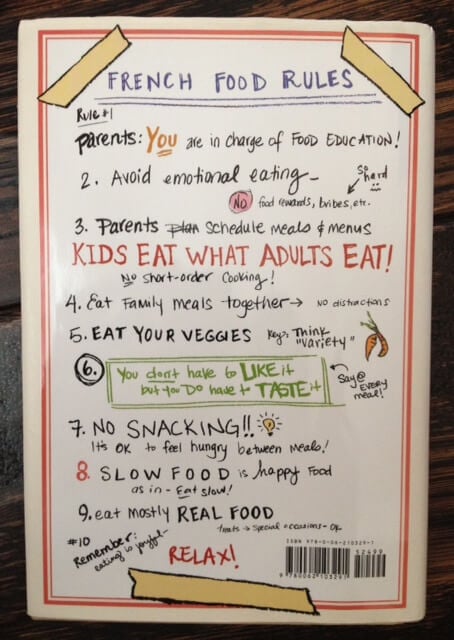
- Parents: You are in charge of your children’s food education.
-
Apparently the French think us Americans cram our schedules so full with activities (like sports, art, music, dance, etc.) that it leaves little time to teach our children "some of the most basic, important things they need to know, like the proper way to prepare, cook, and eat healthy food." You have to admit it's hard to argue with that criticism. And I just love the analogy the author uses when she says, "French parents think about healthy eating habits the way we think about toilet training, or reading." If your child had trouble learning to read or using the potty would you just give up? Same should go for eating a variety of healthy foods...I know, they are right and it stings.
- - Avoid emotional eating. Food is not a pacifier, a distraction, a toy, a bribe, a reward, or a substitute for discipline.
-
I feel like we are so far down this rabbit hole it might be hard to get out, but let’s face it they have a good point here! Food is for nourishment, hunger, and nutrition...not for being a good listener.
- - Parents schedule meals and menus. Kids eat what adults eat: no substitutes and no short-order cooking.
-
If this were a reality for everyone it would certainly make life a lot easier!
- - Food is social. Eat family meals together at the table, with no distractions.
-
How you eat can be as important as what you eat.
- - Eat vegetables of all colors of the rainbow. Don’t eat the same main dish more than once per week.
-
I agree that variety is extremely important, but I am personally a little stumped when it comes to the second half of this rule. We love leftovers at our house and feel they are such a time saver...but that certainly means eating the same main dish more than once, or in some cases, more than twice per week!
- - For picky eaters: You don’t have to like it, but you do have to taste it.
For fussy eaters: You don’t have to like it, but you do have to eat it.
-
When considering these statements it's also VERY important to remember that "you're not going to convince the kids to love food by being too strict with them. It has to be enjoyable. Not necessarily loads of fun, but simply pleasurable." This takes us back to that "gentle persistence" I mentioned above.
- - Limit snacks, ideally one per day (two maximum), and not within one hour of meals.
-
Now, I know out of all the rules on this list that "no more constant snacking" will likely cause the most uproar. But according to the author it's okay to feel hungry in-between meals and guess what...your kids might eat a better dinner if they are actually hungry!
- - Take your time, for both cooking and eating. Slow food is happy food.
-
"North Americans associate food most with health and least with pleasure. The French are at the opposite extreme: they are the most pleasure-oriented and the least health-oriented about food." And ironically enough "20 percent of kids in the United States are obese, but only 3 percent in France." Now if that doesn't send a message, I don't know what does.
- - Eat mostly real, homemade food, and save treats for special occasions. (Hint: Anything processed is not “real” food.)
-
See...I am not the only one preaching this statement! :) But "so much of what French people eat is, by default, 'real food'" so I'd have to say they don't exactly face the same challenges we do when it comes to encountering junk food on almost every corner. The French do have an admirable approach though when it comes to the processed, junk food their kids may want to eat on occasion. They do not police their children's food intake (or ban all junk food), but instead attempt to "train their children to eat a balanced diet and to realize how much healthier they feel if they eat mostly 'real food.'" I've always said that if my daughters only avoid processed food "because mommy said so" then it's not going to get us very far.
- - (The Golden Rule) Eating is joyful, not stressful. Treat the food rules as habits or routines rather than strict regulations; it’s fine to relax them once in a while.
-
I couldn't agree more with the importance of this rule, but striking the perfect balance between "good nutrition" and "relaxing the rules" is no easy task. And maybe that's because most American children are faced with processed, junk food on a regular basis (at birthday parties, friend's houses, church events, soccer practice, school celebrations, etc.). As I mentioned above, our society is (unfortunately) not exactly working together on these issues like they are in France. Regardless though, I agree it is not "healthy" to constantly be stressed out about the food you eat.
In addition to this list of rules there were so many other startling facts and insightful statements that I took away from this book. I wish I could share them all here, but since that's not a very practical idea I will instead just highly recommend that everyone go out and read the book yourselves! I promise you won't regret it...not to mention there are a handful of kid-friendly recipes in the back.
*THIS CONTEST IS CLOSED*
The winners are:
- Ann - "I abide by the kids eat what adults eat rule and don’t offer other options. We also stick to real foods, minimal sugar. So I think that helps kids eat real food without complaint."
- Emily - "My husband can be a picky eater, so my trick is preparing the same food a number of times. He may not like everything, but perseverance pays off!"
- Nicky - "Rule #6 is the big one in our house….even if you’ve tasted it 50 times, taste it again!"

Sarah says
Liked on FB!
Angie Zumach says
Like
Margaret says
My daughter was a preemie and what started as an inability to eat certain foods and textures, developed into picky eating as a toddler. One of our feeding therapists made the suggestion to offer very small pieces (sometimes almost minuscule) of any new food. Large pieces will just overwhelm and intimidate the child. Another tactic was if the child would not willingly eat the food, see if they would give it a kiss. Whether they touch it, play with it, lick it or kiss it, these are all considered steps forward and after a lot of patience and repetition, you just might find your child chewing and swallowing a food they've been kissing for weeks (or months). My battle with my picky eater is not one I plan on losing but I have left the room with tears in my eyes out of shear frustration MANY times (I was told never to let your child see your frustration, disappointment and sometimes even anger - making feeding time a negative experience will only make a difficult situation worse)!
Sarah says
I have the "2 bite rule", too. Also, I find that if I set a veggie tray out before dinner, when they are starving, the kids really eat a lot! I mean, who cares if they fill up on fresh veggies?
Mandy says
Like
Mandy says
I wish I had a good picky eater tip to leave. We are trying to get our four year old to eat more variety.
Erin Crowe says
Like
Erin Crowe says
For my picky eater who doesn't like vegetables I try adding cream cheese to them or yogurt. And then praise her for putting even one bite in her mouth. Would love some more ideas of how to handle this situation.
Greta says
Like
Greta says
Cinnamon is our saving grace!
Michelle says
We encourage our kids to take "try it" bites.
Rebecka says
Like
Christine W. says
My son went through a terrible picky phase where he wouldn't eat any sort of meat at all. Once he got into dinosaurs, however, we were able to encourage him to eat like a T rex, and it worked! It was amazing. My tip is to find an animal that they love and feed them foods that animal eats! It creates as good learning environment and encourages trying new foods in a fun way.
Rebecka says
I hide veggies and other good stuff in favorites like Mac n cheese when he indulge. Often I give a helping of veg that he may not eat but require him to take a bite. I love what I read so far in the post as well as the other comments. Thank you!
Elizabeth says
My son is autistic and we've been struggling with eating since he switched to solids. For years, he ate the standard "autism diet" of bland carbohydrates. I would bribe, beg, plead, and worry just to get him to try some real food. I thought it was hopeless. I can't tell you how many times the "one bite rule" led to gagging and anxiety at mealtimes. I finally came across a tip from a therapist. She suggested a smell and touch test. Now, my son gets the same meal that the rest of the family gets (no more short order cooking!) and he to the test on each new item of food. First he smells it, then he touches it to his tongue. Sometimes I will ask him to take a bite, but only on things I am sure will not incite the gag reflex. Since I know that he can handle raw vegetables fairly well, I always include a dry salad. I've only been using this method for a couple of months, but we've already noticed a difference in his eating habits and most importantly, there is no more anxiety at mealtimes!
Libby says
Like!
Libby says
My husband and I are just starting to get used to eating healthier. He seems to be the picky one, but sometimes it's hard to get myself to eat the veggies I need when I want something chocolaty or carb-loaded. I've been trying to incorporate veggies in the meals that I make by adding them to the dishes I already know that I love. A little spinach in my scrambled eggs tastes great. If I make a sweet treat, I try to add zucchini or carrots to make it a little healthier. I'm hoping that if I can transition to a healthier lifestyle now, it will be easier to continue eating well when we have kids.
Chrisha McGann says
Like
Chrisha McGann says
We have a rule that you take a bite of everything on your plate at every meal. You don't have to love it or even like it, but you have to try it every time. There's been several times where a "no" has turned into a "yeah"!
Valorie says
like
Valorie says
For my picky eater, food presentation has a lot to do with whether or not she will eat something. We have all seen the Pinterest pin of the Banana/kiwi "palm tree". I don't quite go to that extent but make it fun. Also, watch portion sizes. We are guilty of it as adults and are unknowingly teaching it to our kids. Smaller portions means they are still hungry when they get to the "new" food.
Tiffany says
I agree w/ Lisa in that allowing the child to help
In the food prep helps them to be more interested.
I even found that true for my husband :)
Carrie says
To get children to eat more fruit, put it in popsicles. Pretend they are doing a science experiment and let them choose a color and you choose the fruits accordingly. You might even need to resort to lab coats, etc but it works.
Sherrie s says
Like
Sherrie s says
I started slipping in vegetables in fruit smoothies. They know it looks different but still tastes great.
Mary says
Like
Kelly says
If my girls want a snack within 1 1/2 hours of meal time they may only have vegetables. If they are really hungry they eat a serving or two of veggies before dinner even starts.
Heather says
Don't expect your kids to eat something that you don't want to eat. Kids need to see you enjoying your food, so they will want to eat the same things you are eating.
Meghan says
Like!! We follow you on facebook!
Meghan says
Picky eating tip: weaning. My son used to hate eggs. We had bought and raised four chickens so we would have "organic" fresh eggs when he turned one, so we really wanted him to learn to like them. So we took something he loved (happened to be spinach) and added a little egg to it before cooking. The next time we added a little more egg. Then took away a little spinach until he was eating eggs! It works with many things. Like starting out with a little banana in something to sweeten it and slowly decreaing the sweetness, etc. Or just adding more of the good stuff.
Heather says
'like'
Cheri Crow says
My best picky eater tip is actually the same as from the book. My mother-in-law used it with my husband almost 40 years ago and taught me to be patient with my oldest. Keep trying and they will come around!
Rikki K says
Like
Rikki K says
The most helpful thing i did foyer my picky eater was stop requiring he east food he didn't like. Amazingly the minute i took that away he started eating the foods he used took not want to. I do require he taste it that's all.
donna zittel says
we follow you on FB
donna zittel says
I have a very picky eater....We have learned that a fun game can be played to eat ...whoever eats the most gets to spend time with mom and dad alone. It works!
Tara says
We have a "must try" rule but have not had much success. I still hide things in muffins and pancakes (flax seed, avocado, etc). Definitely want to read this book!
Kristen says
Like!
LIsa says
I can't get this to accept "LIKE".
LIKE
Kristen says
I think letting your picky eaters help shop for and prepare the meals gives them more of a feeling of ownership with the meal and they are more likely to try the foods involved.