
Want to Save this Recipe? Enter your email below & we'll send it straight to your inbox. Plus you'll get great new recipes from us every week!
Now I will say, as motivated as I felt after reading the book, there's one huge component we’re lacking here in America. Apparently, in France, their schools, governments, and communities all work “together to create food and education systems that support parents in feeding their children well.” I don’t know about you, but I oftentimes feel like others are working against me (not with me) when it comes to feeding our next generation well. My daughters eat more junk food at school than I would ever dream of giving them at home. I can’t imagine how much easier things would be if everyone in our society was on the same page like they appear to be in France.
But rather than waiting around for that to happen we must just take matters into our own hands. And what I have learned from my own children is that converting a picky eater requires a gentle, yet persistent approach and LOTS of patience! Winning over a picky eater is not something that will happen overnight, but if you really make it a priority in weeks, months, or even a year I guarantee you will start to see some of the dramatic changes you are hoping for. And in the end it will of course be worth the effort.
-
10 great takeaways (the “French Food Rules”) from the book French Kids Eat Everything:
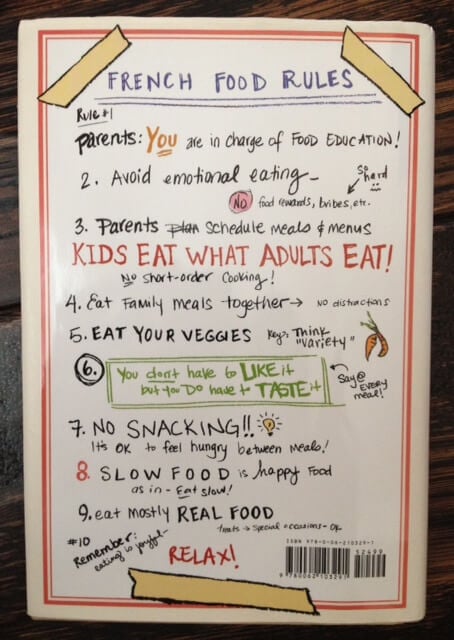
- Parents: You are in charge of your children’s food education.
-
Apparently the French think us Americans cram our schedules so full with activities (like sports, art, music, dance, etc.) that it leaves little time to teach our children "some of the most basic, important things they need to know, like the proper way to prepare, cook, and eat healthy food." You have to admit it's hard to argue with that criticism. And I just love the analogy the author uses when she says, "French parents think about healthy eating habits the way we think about toilet training, or reading." If your child had trouble learning to read or using the potty would you just give up? Same should go for eating a variety of healthy foods...I know, they are right and it stings.
- - Avoid emotional eating. Food is not a pacifier, a distraction, a toy, a bribe, a reward, or a substitute for discipline.
-
I feel like we are so far down this rabbit hole it might be hard to get out, but let’s face it they have a good point here! Food is for nourishment, hunger, and nutrition...not for being a good listener.
- - Parents schedule meals and menus. Kids eat what adults eat: no substitutes and no short-order cooking.
-
If this were a reality for everyone it would certainly make life a lot easier!
- - Food is social. Eat family meals together at the table, with no distractions.
-
How you eat can be as important as what you eat.
- - Eat vegetables of all colors of the rainbow. Don’t eat the same main dish more than once per week.
-
I agree that variety is extremely important, but I am personally a little stumped when it comes to the second half of this rule. We love leftovers at our house and feel they are such a time saver...but that certainly means eating the same main dish more than once, or in some cases, more than twice per week!
- - For picky eaters: You don’t have to like it, but you do have to taste it.
For fussy eaters: You don’t have to like it, but you do have to eat it.
-
When considering these statements it's also VERY important to remember that "you're not going to convince the kids to love food by being too strict with them. It has to be enjoyable. Not necessarily loads of fun, but simply pleasurable." This takes us back to that "gentle persistence" I mentioned above.
- - Limit snacks, ideally one per day (two maximum), and not within one hour of meals.
-
Now, I know out of all the rules on this list that "no more constant snacking" will likely cause the most uproar. But according to the author it's okay to feel hungry in-between meals and guess what...your kids might eat a better dinner if they are actually hungry!
- - Take your time, for both cooking and eating. Slow food is happy food.
-
"North Americans associate food most with health and least with pleasure. The French are at the opposite extreme: they are the most pleasure-oriented and the least health-oriented about food." And ironically enough "20 percent of kids in the United States are obese, but only 3 percent in France." Now if that doesn't send a message, I don't know what does.
- - Eat mostly real, homemade food, and save treats for special occasions. (Hint: Anything processed is not “real” food.)
-
See...I am not the only one preaching this statement! :) But "so much of what French people eat is, by default, 'real food'" so I'd have to say they don't exactly face the same challenges we do when it comes to encountering junk food on almost every corner. The French do have an admirable approach though when it comes to the processed, junk food their kids may want to eat on occasion. They do not police their children's food intake (or ban all junk food), but instead attempt to "train their children to eat a balanced diet and to realize how much healthier they feel if they eat mostly 'real food.'" I've always said that if my daughters only avoid processed food "because mommy said so" then it's not going to get us very far.
- - (The Golden Rule) Eating is joyful, not stressful. Treat the food rules as habits or routines rather than strict regulations; it’s fine to relax them once in a while.
-
I couldn't agree more with the importance of this rule, but striking the perfect balance between "good nutrition" and "relaxing the rules" is no easy task. And maybe that's because most American children are faced with processed, junk food on a regular basis (at birthday parties, friend's houses, church events, soccer practice, school celebrations, etc.). As I mentioned above, our society is (unfortunately) not exactly working together on these issues like they are in France. Regardless though, I agree it is not "healthy" to constantly be stressed out about the food you eat.
In addition to this list of rules there were so many other startling facts and insightful statements that I took away from this book. I wish I could share them all here, but since that's not a very practical idea I will instead just highly recommend that everyone go out and read the book yourselves! I promise you won't regret it...not to mention there are a handful of kid-friendly recipes in the back.
*THIS CONTEST IS CLOSED*
The winners are:
- Ann - "I abide by the kids eat what adults eat rule and don’t offer other options. We also stick to real foods, minimal sugar. So I think that helps kids eat real food without complaint."
- Emily - "My husband can be a picky eater, so my trick is preparing the same food a number of times. He may not like everything, but perseverance pays off!"
- Nicky - "Rule #6 is the big one in our house….even if you’ve tasted it 50 times, taste it again!"

Heidi says
Tip: Make regular foods more fun. Use cookie cutters to make crazy shapes for sandwiches and toast =)
Lindsey B says
Like
Lindsey B says
My tip is just to keep introducing those foods that are not well loved. My 4 boys refused zucchini and now after introducing several times in different ways my 9 year old finally ate it and liked it !!
Tracy says
Try assuming kids will eat it. Always put a bite on the plate. Someyimes the less said the better.
Sarah W says
I always ask my husband to take his first bite before he asks what it is. He's not a picky eater, but I think if he recalls a not enjoying that particular food during childhood, then his adult taste buds will tell his brain not to like it. Sounds silly, but it's worked for everything so far.
Nicole Eisenberg says
Like
Nicole Eisenberg says
I've been hearing a lot about this book! So excited about this giveaway! My 7 y/o is a little picky and my 3 y/o doesn't eat meat (he has never liked it) I just continue to put a little of everything on each of their plate. My 7 y/o is required to try a bite.. my 3 y/o is given the option because I think his pickiness is due to texture!
Jana Beebe says
If its something new were trying they have to try a no thank you portion the first few times before they can say yes or no to liking it. It's small enough for them to get a taste and they learn how to try things new and give it a chance.
Jana Beebe says
Like
Sandra says
like
Sandra says
I have them help cook and help pick the ingredients (both at the store and when making the end product). It gives them a "choice" and ownership.
Sarah says
Like! I'm a facebook follower as well :)
Oh and I love Karla's idea above and do that one too - partner something new/disliked with something you know they do like.
Sarah says
The amount of a new (or disliked) food you have to eat is determined by your age. Example: green beans are not a favourite in my house but my daughter, age 6, eats 6 bites. My son recently turned 4 and on the morning of his birthday he woke up thrilled because (in his words) "now I get to eat 4 bites of stuff I don't like!"
And to add, many things have turned into things that don't need to be counted. We don't count every night. When your consistent & persistent it just becomes normal and the battles get less & less!
Amber says
The exact name we have stolen from the preschool class at snacktime...everyone must try a "no thank you" bite of any food on their plate. If you still don't like it, you don't have to eat any more this time. I think most children can deal with the idea of one small bite to overcome. However, with repetition, my "pickiest" eater has changed her mind from month to month about many foods such as bananas, strawberries, lasagna, hard-boiled eggs, etc.
Karla says
Like!
Karla says
Everything on the plate must be sampled as a way to show respect & say "thank you" to the cook. I also try to make the majority of the meal with foods I know they like plus one new/"yucky" food they have to try.
Dorina says
LIKE
Dorina says
I always encourage mamas of picky eaters to bring their kids to the local farmer's market and let them fill up a basket with colorful finds they want to try. Get them involved in the cooking too! We make it a family habit on Saturdays!
Julia Smiley says
LIKE!!
Julia Smiley says
The 3 bite rule. But, just learned about the Thank You bite. I am going to try that ALSO!!
Amy says
LIKE! :)
Angela Faust says
like
Stacy says
My husband and I enjoy eating and when our nephew sees us eating AND sincerely enjoying every bite, he always ends up asking to try what we are having
Angela Faust says
My kids (ages 5 and 2) help me in the garden and kitchen, so no food is foreign to them. They know what things are and are usually willing to give them a try. This also helps because they can truly tell me what the problem is if they don't like something: "I don't like onions" instead of "I don't want this".
Chelsie says
I found it easier to get my picky nieces to eat something new or something that they have told me that they didn't like by showing them that I enjoy it and why I enjoy it
Chelsie says
Like!
Jada says
LIKE
Jada says
I find getting the kids involved from growing our food, selecting it at the store or market and helping with the prep really helps. They feel a sense of ownership and will at least try the meal.
kelly says
liked you on facebook
kelly says
One way that helped us was to help our older neighbor with his garden. They were introduced to how things grow and very willing to try what they saw growing in the garden.
Also, helping in the kitchen with meal prep helps them appreciate their meal too. It does take longer, but they are learning to do things in the kitchen and help as well. Thanks for the opportunity to win! Sounds like a great read.
cooperkelly4@yahoo dot com
brandy says
like! (=
brandy says
i like to offer one new food with one favourite food. that way, she can try something new, while still enjoying something familiar. sometimes it works, sometimes it doesn't... but last week we finally decided to like sweet potatoes! HUGE SUCCESS!!! lol
Jen Malinowski says
Like
Jen Malinowski says
When I cook, I let my almost 7 year old daughter (my fussy eater) help me. We smell all the ingredients together and talk about them. I let her help serve the food as well. I find by doing this she takes ownership of the meal and then is more likely to try it.
Sallee says
Older sister (6) tries it and at least pretends to like it so little brother (3), who has to copy her, gives it a chance!
We're consistent that they have to eat a small portion of something new to give it a chance. And the word "disgusting" has been banned from the dinner table!
Trish says
We explain the nutritional value of all the foods we prepare. I think the kids will appreciate the food more if they understand how it is helping their bodies.
Sondra says
Like
Danielle says
Like
Sondra says
I babysit my three nephews during the week and they are very picky eaters, especially when it comes to vegetables. I do two things to get them to eat what I prepare. First, we talk about the importance of eating healthy food and what it does to our bodies, the six and four year old understands that their bodies need the vegetables and will eat them, but the younger one struggles a little. So, the second thing I do, is make sure to give their vegetables first and after they finish them, they can have the rest of their meal.
Danielle says
Don't give in to "gaggers." I learned that this is simply a bad habit that children develop as a control method. Consistency in requiring tasting of food - regardless of gagging - will result in a curing of this condition. :)