
Want to Save this Recipe? Enter your email below & we'll send it straight to your inbox. Plus you'll get great new recipes from us every week!
Now I will say, as motivated as I felt after reading the book, there's one huge component we’re lacking here in America. Apparently, in France, their schools, governments, and communities all work “together to create food and education systems that support parents in feeding their children well.” I don’t know about you, but I oftentimes feel like others are working against me (not with me) when it comes to feeding our next generation well. My daughters eat more junk food at school than I would ever dream of giving them at home. I can’t imagine how much easier things would be if everyone in our society was on the same page like they appear to be in France.
But rather than waiting around for that to happen we must just take matters into our own hands. And what I have learned from my own children is that converting a picky eater requires a gentle, yet persistent approach and LOTS of patience! Winning over a picky eater is not something that will happen overnight, but if you really make it a priority in weeks, months, or even a year I guarantee you will start to see some of the dramatic changes you are hoping for. And in the end it will of course be worth the effort.
-
10 great takeaways (the “French Food Rules”) from the book French Kids Eat Everything:
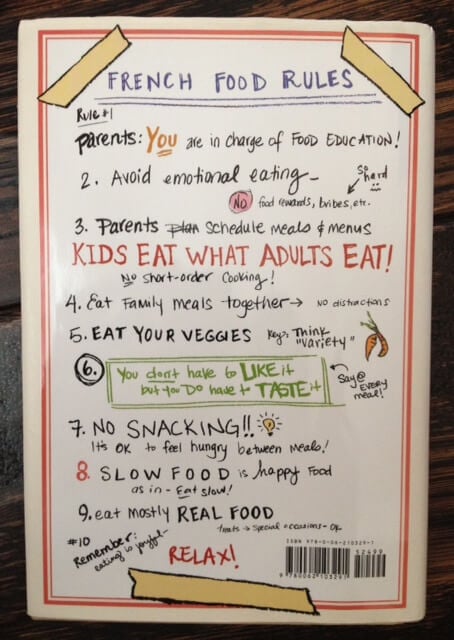
- Parents: You are in charge of your children’s food education.
-
Apparently the French think us Americans cram our schedules so full with activities (like sports, art, music, dance, etc.) that it leaves little time to teach our children "some of the most basic, important things they need to know, like the proper way to prepare, cook, and eat healthy food." You have to admit it's hard to argue with that criticism. And I just love the analogy the author uses when she says, "French parents think about healthy eating habits the way we think about toilet training, or reading." If your child had trouble learning to read or using the potty would you just give up? Same should go for eating a variety of healthy foods...I know, they are right and it stings.
- - Avoid emotional eating. Food is not a pacifier, a distraction, a toy, a bribe, a reward, or a substitute for discipline.
-
I feel like we are so far down this rabbit hole it might be hard to get out, but let’s face it they have a good point here! Food is for nourishment, hunger, and nutrition...not for being a good listener.
- - Parents schedule meals and menus. Kids eat what adults eat: no substitutes and no short-order cooking.
-
If this were a reality for everyone it would certainly make life a lot easier!
- - Food is social. Eat family meals together at the table, with no distractions.
-
How you eat can be as important as what you eat.
- - Eat vegetables of all colors of the rainbow. Don’t eat the same main dish more than once per week.
-
I agree that variety is extremely important, but I am personally a little stumped when it comes to the second half of this rule. We love leftovers at our house and feel they are such a time saver...but that certainly means eating the same main dish more than once, or in some cases, more than twice per week!
- - For picky eaters: You don’t have to like it, but you do have to taste it.
For fussy eaters: You don’t have to like it, but you do have to eat it.
-
When considering these statements it's also VERY important to remember that "you're not going to convince the kids to love food by being too strict with them. It has to be enjoyable. Not necessarily loads of fun, but simply pleasurable." This takes us back to that "gentle persistence" I mentioned above.
- - Limit snacks, ideally one per day (two maximum), and not within one hour of meals.
-
Now, I know out of all the rules on this list that "no more constant snacking" will likely cause the most uproar. But according to the author it's okay to feel hungry in-between meals and guess what...your kids might eat a better dinner if they are actually hungry!
- - Take your time, for both cooking and eating. Slow food is happy food.
-
"North Americans associate food most with health and least with pleasure. The French are at the opposite extreme: they are the most pleasure-oriented and the least health-oriented about food." And ironically enough "20 percent of kids in the United States are obese, but only 3 percent in France." Now if that doesn't send a message, I don't know what does.
- - Eat mostly real, homemade food, and save treats for special occasions. (Hint: Anything processed is not “real” food.)
-
See...I am not the only one preaching this statement! :) But "so much of what French people eat is, by default, 'real food'" so I'd have to say they don't exactly face the same challenges we do when it comes to encountering junk food on almost every corner. The French do have an admirable approach though when it comes to the processed, junk food their kids may want to eat on occasion. They do not police their children's food intake (or ban all junk food), but instead attempt to "train their children to eat a balanced diet and to realize how much healthier they feel if they eat mostly 'real food.'" I've always said that if my daughters only avoid processed food "because mommy said so" then it's not going to get us very far.
- - (The Golden Rule) Eating is joyful, not stressful. Treat the food rules as habits or routines rather than strict regulations; it’s fine to relax them once in a while.
-
I couldn't agree more with the importance of this rule, but striking the perfect balance between "good nutrition" and "relaxing the rules" is no easy task. And maybe that's because most American children are faced with processed, junk food on a regular basis (at birthday parties, friend's houses, church events, soccer practice, school celebrations, etc.). As I mentioned above, our society is (unfortunately) not exactly working together on these issues like they are in France. Regardless though, I agree it is not "healthy" to constantly be stressed out about the food you eat.
In addition to this list of rules there were so many other startling facts and insightful statements that I took away from this book. I wish I could share them all here, but since that's not a very practical idea I will instead just highly recommend that everyone go out and read the book yourselves! I promise you won't regret it...not to mention there are a handful of kid-friendly recipes in the back.
*THIS CONTEST IS CLOSED*
The winners are:
- Ann - "I abide by the kids eat what adults eat rule and don’t offer other options. We also stick to real foods, minimal sugar. So I think that helps kids eat real food without complaint."
- Emily - "My husband can be a picky eater, so my trick is preparing the same food a number of times. He may not like everything, but perseverance pays off!"
- Nicky - "Rule #6 is the big one in our house….even if you’ve tasted it 50 times, taste it again!"

Tracy Smith says
Our tip is to ignore the food on the plate. We don't discuss it, we don't argue it, we just put it on the plate. After a while of my 10yo daughter professing her extreme distaste of salmon and asparagus, she began eating it so that we kind of didn't notice when she did. We didn't make a fuss, then, either. Our policy has been that if you don't want it, don't eat it, but there's nothing else. On occasion we do offer a desert, only if dinner is eaten, and usually it coincides with a particulary kid-unappealing meal!
Callie says
Like
Lindsay Shores says
We expose our kids to many different types of ethnic foods. While that doesn't mean they don't have their picky moments, they actually consider foods like atakilt (cabbage and carrots), lentils, and salad among their favorite foods!
Jenn says
Like
Callie says
Sometimes for us just getting certain foods on the plate is an ordeal. So they have to have everything we are eating on their plate. "And if you don't want to eat it?" I ask. "Just leave it on the plate," they respond. Getting over this hurdle, I have learned, is key. After it has been sitting on their plates for a while it is a lot less intimidating and they are a l of more likely to try it.
Jenn says
We try to eat dinner together every night and we eat the same foods- no substitutes. Everyone has to try 3 bites and then are allowed to say no thank you. My daughter is learning that she likes things once she has taken the first bite!
Angela says
Like!
Angela says
I started early by introducing sauces/gravies which can be full of a variety of good foods, which have gradually gotten bigger over the years (used to mince everything and now I leave larger pieces of bell peppers, onions, broccoli, etc.).
melinda a. says
Like
Krystina says
Like!
melinda a. says
I get my kids to help pick out healthy food and to help prepare. If it doesn't work the first time, don't give up. Sometimes it takes a fews times.
Krystina says
Smoothies all the way!! Lots of green smoothies full of great things and made solely by my 4 year old daughter! Yup she is in charge of smoothie making in our home! It gives her feeling of control and she is proud of herself for making it for the family and the only choices are healthy real food so no matter what comes out, its bound to be good :)
Cortney says
Like!
Cortney says
Here's a strange trick that has worked for me...keep in mind, I used this on my daughter when she was younger. Chopsticks. The novelty of eating with chopsticks was enough that she didn't really seem to care what was ON those chopsticks. Maybe learning to eat with chopsticks would work with older kids. They do have those ones with the holder in the middle that acts as a pivot point--always worth a try!
Rachel Henrichs says
Like!!
kelly jones says
Like
Rachel Henrichs says
My daughter has to pick one new fruit or veggie each week. We use the "Just Taste" list of 100 fruits, vegetables, nuts, and legumes to keep track of what we've tried (found at http://www.justrun.org). If we get ready to finish a catagory, we prepare the food a different way.
Lisa Bee says
My kids are very versatile eaters. And, am allowed to brag because all of you moms rolli g your eyes out there probably have kids with good sleep habits. My kids have terrible sleep issues, so give me my moment to shine! We use the "NO THANK YOU BITE" as our approach. If our children are hesitant to try a new food, they have to at least take one "NO THANK YOU BITE". The rule is, if they don't like it, they can spit it out. They are often taken by surprise as they wait for their tastebuds to process the food...they usually end up liking it. They are 6 and 7, with very expensive palates, but we have so enjoyed dining with them at nice restaurants with them.
Rebecca McDaniel says
LIKE!!! :O)
Rebecca McDaniel says
My husband was the worst picky eater as a child. He would not eat anything. Often times he would just have a plan hamburger or plain pasta with no sauce. He grew out of it and boy let me tell you he eats everything now (not junk) and is the first person to try something new...like jelly fish!
Natalie C says
like
kelly jones says
Let your kids help you cook a meal with you. Also, plant something in the summer that they can be involved in growing, picking and cookong.
Natalie Champagne says
My son has to at least try everything and eat as many bites of the food he isnt crazy about as years he is old.
Annette R. says
My best picky eater tip is to involve your child in the grocery shopping/garden growing, and meal prep! While sprouting beans, I have my children check for sprouts by opening them up and eating the sprout! We make food fun, because good food is fun and feels good!
tosha says
Like
Melissa says
Like!
Sarah says
If all their choices are real food then you really can't go wrong. Offer good stuff and after enough exposure, they'll come around. My three did anyway! :)
Kim P says
LIKE
tosha says
I still struggle with picky eaters, especially when their grandparents, who they see multiple times a week, still load them with all kinds of packaged and sweet treats out there because they say 'but I'm grandma'. I have a big home-made game board on the fridge that the kids can advance at when they eat new dishes at dinner time or eat all of their healthy veggie food that was dished to them. They get simple prizes like a date with mom or a dollar store prize at the end. They get so excited to play they have tried things i normally hadn't been able to get them to try before.
Cara says
like
Melissa says
Try preparing the food different ways.
Alisa says
We have that rule: you have to try it but you don't have to like it. 80% of the time my three year old realizes she actually likes it when she tries it. I don't make her eat if if she doesn't.
Cara says
I think roasting veggies until they are a little crispy makes them more appealing to children.
Amanda says
I get extra vegetables into my toddlers tummy by putting them in homemade smoothies. He LOVES smoothies and thinks they're a treat but they're really full of nothing but real food goodness. :)
Kim P says
I ALWAYS serve the veggie first, oftentimes as an appetizer while I'm finishing up cooking...otherwise, the protein and carb would fill up the little mans tummy before he even got to the veggie. Works like a charm!
Lori says
Like!
Evelyn says
Like
Lori says
You have to try at least 3 bites of something new.
Evelyn says
I am guilty of the short order cook, however we sit down every meal together. My kids always know they have to have a fruit and veggie with every meal. I let them plan those but the main dish is mine. I short order for the oldest who doesn't eat meat(which I didn't at his age either).
Amy says
My boys love to help make dinner and are more willing to try new things when they do. We also call broccoli trees and they pretend to be dinosaurs and chomp them up.