
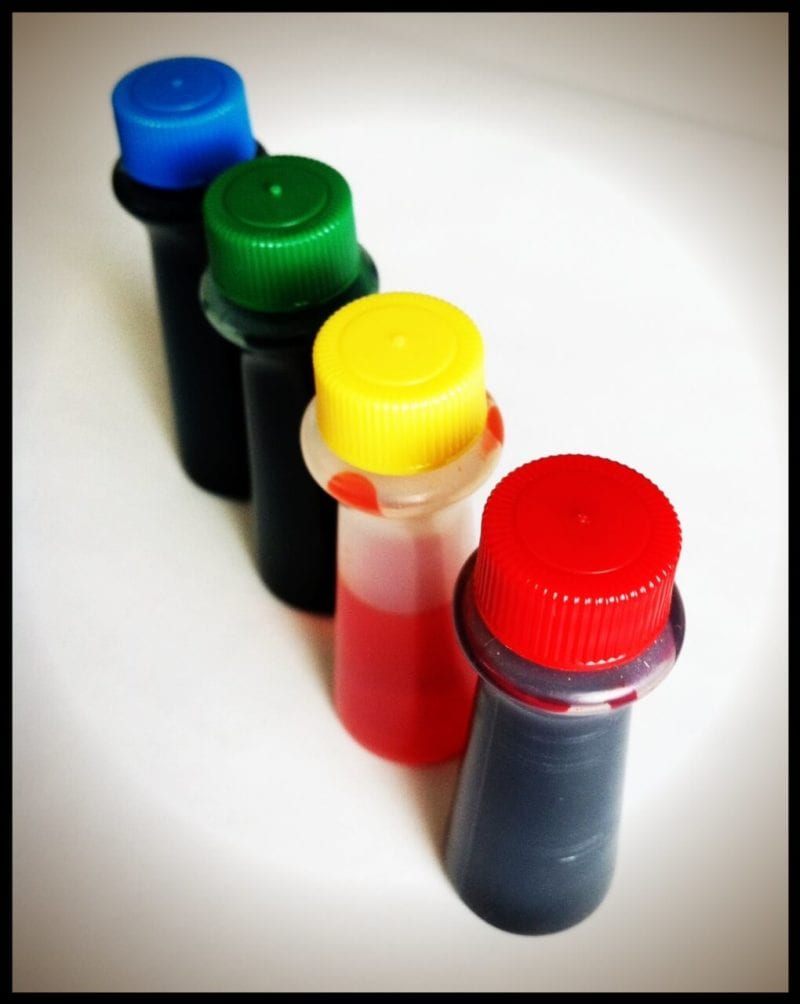
Artificial food dye, synthetic food dye, food coloring, FD&C Red No. 40, FD&C Blue No. 1, or Tartrazine (a.k.a. Yellow No. 5)… whatever name it’s listed under, it is all pretty much the same stuff. And as I’ve said on this site before I have no problem occasionally digging into yummy homemade baked goods made with plenty of chocolate, sugar, or whatever else we’re craving, but what I NEVER want to “treat” myself (or my children) to is a dose of chemicals derived from petroleum.
Yep, no typos there…that’s what artificial food dye is made from (it used to be derived from coal tar - so we haven't improved much!) and unfortunately the 15 million pounds of food dye used in the U.S. per year (5 times more than in 1955) is in much more than just colorful icing these days. Dyes, made from the same petroleum that fuels our vehicles, is turning up in an insane amount of packaged foods including Kraft Macaroni and Cheese, Minute Maid Lemonade, Lunchables, Fruit Roll Ups, Cheetos, and even “Light and Fit” Yoplait Yogurt.
And the crazy thing is these food manufacturers tell us right there on the ingredient label that artificial food colorings (and sometimes “artificial flavoring”) have been added…but most consumers don’t seem to be fazed by it.
Want to Save this Recipe?
Enter your email below & we'll send it straight to your inbox. Plus you'll get great new recipes from us every week!
Upon discovering what this (seemingly harmless and common) additive is made from I had to tell my daughters. I explained how it’s in thousands of products including birthday party cupcakes, salad dressing, cough syrup, and even daddy’s mouthwash. Rightfully so my 1st grader looked at me a little shocked and went on to say, “Can we write a letter to the president?”
Now I love how that girl thinks, but at the same time it broke my heart that my innocent child thought that’s all it would take. If we just told the president that food manufacturers were feeding us petroleum based chemicals disguised as brightly colored food dyes he surely wouldn’t allow it anymore. And while I am not very good at politics myself what I’d like to be good at is educating and influencing all of you to vote with your dollars. I truly believe that if consumers stop purchasing artificially dyed and flavored foods we can make an impact.
If enough of us speak up the big food companies will listen to consumer demand. And I know this for a fact because that’s exactly what’s happened in other countries outside of the U.S (check out #3 below).…we are apparently just behind the curve on this one.
7 Reasons I Hate Artificial Food Dyes
1. They are made in a lab with chemicals derived from petroleum, a crude oil product, which also happens to be used in gasoline, diesel fuel, asphalt, and tar.
NPR.org: “Artificial food dyes are made from petroleum and approved for use by the FDA to enhance the color of processed foods.”
2. They’ve been linked to long-term health problems such as cancer. If you’re a child of the ‘80s (like me) do you remember that rumor about red M&Ms causing cancer? Maybe it wasn’t just a rumor after all.
CSPInet.org: “The three most widely used dyes, Red 40, Yellow 5, and Yellow 6, are contaminated with known carcinogens, says CSPI. Another dye, Red 3, has been acknowledged for years by the Food and Drug Administration to be a carcinogen, yet is still in the food supply.” FYI – According to Wikipedia, “A carcinogen is any substance … that is an agent directly involved in causing cancer.” !!!
CBSnews.com: “There's no good reason not to ban Red 3, something then-acting FDA commissioner Mark Novitch tried to do in 1984, saying the dye ‘has clearly been shown to induce cancer’ and was ‘of greatest public health concern.’ … Other dyes, namely Blue 1, Red 40, Yellow 5, and Yellow 6, are known to cause allergic reactions in some people and have shown signs of causing cancer in lab animals. Of course, this isn't the same thing as leading to cancer in humans, but it argues for limiting intake, especially among children, who are getting the biggest dose of food colorings from a gazillion brightly colored, fun-looking foods.”
3. Did you know that food products containing artificial dye are required to have a warning label in the U.K.? The label states that the food "may have an adverse effect on activity and attention in children." So speaking of M&Ms, they aren’t so brightly colored in some countries outside of the U.S. because manufacturers would rather do away with the artificial dye than have to put a warning label on their products.
Mercola.com: “This is why if you eat a Nutri-Grain strawberry cereal bar in the United States, it will contain Red 40, Yellow 6 and Blue 1. But that same bar in the UK contains only the natural colorings beetroot red, annatto and paprika extract. In fact, the UK branches of Wal-Mart, Kraft, Coca-Cola and Mars have removed artificial colors, sodium benzoate and aspartame from their product lines as a result of consumer demand and government recommendations. In the United States, however, the Food and Drug Administration (FDA) continues to allow these toxic ingredients in countless popular foods, including those marketed directly to children.”
CBSnews.com: Many Grocery Manufacturers Association members (like Pepsi, Kraft and General Mills) “have switched to natural colorings in their products in the U.K., where warning labels are required, but they're not doing that here for the most part. That's because no one's making them do it, and switching would cost a lot of money.”
4. Synthetic food dyes have been shown to cause an increase in hyperactivity in children as well as a negative impact on their ability to learn.
Washingtonpost.com:"Artificial food dyes (in combination with a common preservative) could make even children with no known behavioral problems hyperactive and inattentive."
CSPInet.org: "The science shows that kids' behavior improves when these artificial colorings are removed from their diets and worsens when they’re added to the their diets." and "While not all children seem to be sensitive to these chemicals, it's hard to justify their continued use in foods—especially those foods heavily marketed to young children."
Mercola.com: “According to scientific studies, these dyes are causing behavioral problems and disrupting children's attention.”
5. They add absolutely no value to the foods we are eating, but do in-fact pose quite a few serious risks.
FDA.gov: “Without color additives, colas wouldn't be brown, margarine wouldn't be yellow and mint ice cream wouldn't be green. Color additives are now recognized as an important part of practically all processed foods we eat.”
Huffingtonpost.com: "These dyes have no purpose whatsoever other than to sell junk food."
CSPInet.org: “These synthetic chemicals do absolutely nothing to improve the nutritional quality or safety of foods, but trigger behavior problems in children and, possibly, cancer in anybody. The Food and Drug Administration should ban dyes, which would force industry to color foods with real food ingredients, not toxic petrochemicals.”
6. They trick your senses…just like other artificial additives including sweeteners.
In Defense of Food: “One of the problems with the products of food science is that, as Joan Gussow has pointed out, they lie to your body; their artificial colors and flavors and synthetic sweeteners and novel fats confound the senses we rely on to assess new foods and prepare our bodies to deal with them. Foods that lie leave us with little choice but to eat by the numbers, consulting labels rather than our senses.”
7. They are contributing to the obesity epidemic by attracting children (and adults) to highly processed food, which in many cases is being eaten instead of fresh whole foods.
Washingtonpost.com: "Beyond the behavioral problems and cancer risks, the greatest hazard that dyes pose for children may also be the most obvious: They draw kids away from nutritious foods and toward brightly colored processed products that are high in calories but low in nutrients, such as fruit-flavored drinks and snack foods. Those types of foods are a major force in America's obesity epidemic."
Disclosure: My children do occasionally eat foods containing artificial dye because it's provided to them by teachers, other parents, and friends, but it's not something we spend our own money on anymore.


Ashley Eidsvik says
I'm just learning about food labels and what to cut out. I am trying to find clear information on natural food coloring like annatto and turmeric. Are these safe? All the cheddar cheeses I looked at had annatto for color and I am not sure if that is an acceptable NATURAL coloring or not. Thank you in advance.
Assistant to 100 Days (Amy) says
Hi Ashley. Lisa trys to stick with white cheeses (no color added) as much as possible. That said, annato and tumeric are completely natural and certainly better choices. Annato has been associated with allergic reactions in some individuals. ~Amy
Shawna says
For more information about how dyes/flavoring/preservatives affect us check out http://www.feingold.org
This is an amazing non-profit group that has changed my family's life. My son was diagnosed with ADHD when he was 6. 3 days after starting on the Feingold program his symptoms were gone! 4 years later we are proud to say that we will never allow petroleum derived foods in our diet ever again.
corben says
i think you are very right i know that artificial candies and such are made a lot to attract children and adults uncountable times especially on halloween and i feel that every normally positive holiday has been turned into ... well CANDY, CANDY, AND MORE CANDY you are one of billions to be awake from the system's controlling and attracting curse.
Lauren says
Do you have tips for helping young children make wise decisions about candy, etc.? We do not uy anything with dyes so it is very easy to control at home. However, grandparents and others don't buy into any of this. Therefore, the amount of junk they buy her or let her buy herself is out o control. It all goes int he garbage. We are trying to explain the harms of dyes, but when only two people promote it, it's very hard. Ideas? Thanks!
Assistant to 100 Days (Amy) says
Hi Lauren. Yes, it can be tough when others aren't on board with your real food standards. Here are a few posts that will help: https://www.100daysofrealfood.com/2013/04/19/how-to-talk-kids-about-real-food/ and https://www.100daysofrealfood.com/2012/07/24/being-polite-vs-honoring-your-values/ and https://www.100daysofrealfood.com/2012/04/12/newsflash-we-are-not-just-fine/. You might share the posts with the grandparents, as well. :)
Annette says
My doctor told me this month she had a migraine patient that tracked her migraines to artificial food coloring!
Jennifer says
I completely agree with you. I am currently in a "war of words" with Yoplait regarding their use of food dyes in yogurt for kids. It makes no sense that their products in Europe and some products in the US use fruit and vegetable purees and juices for color and flavor, while others, particularly Go-gurts, contain no fruit in any form. Whether they believe the overwhelming evidence of the adverse health effects of dyes or not, the fact of the matter is that they contribute nothing to the nutritional content of the food.
Linda says
years ago (as an adult!), I developed an allergy to these dyes (probably yellow and maybe red). I was going into anaphylactic shock after drinking Tang, slushies and eating vanilla frosting. When I took these items to the doctor, he laughed and said he'd never heard of such a thing. Thankfully, this is more known now.
Melissa says
I think this is right on. I've recently discovered that my 4 year old son is sensitive to artificial colors. I didn't know this until his preschool teacher suggested I put him on medication for ADHD. After doing some research on possible diet changes and alternative options, I decided to pull him off dyes and try to limit sugars instead of getting him an evaluation. He's a totally different kid! He listens better, doesn't get upset as easily, doesn't have as much trouble concentrating, sits still, even makes better eye contact, which adds up to him getting in trouble less and feeling better about himself. What's surprised me though is how many people roll their eyes when I mention that we're trying to keep him off sugars and dyes. They look at me like I'm a crazy mom when I'm just trying to keep my children healthy and happy. Thanks for helping to get the word out!
Lauren says
Same with my daughter. People just don't get how powerful dye is in changing her behavior. She feels terrible--headache, stomachache--and acts out, talks non-stop (got in trouble in school because of it), fidgets, runs around, or cries about everything and is easily frustrated. She's much more even when she doesn't have dye, sugar, or wheat.
Brittany @ Proteinandpumps says
I don't remember the last time I touched food die but in the event I come accross a recipe that requires one, do you have a resource for natural/healthy food coloring?
Zeke says
Hi Brittany - India Tree is a great resource for natural food dyes. They even have color sprinkles for ice cream. My kids never know the difference! They're not cheap, but they are good and nothing artificial - http://www.indiatree.com is the website.
Valerie says
I live in Germany right now and they do not use these dyes as well. There is no difference to the taste and you get use to the different colorings pretty quickly. The US is so advanced in a lot of areas, I wish they would get on board when it comes to our health and safety!
Marcy T says
Do you know if Wilton icing colors have petroleum? Have been searching for 30 minutes and can get not ingredient listings...
Assistant to 100 Days (Amy) says
Hi Marcy. I did a quick search and came up with nothing, too. Sorry. ~Amy
aisha says
Did you try calling the company's customer service number?
Ash says
I got this from another site listing the ingredients of one of the Wilton icing colors:
Sugar, corn syrup, glycerine, water, FD & C colors yellow 5, yellow 6, red 40, blue 1, vegetable gums, potassium sorbate, citric acid
Not sure if it's exactly accurate, but since it looks and feels just like Vaseline (which is 100% Pure Petroleum Jelly), I would bet money it is made from the same petroleum that makes the gas in your car.. **Mmmmmm - yummy!**
Laura says
Especially #5 above ... I don't need my cake/breakfast pastry/yogurt to be florescent blue! How is that even appetizing? And I swear I can taste the dye (in a bad way) in those super boldly dyed grocery store bakery cake frostings (which is why I wouldn't eat it, even if it were proven to be 100% safe).
Jordan Miller says
I think this is so important. My brother definitely experienced the hyperactivity that dye can cause when we were children. He became very agitated, had a hard time listening, and was even less responsive to social cues he normally would have picked up on whenever he consumed artificial colors. When my mom pulled him off of these dyes, he went back to his normal self. Even though he is 20 now, he can still feel the effects that these dyes have on him and he tries to avoid them at all costs. Thanks for helping to get the word out!
Bosco says
If U don't like it don't eat, stop trying to ruin everything that tastes good! Everyone should be able to decide what they want to eat for themselves. I am tired of a small percentage of people trying dictate what the majority of us should eat or drink. mind your own business and worry about yourselves!
Jen Knecht says
I'm highly allergic to Red 40 dye. It's amazing what food items include this additive! What I still laugh at is, I was having this weird reaction so I took a Benadryl. What color is Benadryl? Bright pink and full of Red 40! Thankfully through trial and error I finally figured out what I was allergic to and thankfully have found dye-free Benadryl!
Sharon Williams says
I wonder how many parents realize that food dyes are a common link to ADHD in their children? My son gets extremely agitated after a dose of yellow food dye. It takes several days to go away. Red food dye makes him crazy. Gives him headaches. It took us a while to figure out what the common link was. So many cases of ADHD in this country...so many colorful reasons.
Kate McGee says
Hi Lisa!
Thank you so much for posting this about artificial coloring. I didn't realize yellow dye could be used another another name. I am very allergic to artificial coloring and have been since about 10 years ago. It's so hard for me to find food to eat as well as medicine and everyday products. It sucks! Reading every label gets exhaustingly! At least there are places like Earth Fare. I had no idea though that it caused all these problems and more so that it's not even used as much in England. That makes me mad. Why can't those companies just make it the same way here they do in England? It's better than the other. At Earth Fare they have a brand of Pop Tarts that are all natural and they taste exactly like the other Pop Tarts. Thanks for posting this. I hope you post another about food coloring.
Lisa says
This makes me sick but doesn't surprise me that they would do this. Our country is so corrupted by greed and money that what's "right and wrong" just doesn't exist anymore with the higher ups. So even if we stopped buying this crap then who's to say they're just not going to switch it out for another chemical that no one will know the harms of until 20+ years down the road? I've heard about the yellow dye years ago... Still going strong, the red same thing only this time it's back on the news as of last week. So will they stop it? Probably not. I've seen so many things get recalled and a week later it's back on the shelf or apple juice for instance, they let us know about it but that didnt stop them from removing it altogether and stop selling it. I think the U.K is lucky however it's very different then here in the states.
Ken Andersen says
This is an interesting and informative read, but I’m concerned about the advertising that comes up on this site. Next to the “7 Reasons I Hate Artificial Food Dyes†article there’s an ad for Crest Pro Health products, but Crest Pro Health mouthwash contains artificial food dyes. You say that your kids will occasionally consume products with artificial dyes in them but that “…it’s not something we spend our own money on anymore.†If you won’t spend money on them, why is it ok to make money from the advertising of such products?
Jason Leake with 100 Days of Real Food says
Hi Ken - We use ad networks and there are literally thousands upon thousands of potential advertisers, so we cannot possibly review them all manually. As a result we categorically block food and pharmaceuticals (and the standard "shady" categories) to avoid the brunt of undesired ads. An exception to this is our Federated Media (premium) network, for which we review every single ad. Even with these precautions, an undesired ad slips through the filters occassionaly. For example, a Target ad might actually be promoting Oreos. And sometimes there are just errors on the ad network side. We try to sniff these out and block them when possible. Also note just because you see an ad does not mean the rest of our readers are seeing it as well. Some are geotargeted by the networks.
Ken Andersen says
Thanks for the reply. It's a shame that these toxic products are so prevalent. It makes doing the right things for our bodies far more difficult than it should be.
Roy says
My first dangerous reaction to red dye # 3, the synthetic coal tar dye erythrosine, resulted in me being admitted to the hospital blacked out with convulsions. My second resulted in total unconsciousness (I never even felt myself hit the cement floor) and a coworker had to rescue me with CPR. When it was found to cause cancer, the FDA banned red dye # 3 in about 1/5 of its uses, but it's still allowed in canned fruit, candy, ice cream, maraschino cherries, snack foods, pudding, gelatin desserts, sausage casings, popsicles and cake icing. There is no excuse for this and it has to stop!
Ryan says
Maybe it's time to start citing scientific references instead of NPR, Huffington Post, CBS, and Washington Post. I feel similarly about artificial food dyes, but citing media references which may or may not contain actual scientific references is like asking Rush Limbaugh for biology help and swiftly undermines this article.
Brandon says
I'm very bothered that you link to Mercola in seeking nutritional quotes and guidance. Mercola makes money selling supplements and other products and supports a number of things that are known to be more harmful than some of the things he opposes. I do agree with many of your sources, but Mercola is one you should drop from your list of references.
Gilbert says
Presumably, manufacturers of processed foods add artificial color and flavor to disguise what these foods must really look and taste like. I wonder how many products would be sold if consumers could see and taste the real products beneath all the artificiality.
Kendra Bartlett says
Very interesting article! I will certainly take it into consideration. Something to add, take it or leave it, is that as common as birth control is, it too has been labeled as a Group 1 Carcinogen...right up there with cigarettes and radiation. Something to ponder :) My husband and I practice Natural Family Planning and love it.
Emily says
thanks for this informative if disheartening post. I've recently come to see these companies putting their profits at the expense of our health and well being as pure evil.. as well as the fda for allowing it to happen. I didn't realize the extent of the problem with artificial coloring.. but will be making some changes after reading this.
Jenn says
So I have a question. Have you found anything that can color frosting that is made differently? I love decorating baked good, especially around the holiday's and peoples birthdays. Do you have any suggestions on how to make different colors?
Sarah says
You can boil vegetables to remove the color and then use the water in your products. Or you can blend fruit right into your frosting to add color like blueberries or strawberries. Juicing things (spinach/green, carrots/orange) also works. If you taste the veggie just add a little vanilla.
Jenn says
Thank you! That makes sense and actually sounds good. I will have to try that, the blending...
Assistant to 100 Days (Amy) says
This post will help, too: https://www.100daysofrealfood.com/2011/12/21/natural-food-dyes-for-holiday-cookies/. :)
maude says
I wasn't aware of any of this. It makes me wonder what the point of the fda is if they allow all of this.
Joanne Ross says
22 years ago when my son was little we began to have behavioral problems when he had certain things. It took us a while, but we narrowed it down to red dye when he was about 3. It changed his behavior to a disruptive one where he could not listen and follow directions. I mistakenly let him have purple Kool-Aid at someone's house not realizing it had red dye. He was awake for 3 days. We were asked to remove him permanently from his daycare because he needed a medicine that had red dye. Back then it was difficult but imperative that doctors find alternatives to red dye medicines. We found older remedies to be helpful. I insisted I be the one to send in juice for parties at school so I knew what he was getting and there would be no problems. There are more choices today than 20 years ago, but I think red dye may be the culprit for many school behaviors that they are giving medicine to control in todays society. Something needs to be done.
That Neil Guy says
A couple years ago, I read a book that opened my eyes to the petroleum-based food product world. It's called Twinkie Deconstructed http://amzn.to/1ackWsK. The author investigated all the ingredients on a Twinkie label, giving us the derivations of each. My main takeaway was that most of the processed food we consume comes from oil, rocks and corn. Creepy.
Andrea Donsky says
I totally agree. We wrote 2 books on this subject as food coloring is one of our "Scary Seven" ingredients. You can download our book Label Lessons (for free) here until June 26th: http://www.naturallysavvy.com/labellessons/. You can also check out our book Unjunk Your Junk Food here: http://www.naturallysavvy.com/book/unjunk-your-junk-food.
Kristi says
What do you use instead?
Assistant to 100 Days (Amy) says
Hi Kristi. If you need to add color for aesthetic reasons this post will help guide you: https://www.100daysofrealfood.com/2011/12/21/natural-food-dyes-for-holiday-cookies/. Also this post on natural coloring for Easter eggs: https://www.100daysofrealfood.com/2012/03/30/guest-post-natural-easter-egg-dyes/ offers loads of color possibilities! ~Amy
Sheila Hoselton says
As for "My kids occasionally eat food dyes because TEACHERS, and others give it to them" I am so ready to sue the school because of this, I live in an area where there are very few NaturoPathic Dr because they can not be liscensed here. With that said the dr pool around here is nothing but educated morrons that take no clinical studies related to food seriously. Not to mention the school is incapable of seeing a difference in my daughter since the diet change but her counslor who only sees her once a week noticed! I think it is child endangerment for people to give children something the parents do not really approve of because it causes emotional problems between the child and the parent and when enough people are against the parent (as in my case) the damage is inconcivable.
Severus says
Great article. Thank you for the heads up on this poison.
Cat says
I cut that gross stuff out of my diet over two years ago, and I notice a change. I used to have really terrible skin problems. Before, I was reliant on weird prescription meds and skin applications since I was about 6. I stopped eating dyes as a personal choice when I was like 12 ( I'm 15 now). My family thinks I'm like a hypochondriac or something, but I'm eczema free now, and the only thing I have to use is lotion to keep my skin clear. I only use dyes in cosmetics ( the way it should be!), but I really would like my family to join me in my "all natural" lifestyle.
Glenda Eakle says
I would like the FDA to ban dyes in all food and drinks. I worry about our children. I have come to realize that when I ingest anything with dyes,I shake very badly...itch..and get hives. I also have Hemiplegic Migraine Disease and find the dyes to be a trigger. I will try and post this information and the petetion on my Migraine site. I'm sure many will sign it. Thank you for your good work!
Kimberly says
I have to tell you my experience. I thought I had a bladder infection (UTI). My gynecologist informed me I have interstitial cystitis. I'am being treated and feeling a lot better. One of the culprits of this is artificial coloring's/dyes/sweeteners. Among other ingested food and drinks, wine was another "trigger" for me. I have been awakened by my doctor about the dyes and artificial ingredients in foods and drinks and have been more cautious about this. Wish I would have known about this when my boys were young. I gave them Crystal Light and diet sodas instead of kool aid and regular sodas. I would have made better decisions had I known.
Andi says
Hi. I just discovered a few months ago that I am allergic to red#40 food coloring and I was wondering if that also means I can not have any foods with artificial flavors as well?
Assistant to 100 Days (Amy) says
Hello Andi. You would need to check with your doctor regarding your allergies. Good luck. ~Amy
Stephen Mannion says
Has anyone heard of any dyes causing speech difficulties? Something I am eating is triggering a short term speech impediment. Please e-mail me directly if you have. I would REALLY appreciate it. [email protected]
Donna says
First I want to say Way to go! Thank you for starting this petition. I have signed and will keep passing it around. I do have a question though. Shouldn't we really be targeting the FDA with this as well since they are the ones allowing it into the food system in the first place? (Please in no way think of this as an attack. Just wondering). Thanks and keep up the GREAT work!
Bruce Stewart says
Thanks for the good work. It's unfortunate that most Americans rely entirely on the FDA, assuming that if it's on the shelf at a store it's safe and healthy. Maybe web-sites like yours are helping to educate the public but looking around at the shoppers in my local grocery stores can be pretty discouraging.