
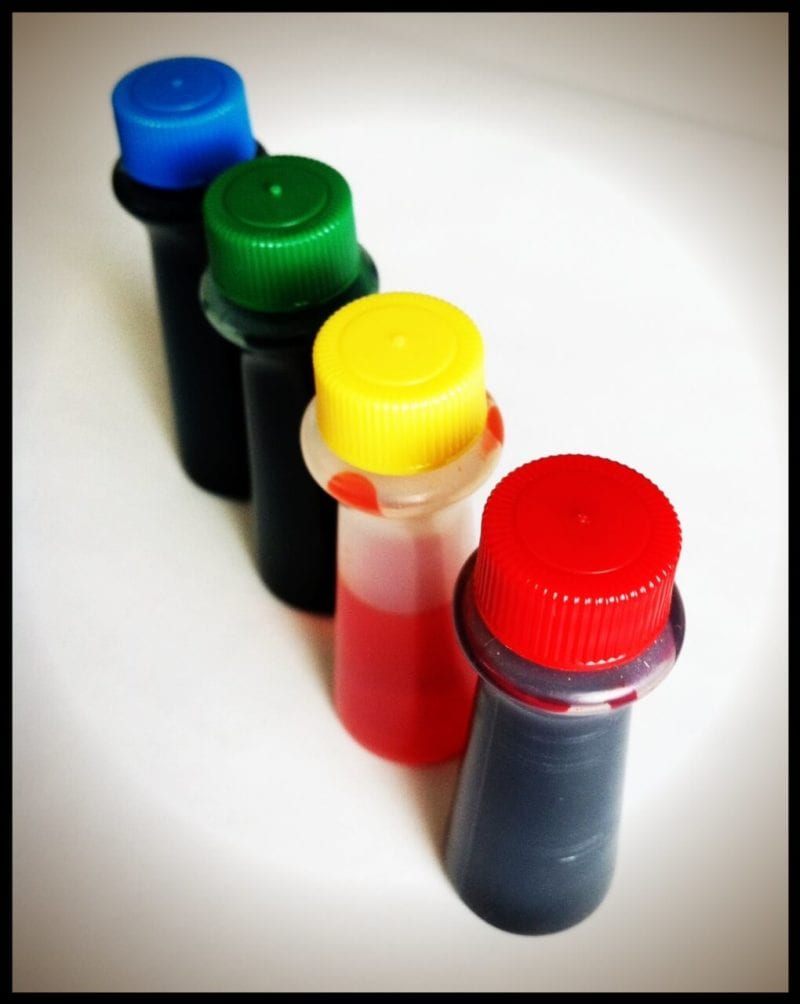
Artificial food dye, synthetic food dye, food coloring, FD&C Red No. 40, FD&C Blue No. 1, or Tartrazine (a.k.a. Yellow No. 5)… whatever name it’s listed under, it is all pretty much the same stuff. And as I’ve said on this site before I have no problem occasionally digging into yummy homemade baked goods made with plenty of chocolate, sugar, or whatever else we’re craving, but what I NEVER want to “treat” myself (or my children) to is a dose of chemicals derived from petroleum.
Yep, no typos there…that’s what artificial food dye is made from (it used to be derived from coal tar - so we haven't improved much!) and unfortunately the 15 million pounds of food dye used in the U.S. per year (5 times more than in 1955) is in much more than just colorful icing these days. Dyes, made from the same petroleum that fuels our vehicles, is turning up in an insane amount of packaged foods including Kraft Macaroni and Cheese, Minute Maid Lemonade, Lunchables, Fruit Roll Ups, Cheetos, and even “Light and Fit” Yoplait Yogurt.
And the crazy thing is these food manufacturers tell us right there on the ingredient label that artificial food colorings (and sometimes “artificial flavoring”) have been added…but most consumers don’t seem to be fazed by it.
Want to Save this Recipe?
Enter your email below & we'll send it straight to your inbox. Plus you'll get great new recipes from us every week!
Upon discovering what this (seemingly harmless and common) additive is made from I had to tell my daughters. I explained how it’s in thousands of products including birthday party cupcakes, salad dressing, cough syrup, and even daddy’s mouthwash. Rightfully so my 1st grader looked at me a little shocked and went on to say, “Can we write a letter to the president?”
Now I love how that girl thinks, but at the same time it broke my heart that my innocent child thought that’s all it would take. If we just told the president that food manufacturers were feeding us petroleum based chemicals disguised as brightly colored food dyes he surely wouldn’t allow it anymore. And while I am not very good at politics myself what I’d like to be good at is educating and influencing all of you to vote with your dollars. I truly believe that if consumers stop purchasing artificially dyed and flavored foods we can make an impact.
If enough of us speak up the big food companies will listen to consumer demand. And I know this for a fact because that’s exactly what’s happened in other countries outside of the U.S (check out #3 below).…we are apparently just behind the curve on this one.
7 Reasons I Hate Artificial Food Dyes
1. They are made in a lab with chemicals derived from petroleum, a crude oil product, which also happens to be used in gasoline, diesel fuel, asphalt, and tar.
NPR.org: “Artificial food dyes are made from petroleum and approved for use by the FDA to enhance the color of processed foods.”
2. They’ve been linked to long-term health problems such as cancer. If you’re a child of the ‘80s (like me) do you remember that rumor about red M&Ms causing cancer? Maybe it wasn’t just a rumor after all.
CSPInet.org: “The three most widely used dyes, Red 40, Yellow 5, and Yellow 6, are contaminated with known carcinogens, says CSPI. Another dye, Red 3, has been acknowledged for years by the Food and Drug Administration to be a carcinogen, yet is still in the food supply.” FYI – According to Wikipedia, “A carcinogen is any substance … that is an agent directly involved in causing cancer.” !!!
CBSnews.com: “There's no good reason not to ban Red 3, something then-acting FDA commissioner Mark Novitch tried to do in 1984, saying the dye ‘has clearly been shown to induce cancer’ and was ‘of greatest public health concern.’ … Other dyes, namely Blue 1, Red 40, Yellow 5, and Yellow 6, are known to cause allergic reactions in some people and have shown signs of causing cancer in lab animals. Of course, this isn't the same thing as leading to cancer in humans, but it argues for limiting intake, especially among children, who are getting the biggest dose of food colorings from a gazillion brightly colored, fun-looking foods.”
3. Did you know that food products containing artificial dye are required to have a warning label in the U.K.? The label states that the food "may have an adverse effect on activity and attention in children." So speaking of M&Ms, they aren’t so brightly colored in some countries outside of the U.S. because manufacturers would rather do away with the artificial dye than have to put a warning label on their products.
Mercola.com: “This is why if you eat a Nutri-Grain strawberry cereal bar in the United States, it will contain Red 40, Yellow 6 and Blue 1. But that same bar in the UK contains only the natural colorings beetroot red, annatto and paprika extract. In fact, the UK branches of Wal-Mart, Kraft, Coca-Cola and Mars have removed artificial colors, sodium benzoate and aspartame from their product lines as a result of consumer demand and government recommendations. In the United States, however, the Food and Drug Administration (FDA) continues to allow these toxic ingredients in countless popular foods, including those marketed directly to children.”
CBSnews.com: Many Grocery Manufacturers Association members (like Pepsi, Kraft and General Mills) “have switched to natural colorings in their products in the U.K., where warning labels are required, but they're not doing that here for the most part. That's because no one's making them do it, and switching would cost a lot of money.”
4. Synthetic food dyes have been shown to cause an increase in hyperactivity in children as well as a negative impact on their ability to learn.
Washingtonpost.com:"Artificial food dyes (in combination with a common preservative) could make even children with no known behavioral problems hyperactive and inattentive."
CSPInet.org: "The science shows that kids' behavior improves when these artificial colorings are removed from their diets and worsens when they’re added to the their diets." and "While not all children seem to be sensitive to these chemicals, it's hard to justify their continued use in foods—especially those foods heavily marketed to young children."
Mercola.com: “According to scientific studies, these dyes are causing behavioral problems and disrupting children's attention.”
5. They add absolutely no value to the foods we are eating, but do in-fact pose quite a few serious risks.
FDA.gov: “Without color additives, colas wouldn't be brown, margarine wouldn't be yellow and mint ice cream wouldn't be green. Color additives are now recognized as an important part of practically all processed foods we eat.”
Huffingtonpost.com: "These dyes have no purpose whatsoever other than to sell junk food."
CSPInet.org: “These synthetic chemicals do absolutely nothing to improve the nutritional quality or safety of foods, but trigger behavior problems in children and, possibly, cancer in anybody. The Food and Drug Administration should ban dyes, which would force industry to color foods with real food ingredients, not toxic petrochemicals.”
6. They trick your senses…just like other artificial additives including sweeteners.
In Defense of Food: “One of the problems with the products of food science is that, as Joan Gussow has pointed out, they lie to your body; their artificial colors and flavors and synthetic sweeteners and novel fats confound the senses we rely on to assess new foods and prepare our bodies to deal with them. Foods that lie leave us with little choice but to eat by the numbers, consulting labels rather than our senses.”
7. They are contributing to the obesity epidemic by attracting children (and adults) to highly processed food, which in many cases is being eaten instead of fresh whole foods.
Washingtonpost.com: "Beyond the behavioral problems and cancer risks, the greatest hazard that dyes pose for children may also be the most obvious: They draw kids away from nutritious foods and toward brightly colored processed products that are high in calories but low in nutrients, such as fruit-flavored drinks and snack foods. Those types of foods are a major force in America's obesity epidemic."
Disclosure: My children do occasionally eat foods containing artificial dye because it's provided to them by teachers, other parents, and friends, but it's not something we spend our own money on anymore.


Anonymous says
I am a big fan of your cookbook, recipes and ideas in general about eating real food but it is always such a turn off when you use strong language like "hate' when you try to deliver a message. I get your passion, I do really, but I just think there are kinder ways to share information and educate people without having to be so extreme.
Anonymous says
My grandchild has an allergic reaction to all food colorings, preservatives & artificial flavorings. Fortunately, I do make my foods from scratch, However, it's difficult when you want to make desserts, Other than making waffles, using gelatin, fresh fruits, or making fresh veggies, it's not easy! What can one do, what foods are available without these ingredients?
Jennifer says
There are natural colorings that you can purchase. Just do a google search. I bought them online from a company that sold chocolate making ingredients. You can also purchase them on Amaxon. They should be refrigerated for maximum shelf life (as they are vegetable extracts).
mari says
Artificial dyes, especially the reds, also cause symptoms that mimic ADHD. I would bet anything that 99% of the kids diagnosed with ADHD are actually just reacting to food dyes.
Another coloring, one that is considered natural and that you mentioned in this article, Annato also can cause ADD-like symptoms.... note, I left the H off in ADD.... that is because Annato has been known to cause Inattentive-type ADD, which is the ADD where you're scatterbrained and unfocused, but not hyper.
Rhonda says
Interested in your opinion of annatto, where did you read your findings? I'm researching for natural colorants in skincare but would surely want to stay away from anything that can effect ADD/ADHD as well.
Ashley says
My son allergic to food dyes. It took 3 years for us to make the connection. My son does not react to Annato. However, some kids do. Annato comes from a berry, it's not artifical. Be sure to eliminate TBHQ, BHA and BHT as these preservatives are also made of petroleum.
Dina says
Can you' share what you use instead of the artificial dye? Pomegranate juice? I don't have any other ideas!
Amy Taylor (comment moderator) says
Hi there. Yes, you can use various fruit juices and veggie dyes. This will give you some ideas: https://www.100daysofrealfood.com/2013/06/07/naturally-colored-rainbow-party/.
Shey says
Beet juice
Izzi says
What exactly are all the chemicals in food dye? There could be more...O-O
Thanks!
-Izzi :)
Beth says
Medicine also has artificial color added. Our son's behavior is greatly affected by artificial colors, especially red and blue. He had to be on antibiotics for an urgent issue, both antibiotics contained artificial color in them and the pharmacy couldn't make the liquid without it. I contacted both drug manufacturers and complained, asked them WHY?, one company ignored me. The other company made reports of the adverse behaviorial issues that the artificial colors in the medicine gave my son. So frustrating when companies, especially who make life saving meds, add artificial colors to their medicines... extremely frustrating!
R says
That's really unfortunate. My daughters antibiotics were white liquid. Maybe switch pharmacies? We go to walmart
Katie says
Lisa, what natural food dyes do you use for cookies and cakes?
Thanks! Love your site!!
casey cat says
artificial foods are crazy>>>>>> what are the good for??
Tracy Myall says
Can't wait to see how to eat more healthy. Praying that it will help me eliminate some of the health issues I have been having recently which the doctor seems to think are allergic reactions of some type.
Steve Nordquist says
I sure wish there were first sources cited. I don't appreciate being sent through CSPI and mercola to see an honest reason, and I do appreciate a supply company making a reasonably natural way to have blue chocolate.
It's been a horror show of failing to remake food safety governance, where you parked us in the fake Federal building where food safety is supposed to be made. Lobbyists can come in and say how important the work they wave hands at is, and please send the check to another building. The lobby is full of something like bees.
Tabi says
Hi, Question: I only use food coloring for things like playdough and sensory. Do you think there is much harm in that? or can it be absorbed through the skin as well? Thanks.
Amy Taylor (comment moderator) says
Hi Tabi. Yes, they can be absorbed through the skin. :( Try natural dyes. They aren't as vibrant but you can get some nice colors as well as the natural scents that accompany them.
M Schmeltzer says
I have a ridiculous question. It disgusts me that the dyes are made from petroleum, which then made me think about Vaseline, or petroleum jelly. Is Vaseline safe to put on our skin?!?! On another note, thank you so much for putting so much work into your website. I've learned how to feed my family healthy food!
Cocoa says
I've heard that Vaseline isn't the best for skin because of the petroleum in it. Anything you put on your skin gets absorbed into your body because skin is your largest organ, so don't put anything on your skin you wouldn't eat. I've heard coconut oil is one of the best for skin.
Amy Taylor (comment moderator) says
Hi there. I second using coconut oil for skin care. Kick the petrochemicals to the curb. :)
Erin B says
I did my thesis on food additives and behavior in children. It changed the way my household ate! There's some pretty strong research out there about how food effects our behavior. I wish our government would put some pressure on the food manufacturers. We already have a health epidemic in the country, let's start changing where we can!
Cedona says
I am 12 and am writing an argumentative essay on why artificial food colors should be banned from the U.S. and your website helped me a lot. When I was 2 I had a seizure because of these artificial colors. I have something called M.C.S (multiple chemical sensitivity) which means I am allergic to petro chemicals. I had an allergic reaction to a bright red heart lollypop for valentines day and that is how we figured out about my allergies.Before I read your article and my parents told me what food dyes are made of I thought it was totally fine to eat them but now that I know so much more I am happy I do. Your article really inspired me to not change my subject and really try and get food companies to stop using them. Once again thank you so much for your article, it really helped me!
Sandy says
Thank you for this article. I am severely allergic to Red 40. It is amazing all the things it is in. It took some time, but I gradually changed everything in my pantry to organics. For anyone else with allergies...if you allergic to aspirin you may develop an allergy to Red 40.
Rachel says
I have a friend that is also severely allergic to red 40, so I'd like to ask you, do you know if that means you are allergic to petroleum? He has no idea what to avoid other than the dye itself.
Erin says
I am making an Elmo cake for my daughter's 2nd birthday party and would love to avoid these dyes, but I don't know of any icing dyes that make true colors (red, orange and black). Do you have any recommendations for alternatives??
Amy Taylor (comment moderator) says
Hi Erin. I bet this post will give you some ideas: https://www.100daysofrealfood.com/2013/06/07/naturally-colored-rainbow-party/.
Molly Harris says
I reposted this. I am quite disgusted with our government and the food manufacturers. I would support a petition for sure!
E Zamboni says
How can we, their customers and reasons for them having businesses, DEMAND they use the UK formulas if available? Can we flood the FDA? Heir complaint lines? Perhaps 2015 is the year to start another petition, this time to FDA and a letter campaign. Just a thought
Kristin says
Why would companies like Pepsi, GM and Kraft change their product to sell abroad but keep the toxic chemicals within the product to sell here in the U.S.? Is it really THAT much easier/cheaper to use the food dyes to the point that they leave them in for sales and consumption here!? Sad.
Shannon says
#1 when I was a child, in the 1970's, I couldn't have anything with red dye in it because it would make me throw-up. Now as an adult, I seem to be fine. People have told me some reed dyes of the 1970's are banned now--hmmm, that makes sense.
#2 I had the chance to sit next to someone at a wedding who worked for Jello and when I asked why food had to be day-glow colored. He told me dyes int he 1950's use to be flammable...Out of politeness and knowing I would get no where, I ended that conversation.
#3 I was a nanny with a girl from Norway and she said the bright blue coloring we use has been banned in Norway because it considered a carcinogen--mid 1990's. The United States is so far behind!
#4 I tried really hard when my children were born to eliminate artificial coloring and flavoring and that is when the real wake-up call happened. This crap is in everything!! Even "clear" items have it. I gave up for a while I trying to eliminate these poisons, but by youngest has some attention and behavior problems so we are closely looking at his diet and recording what he eats and his behavior--just started, but a lot of work!
Thanks for posting this information about food dyes! Hopefully more people will start to listen and demand change.
Jessie says
I love your site and agree wholeheartedly with most of your advice, including the recommendation to avoid artificial food dyes. But I would urge you to consider citing sources other than mercola.com because it affects your credibility. Among other things, Joseph Mercola is an anti-vax advocate, and his advice should be taken with a grain of salt. Please see more here: http://skepdic.com/mercola.html.
Penna says
This concern of yours might be more legit if that were the only source she was citing. She has several reputable sources and mercola was just one of many who shared her point. It does nothing to diminish her credibility.
Jill G. says
I just had my mind blown while reading the ingredients on the back of the one-a-day multivitamin bottle. They actually use several artificial colors in there. How is anyone ever supposed to get ahead in this world when there is garbage in the multivitamins.
Jessie says
Hi Jill, you might try skipping the multivitamin. There is some relatively new research suggesting that multivitamins are not so helpful. See here, for example: http://hub.jhu.edu/2013/12/17/vitamins-might-be-harmful#. If you are worried about a particular nutrient, maybe you could eat more foods that contain that vitamin.
lmn says
This was a really well thought out and written article. It didn't have the hype normally found with these sorts of things. I'm glad you also linked out to your references.
One thing to note. It is true that the organic molecules used to produce these food additives come from the petroleum industry, but that is true for almost all organic compounds. The chemicals used to make pharmaceuticals also come from the petroleum industry. I know, that doesn't make it better.
If anybody wants to read more about tartrazine or other food additives, please visit my site at Food - Construed. (http://foodconstrued.com/2012/09/tartrazine/)
Alexis Schneider says
I appreciate everything that you do and I have followed your blog for a while now, I totally support you in the real food movement and I agree about artificial dyes. But explaining in detail about food dyes to a 1st grader? That seems a little unnecessary. I think we can all help our children make good food choices without scaring them to death about every little thing they might happen to pick up and eat. Let kids be kids.
Alissa Magrum says
Great article. Tell your daughter to write that letter to the President! I told Jason's Deli about the danger of food dyes as my daughter is allergic/sensitive to dyes and we have been dye free for 7 years. Check this out: http://www.jasonsdeli.com/blog/2010/04/05/you-asked-we-listened-no-artificial-colors-or-dyes/
Jason's Deli now uses NO artificial dyes or colors!
Thanks.
Alissa
terry berry says
great website mate
Debbie says
are there dyes in organic food?
Assistant to 100 Days (Amy) says
Hi Debbie. There are not artificial dyes in organic foods. ~Amy
Sue says
Has anyone experienced headaches after ingestion of food dyes?
Becky says
hi- I started having seizures when I was twenty. never had them before. I moved to China for work and noticed my seizures almost disappeared. I always recorded what I ate the day before the seizure. the common thread...Carmel color- e150. I'd suggest don't just know heir name but know their number. it is legally allowed to be written as either.
Joni says
I don't have time to read very comment here, but everyone should also be aware of the immediate threat of carmine, disguised as red dye with a variety if names, It is actually a red beetle, that is used to make red more vibrant in food
I've had severe, life threatening allergic reactions to this and it's taken my own self process of elimination by reading food labels and finding the common ingredient to find the answers. It's true name is cocheal, which is the name of the bug, but it's under several disguises If you google it, you can see all the problems with it, which is just as deadly as peanuts to some of us, but never discussed
There's a great article in an old National Geographic, titled "Red Alert", which I keep a copy of with me at all times to show anyone who doesn't know, INCLUDING MY PHYSICIANS (who should know without explanation)
I hope this comment helps someone else who hasn't found the answers to the reactions they've had
Cody P says
I'm sorry, but I can't take an article seriously when it starts saying dyes are "all pretty much the same stuff." If you've done your research, you'll know that Orange No. 1 and Red No. 2 are way more dangerous than most other dyes, for example. Plus, saying "They are made in a lab with chemicals derived from petroleum" is simply spreading fear, not reason. Vitamins and medications are made in a lab, sometimes with petroleum, which is a rich source of hydrocarbons. You wouldn't say someone should avoid treating wounds with Neosporin just because it's made in a lab with petroleum, would you?
Also, the FDA recently released a statement that after dozens of studies, the link between artificial dyes and ADHD is uncertain.
Candy says
I love that your article is packed full of information without being overwhelming. I'll be sharing a link to this page in an upcoming post for my blog. Thanks!
Millie Brady says
I told my daughter today that we couldn't buy something that had artificial colors and flavors and she said, at 5 years old, "Why do people make food with artificial stuff in it? Why? Do they want us to be sick? Or sad? They need to stop doing that!"
Enough said.
Darren Bridgewater says
Just wanted to chime in in support of requirements such as those in the UK, I was born there in the late 80's and grew up eating with no real problem, I could eat candy if I wanted to, drink soda etc. Around when I started dating my now wife (american) I suddenly had a serious of huge allergic reactions, turns out her lipstick was colored using Red 40.
Suddenly links were made to more minor allergic reactions from when I Was younger occasionally eating cheaper frozen meals which looking back were artificially colored. However they were rare, even in the 'cheap' supermarkets with dollar frozen meals and every candy under the sun, almost all state 'No artificial flavors, colours, or preservatives'.
I thought this was the norm until I moved to the US about 4 years ago, suddenly I can't drink any cocktail with a color as colors aren't legally required to be reported on alcohol, amlost all candy is off limits to me, as are things like sprinkles on cupcakes, white icing sometimes, body wash (WHITE!), certain types of floss. It's honestly ridiculous how many things these colors are in.
It's obviously doable, as many other countries are close to dye free, but in the US it seems that money talks louder than citizens and there are way too many lobby groups who simply pay off their studies and their congresspeople.
Kristi says
I have recently become aware of the dangers of artificial dyes in foods. It started because of behavior problems in one of my children . But I honestly just learned even more by reading the above article. It seems if the 89,000 people who have shared this story could band together we could make a change. Where do I start?
Concerned in OH
Assistant to 100 Days (Amy) says
Hi Kristi. Start where you are by educating yourself and the people you care about. Let people know that we can all vote with our wallets by not buying foods from companies who act irresponsibly with our health. Food companies are waking up to the fact that consumers have power when they have a voice. Knowledge and passion are key. Did you read Lisa's posts regarding their petition against Kraft: https://www.100daysofrealfood.com/2013/03/05/kraft-yellow-petition/? It's a good example of what can work. In the end, Kraft did remove artificial dyes from some of their products. :) ~Amy
Eve says
Hello, I am in the process of transitioning my family to a dye free diet. Other than the obvious artificial coloring names (yellow 6, red 40, caramel color...)what other names should I be looking for? Are there hidden names for some of these artificial colors? Thanks in advance for your professional input!
Assistant to 100 Days (Amy) says
Hi Eve. This post has a list: https://www.100daysofrealfood.com/2013/04/04/artificial-dyes-how-to-find-and-avoid/. ~Amy
Assistant to 100 Days (Amy) says
Hi there, Lisa. Check out these posts and see what Lisa did: https://www.100daysofrealfood.com/2013/03/05/kraft-yellow-petition/. ~Amy
Lisa says
So if want to see change here in the US please help us know how we can do that. Write to our Senators? Call the food companies? How so we start the movement?
Kathleen diong says
Is there any natural home remedies for this problem of food coloring? Anything we can do to make our own at home without the Bad colors additives?
Assistant to 100 Days (Amy) says
Hello Kathleen. Here are some ideas: https://www.100daysofrealfood.com/2011/12/21/natural-food-dyes-for-holiday-cookies/ and https://www.100daysofrealfood.com/2013/06/07/naturally-colored-rainbow-party/. ~Amy
Kim says
Thank you for informing everyone about why artificial colors in food are just not necessary. Your article is very insightful. There are still probably so many things we have yet to learn about food dyes-and a lot of people don't seem to suspect them of being bad, since they sometimes make food look so good. Please check out my song on youtube (Red Dye 40 Song) about this very same subject. It's just my way of spreading the word about these unnecessary food additives to everyone, but in musical form. Keep up the great work about all of your information about why food should be real!