Why Some Milk Is Not Refrigerated (and an explanation of UHT)
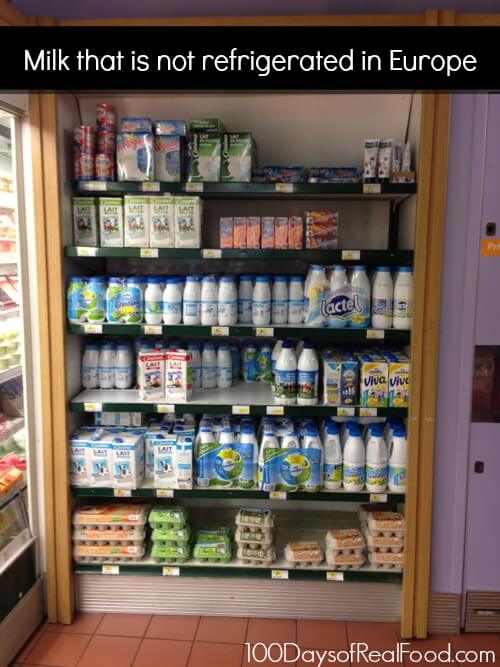
When we were in Europe last month I shared how almost all of the milk options we saw in the supermarket are not refrigerated and are considered "shelf stable." It stirred up quite a bit of discussion on Facebook...
Want to Save this Recipe?
Enter your email below & we'll send it straight to your inbox. Plus you'll get great new recipes from us every week!
Have you ever noticed how some milk here in the US is not refrigerated either?
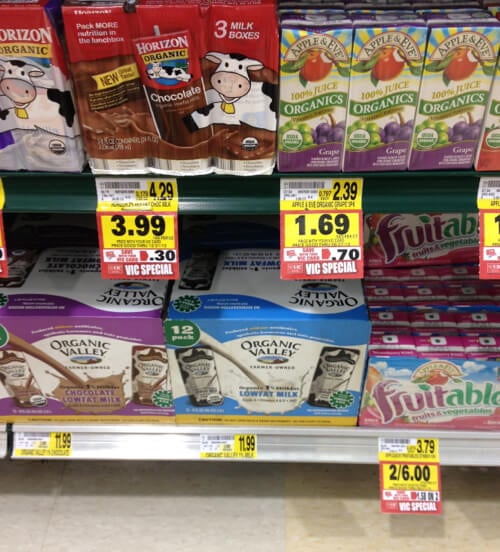
Why is it that these small individual sized organic milk containers in the US aren't sold cold? If you haven't already noticed almost all the commercialized organic milk options here in the US are Ultra High-Temperature Pasteurized (UHT) - which is actually the same process widely used in Europe - but that still doesn't answer why some versions are refrigerated and some aren't. The only difference is the packaging.
Just like the pictured Organic Valley "Single Serve" milk boxes, almost all European milk is UHT and put into what is called aseptic (i.e. sterilized) packaging. UHT milk can last for several months in this type of packaging without spoiling...at least until you open it at which point the shelf life does shorten and it does need to be stored in the fridge.
What is UHT (and is it good or bad)?
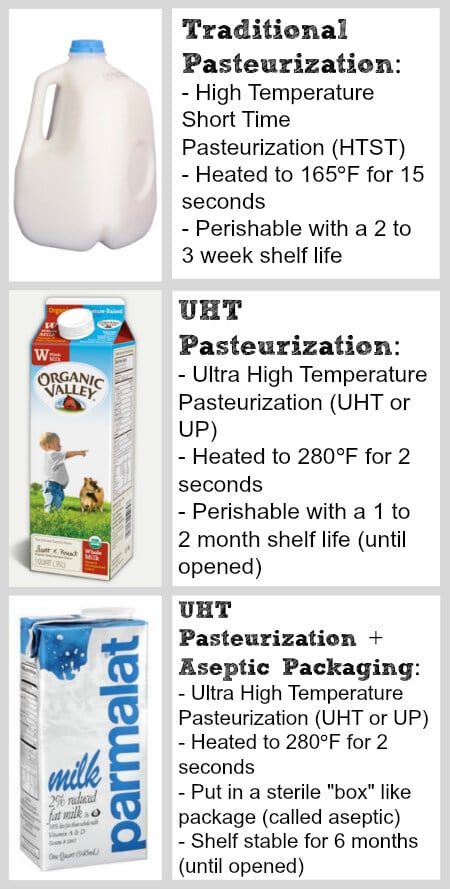
UHT stands for Ultra High-Temperature Pasteurization (also referred to as Ultra Pasteurization or UP) and means that milk is heated to about 280 degrees F for 2 seconds, which kills more bacteria (both good and bad) than traditional pasteurization therefore giving the milk a much longer shelf life before it spoils. Compare this to other milk here in the US, which is typically High Temperature Short Time Pasteurized (minus the "ultra" and shortened to HTST) indicating it has been heated to 165°F for 15 seconds.
So which type of pasteurization is the better choice? Well, it depends on who you ask and what your criteria is...
Producers and retailers - and even some consumers - think UHT milk is the greatest thing since sliced bread. Just think of the cost savings if refrigeration is not required after production, during delivery, or once it arrives to the store - not to mention the extended shelf life. Also, in Europe, many people don't have the mega-sized refrigerators that are so common here in the US so having one less thing to refrigerate is pretty convenient.
Apparently Europeans are fine with the idea of warm, shelf-stable milk, and since it is a rather practical choice that is the majority of what consumers purchase there.
Now here in the US, I haven't exactly heard people singing the praises for UHT. Yes, it may be more convenient, but from a health standpoint while the higher temperature kills even more potentially bad bacteria - the good bacteria, unfortunately, goes with it. One article even calls UHT milk "dead milk" - wow, that's pretty harsh.
I have to agree that I am a little leery of UHT even here in the state of North Carolina where raw milk is not legal for human consumption. I do have to say though that if organic UHT milk was the only organic option in my area - that is definitely what I would choose over conventional. What is your take on UHT milk (please share in the comments)?
So why isn't shelf stable milk sold here like it is in Europe?
A large Italian food company called Parmalat actually tried to take the US dairy industry by storm with their little boxes of shelf-stable UHT milk in the early 90's, but Americans were just not fond of the idea. The reason - we apparently still value the idea of fresh milk, although ironically enough if you are buying your milk from a big box organic dairy company it is likely not much "fresher" than the luke-warm milk sitting on the shelves in Europe (again the only difference is the packaging).
I am the first to admit I am guilty as charged. I was one of those "crazy Americans" searching high and low for refrigerated milk when we were food shopping in France. I just could not buy into the idea of the warm, boxed milk that lined the shelves.
I looked at the labels and saw that they were UHT (something I am familiar with, but do try to avoid at home) so I kept looking and somehow managed to find one lonely brand that offered a few cold bottles of milk in the cheese aisle. I didn't even look to see if that version was also UHT and just went with it because I was so pleased to be able to find what I was "used to" at home.
Check out my Milk 101 post to learn all about the different types of milk that are available here in the US (including low-fat vs. whole) and what kind our family chooses to drink on a regular basis (hint: it is not any of the choices listed in the chart above.) What kind of milk do you buy (and why)?
Sponsor Shoutout: Lunchbox Love
Before I let you go, I have to make sure you know about our sponsor Lunchbox Love. Just in time for back-to-school, they are offering 16 new volumes of cards - including all new facts, jokes, trivia, and positive messages - that you can put in your child's lunchbox each day.
We started sending these cards in our girls' lunches last year, and they honestly adore them. Our oldest daughter shares the cards with her entire lunch table and both girls routinely give us a hard time if we ever forget to add one to their lunch box before sending them off to school!
I feel like these are a great way to make the "real food" lunches I lovingly pack just as fun as all the cartoon-laden packaged foods their friends might be eating. Sure, I could write my own little cards, but I could never be as creative as the Lunchbox Love crew. So I think it is totally worth the cost - plus since the cards come on fairly thick paper they could easily be reused a few times.
Lisa is a wife, mother, foodie, blogger, and #1 New York Times Best-selling author who is on a mission to cut out processed food.
Comments
Wynnsays
Another here who is going to be a bit picky and disagree that 'Europe' largely drinks UHT milk. I'm from the UK and again the majority of milk consumed is of the refrigerated variety. I, and most I know, do buy the odd carton of UHT and keep in the cupboard for 'emergencies' (we can't live without our cups of tea).
According to my research "Seven out of 10 European milk drinkers choose [shelf stable] over regular milk" and that is also mainly what we saw in the 4 countries that we visited. This is in comparison to basically the opposite here in the US (which is also a big place with varying cultures from state to state). Point taken. I've updated the photo to read "Milk that is not refrigerated in Europe" instead of "Milk is not refrigerated in Europe." Thanks for your feedback.
I can't comment on the other 3 countries (though I have seen a lot of UHT milk in France, I haven't noticed whether there was a corresponding lack of fresh milk) but did you really see more UHT than fresh in the UK? Which sort of shops were you looking in? Supermarkets have a large fresh milk section with all sorts of choice, and will have a UHT section but it won't be as big. Did you see people buying lots of UHT milk?
maria @ me in the kitchensays
This is something I have always wondered about,but never taken the time to research as I don't drink much milk. Thanks for the great information you share.
Europe is a melting pot of different countries, languages and cultures. It is comprised of 45 countries and there are roughly 150 different languages spoken. It is impossible to generalize milk consumption.
In Austria/Germany/North Italy you get both versions, UHT and pasteurized. However, your explanation about the pasteurization process is out-dated. About 10 years ago a new technique was developed known as ESL (extended shelf life) and has unfortunately largely replaced traditional pasteurization. Traditionally pasteurized milk has a shelf life of about 1 week, while ESL milk lasts about 4 weeks. Considering the long shelf-life of refrigerated milk in the US I assume it is ESL and not HTST.
UHT milk has a clear off-flavor. Since decades, food industry and public research organizations are working on a way to get rid of the off-flavor - so far without any success. I noticed that the majority of organic milk in the US is UHT and I also know some people in the US who claim that organic milk tastes better/different. I am pretty sure that they are referring to the off-flavor.
We live overseas in Uganda and this is all we drink here, I am SO thankful for it and how available it is! We live 4 hours from the grocery store, so we're pretty thankful for the non-refigeration:)
I did a study abroad in Australia, where both milks were options. I usually went for the shelf stable, because I could buy about a 1/2 litre (or maybe it was a litre) at a time - and since I didn't use milk often there was less for me to toss when it did go bad after it was open (vs a 2 or 4 litre of cold milk). And at over $4.00 a "gallon" in the year 2000, milk was spendy there.
However, now that I am older, wiser, and consume more milk, I'd go for as much bacteria in my milk as possible, staying within this side of harmful of course. Some research suggests that so many of the allergies and food intollerences the general population experiences may be due to a lack of variety in the "flora and fauna" of our guts. So bring on the dirt and bacteria and make my family healthier.
I usually don't comment because of this little pet peeve of mine and though I am not the first one to make this comment, I'm going to say it anyway: 'Europe' is not a country. It is a continent which consists of many, many countries with many many different ways of dealing with things. Saying 'that's how they do it in Europe' is just overgeneralizing, in the same way as saying 'I am going to Africa and all African people are poor'. I am from Holland and we both have the refrigrated and non-refrigated milk here.
According to my research “Seven out of 10 European milk drinkers choose [shelf stable] over regular milk†and that is also mainly what we saw in the 4 countries that we visited. This is in comparison to basically the opposite here in the US (which is also a big place with varying cultures from state to state). Point taken. I’ve updated the photo to read “Milk that is not refrigerated in Europe†instead of “Milk is not refrigerated in Europe.†Thanks for your feedback.
Interestingly, shelf stable milk is a huge commodity for the summer feeding program here in my community. The program offers free lunch during the summer to kids that normally get free or reduced lunch at school. They have been using shelf stable milk for a few years now. I know that all the kids I work with in this program love the shelf stable milk (I think it tastes a little sweeter than fresh), but I always feel disappointed that this is the only choice we have to give them (it's provided to us from a third party) and always wondered about it's nutritional value versus fresh. This summer, they attempted to switch to fresh milk but by the time it got to our site and we served it, it was almost always spoiled. The little shelf stable juice box style servings are the most economical and practical in our case I guess, and thousands of kids in my community are drinking it daily. In this instance, it may be better than the alternative at home, which is usually nothing. However, I found your post very interesting and I might even use it to spark some debate with my local food bank that provides these summer meals!
We also drink raw milk here in TN. It is legal to sell "for pet consumption only", so all the milk has that labeling, but it's made for and safe for humans! You can also get raw milk legally if you own a herd share. Check out http://www.realmilk.com for more info on the health benefits of raw milk and where to get it in your state!
I think the raw milk is much healthier, as it usually comes from small farms with grass-fed cows. Heating destroys all the beneficial bacteria and enzymes, including lactase, which is needed to digest lactose. Explains why many people have issues with dairy! I don't know this from personal experience, but supposedly many people with dairy allergies tolerate raw milk a lot better.
Hi, I live in Hungary and like others in other parts of Europe, I was surprised that you couldn't find refrigerated milk. There is UHT milk here, but I think most stores actually have a wider selection of refrigerated milk that last about a week and many people buy raw milk, either from the farmers (who often provide home delivery) or from dairy stores that sell it.
likewise.
I am originally from the UK, although I live in Canada now... In the UK, UHT milk is generally regarded with suspicion, is considered something to keep in the pantry incase of an emergency (it does not taste as good and is usually skimmed), and fresh milk is the norm. You can even get it delivered by a "milkman" in some areas and have fresh milk on your doorstep when you get up! In addition, it is not normally homogenized like it is in the US/Canada.
You can't buy raw milk in the UK as the milk marketing board controls sales and milk is collected by large creameries who mix it all together and pasteruize it, but you can buy fresh, non-uht treated milk easily in every grocery store, corner shop and convenience store.
I stopped buying UHT milk when I took a cheese making class and learned that UHT milk cannot be used to make cheese, because all the good bacteria gets killed in the heating process. It wont set up properly. That was enough for me to stop buying it altogether. Regular HTST milk still can produce cheese, so I always seek that out. Both Whole Foods and Trader Joes sells organic milk that is just HTST pasteurized. The major organic brands are nearly 100% UHT now, though I recently noticed at Whole Foods new grass fed Organic Valley milk that just says pasteurized on the label, presumably trying to get part of the market that stopped buying their UHT product.
We purchase and drink raw cows milk (un pasturized). We have been to the farm where we purchase it, and know the cows (fully grass fed and pastured) and collection process is perfect. The milk tastes amazing and has made such a big difference in my family's health. My husband no longer has his digestive issues (getting more good bacteria) and my daughter, who is usually sensitive to dairy, is so happy to be able to drink milk again.
I'm a raw milk fan! The taste and nutrient content is far superior to anything pasteurized. My milk supplier chills the milk to 40 degrees within seconds of it leaving the cow, so there isn't any time for bacteria to grow. He also sells some of the milk for pasteurization which is tested every other day for E. coli, etc. More people have gotten sick from commercial spinach, peanut butter or cantelopes than from drinking raw milk. It is a safe, local, direct from the farmer option that also tastes better and is healthier. Win in every way! :)
When you say raw cow's milk is illegal for consumption in NC, do you actually mean that or is it just illegal to buy and sell it? I know here in TN, we can buy a share of a cow, then pay for the raw cow's milk. Since you own the cow (or a part of it), it's perfectly legal.
Also, pasteurized milk causes serious health problems for children such as auto immune disorders like type 1 Diabetes.
The pasteurization process scrambles the amino acid sequences which can trigger a violent reaction from the immune system which damages the Beta cells of the pancreas rendering them from producing insulin. Conventional dairy products also contain very high levels of pesticides, herbicides, dioxins (up to 200x the safe levels), and up to 52 different types of antibiotics that toxify the body and compromise the immune system.
I looked on the Whole Foods website and their 365 Organic and non-Organic milks use the lower temp HTST instead of UHT. For those who have a Whole Foods in their area this might be of interest.
Nice to know there are some organic options out there that aren't UHT. I've sent emails to Trader Joe's and Whole Foods to ask about additives like powdered milk in their low fat and fat free organic milks, since that's typically what I buy. I wondered if anyone knew if the additives mentioned are in all low-fat milks or just non-organic ones?
As far as I understand, the additives are in all low-fat milks because after you take the fat out of milk it is blue and unappetizing. To market it to people so producers can sell the cream AND the milk, they add stuff.
As a quick follow up to this, I received a response from Whole Foods after asking specifically if powdered milk or any other things are added to low fat or fat free milks (365 brand both organic and non) and received this response:
"There are no supplemental ingredients added to our fluid milks beyond the vitamin a and e required by the FDA in lower fat milk products. All of our ingredients are clearly listed on our milk labels. "
Roversays
I stumbled across your blog yesterday while I was looking for some ideas on changing my diet to avoid processed food. I think switching away from box dinners and fast foods is a great thing to be doing in this day and age and I think it's awesome that you and your family are doing this. However, when I looked at your rules I was disappointed when I realized that some of the food you consider okay to eat is still processed.
Milk, for one, is processed. So is cheese and yogurt (unless you are making it yourself, or buying local from someone who makes it fresh).
Also most bread products from the grocery store are processed. The whole wheat wraps, and whole grain bread I have bought (from Harris Teeter) may not contain white flour (though some of the wraps seem to include both white and wheat, which is frustrating) but they also contain a load of ingredients I cannot even pronounce. They are processed foods...
Just curious as to what your take on this is.
In New York, you can consume raw milk. There is one licensed dairy farm near me, or you have to own a "share" of cow and share in its production of milk. I did a lot of reading on UHT and you are better off not drinking that kind at all. It strips the good enzymes and protein out of the milk. Dead amoeba milk is what I call any "pasteurized milk" Homogenization is the second bad thing we do to milk. The "dead" bacteria are not filtered out. Homogenization emusifies the milk so there is no milkfat separation. Low heat pasturization can be found in some local co op stores and I think this is a safe, reasonable option for those who want their milk safe but closest to nature!
Thanks. I have always wondered why the milk is shelf stable. I am glad that is does not contain any preservatives that could be harmful. I feel a bit better about letting my daughter drink these now but I still prefer my fresh organic nonhymogonized milk for me. :)
This is why I love milk from the SC farm, happy cow creamery. It is cold pasteurized (and non-homogenized), preserving even more good bacteria without the risks of raw milk. The ultra high pasteurization seems to be harder to digest without the beneficial bacteria, I try to avoid it but, like you said, would still choose it over conventional milk if it is the only choice. Better than antibiotics and unhealthy cows...
I buy several gallons of UHT milk to have on hand with my Hurricane Emergency supplies. That way, we will have milk to drink (even if it's warm) if the power is off for an extended time. At the end of Hurricane season, I use it to make yogurt or in cooking to get it off the shelf. The next year, I go through the same process. Only have had to use it once but it's great to have on hand!
The little unrefrigerated boxes are a great choice for a post-run recovery drink. I struggled to find "real food" options for after long runs - things that I could bring in the car and eat immediately that weren't highly processed. Unfortunately most of the options marketed to runners - sports drinks, gels, bars - are full of artificial colors, favors and chemicals. Chocolate milk - while it does contain sugar - is a good recovery drink because of the balance of protein and carbs in it; p.us, the little boxes made for kids' lunch boxes are a reasonable portion.
I started buying raw milk (it is legal here) and my whole family loves it! I wish it was legal and available everywhere! In this world of "choices" we should have the choice when it come to our health. When I run low on the raw milk between milk runs or if we are on vacation, then we choose only whole organic milk.
Not all milk in Europe is shelf stable. The fresh milk is available in the refrigerated section of the shop, it's not hard to find. Fresh milk is actually only good for about a week (at least in Switzerland). We used both. Fresh for drinking, and always have shelf stable for emergencies and cooking.
I was just thinking about going to my grandparents home in the late 1950's. They lived in a very rural area and grandfather would be up before daylight milking. I still remember hearing butter being churned in a room behind the little kitchen filled with a big wood cooking range.
I have wondered just how clean are a cow's udders, the hands that milked the cow ?
I don't know, but our standards change don't they ?
My grandparents did not have refrigeration. When we visited our job was to go to the natural ground fed spring where they got pails of water, but they also kept gallon jars of milk chilled for mealtime.
A look back in time and the realities of survival when there were not many choices.
Hi, I live in France, but I am an American. I buy the UHT box milk to be used in baking and cooking and I buy fresh milk for general drinking. For me there is a taste difference and being raised on fresh milk, I prefer it. Raw milk is not readily available, so fresh is at least 2nd best.
Hi, I live in England, and not only is refrigerated milk (like in the US) the most common, many English friends of mine (I'm American) consider UHT milk "what you take camping." Saying this is what they do "in Europe" is a bit of a generalization. The UK is more like the US in regards to milk preferences, although UHT milk is available. It would be more accurate to say "mainland Europe" or "certain parts of Europe" or "France" instead.
I agree! I live in Norway, and have never see non-refrigerated milk here, nor in neighboring countries.
Saying they do something "in Europe" is as silly as saying they do something "in Africa" or "in Asia". These are huge continents concisting of different countries with different cultures and different food choices.
It's disappointing to read this in a blog that usually seems well researched.
Other than that-keep up the good work!
According to my research “Seven out of 10 European milk drinkers choose [shelf stable] over regular milk†and that is also mainly what we saw in the 4 countries that we visited. This is in comparison to basically the opposite here in the US (which is also a big place with varying cultures from state to state). Point taken. I’ve updated the photo to read “Milk that is not refrigerated in Europe†instead of “Milk is not refrigerated in Europe.†Thanks for your feedback.
Beckysays
While I hardly ever buy it due to price and it being harder to find, I think raw milk is really the best option. Obviously, you said where you live it's not legal...and while I haven't done a ton of research on it, I do think that farmers should be able to sell raw milk. Like mentioned, pasturizing, especially UHT, kills all the good stuff along with the bad stuff. So why bother drinking it? There are no health benefit left in it. In an ideal world, there would be no middle man telling us "fresh" milk is bad. :)
Hi, here in the Czech Republic we have many choices it terms of milk. You can buy the UHT milk, which is usually the cheepest and lasts the longest time. Or you can buy the so called "fresh milk", which is sold from the refrigerator and it last some week or so. And the final version (if you do not live in the country and have no access to a farmer) is the milk vending maschine, where you can buy a raw milk into your own bottle or you can buy a clean bottle in the next "window" of the maschine. This milk is said to be better consumed after heating it up at least to 72°C at home, but many people do not do it as they prefer the taste of the raw milk. My friend has a small boy (not even 2 years old) and he drinks such milk, loves it and was never sick. But still many people are kind of afraid of it. And it is the most expensive milk. So, I would say we have pretty much to choose from :-)
I buy my organic milk at Publix because it is only pasturized not sterilized. I don't see why even bother to drink milk which is sterile. It has no health benefits only calories.
You're overly-generalizing about our milk in Europe! In *some* countries, UHT is the norm - France, for example. But in the UK, Scandinavia, the Netherlands, etc etc fresh milk is the standard. I wouldn't touch UHT with a bargepole, think it is disgusting. Europe is big and diverse! :)
I also want to emphasize this same point. I am an American living in Germany for many years. Although there are a number of UHT brands here, there are also a number of brands of fresh milk as well. It seems about 50/50 here. I saw your postings about your European travels, but you did not go to Germany, Scandinavia, etc., so please be careful about your generalizations. It would be like someone visiting the East Coast of the US and then generalizing their experiences for the entire country.
And I agree, UHT milk is disgusting. I've had it many times, and it tastes like all of the good tasty nutritious parts have been killed. In fact, right now there is a commercial running in the radio that comments on the strong taste difference from a company that normally produces fresh milk but who is now putting out a UHT product.
In truth it depends. When our budget is getting pressed and Sam's has gallon milk for $2.88 it is hard to pass up. Right now in my fridge there is Organic Soy (I still don't know the difference between non-GMO soy and Organic non-GMO soy, but the cost was the same so I bought Organic), Dark Chocolate Almond Milk (in my coffee and my son likes to have his mixed with "white milk"), and regular almond milk, and because something I was making didn't turn out correctly using different types of lactose-free milk, I purchased Horizon Organic Fat Free milk.
In England we didn't go to any stores, but at the hotel my 5 year old son is big on chocolate "milk" in the morning. He asked a staff on 3 different days for chocolate milk and 2 days they gave him hot chocolate and when we said, not HOT chocolate just regular cold chocolate milk, they put ice in the hot chocolate. I don't know what they must call it or maybe they don't drink it over there but that was the only thing he wanted when he woke up the first morning at home.
My family has been living in Barcelona for over 4 years. Originally from California, with grandparents who were dairy farmers, I searched for "fresh" milk when we arrived in Spain. The larger grocery stores usually have a small section of cold, us-style milk. My husband worked as the Marketing Director for Parmalat in Argentina for many years as well. I quickly made the switch to UHT and my kids didn't even notice.
I don't serve the milk warm though; box goes into fridge before opening. Comparing US cold milk to Europe lukewarm milk is a bit misleading. While it is lukewarm at the point of sale/purchase, no one I know drinks it warm. It is a practical matter of shelf/fridge space. The best thing about UHT milk is that I never run out of milk. There is always a box waiting on the shelf. My husband swears that US milk has a cooked taste because it is processed longer. As far as dairy-based good bacteria, I am sure European consumption of yogurt and kefir is much higher than the US (did you see the huge yogurt sections in the supermarket?). So there may not be a concern that some good bacteria gets killed in UHT. I also noted here that milk is not really a beverage here as it is in the US. It is a drink for young children, and coffees. I have never seen someone having a glass of milk for dinner or just because like in the US.
I live in the Netherlands, and here traditional pasteurized and refrigerated milk is the most popular option. Most of the packages are one liter. We do have de UHT, but I never use that. I really don't like the taste. Also, our supermarket has a variety of organic options, which is becoming more popular by the day.
I was at Costco in Seattle last week and they had the chocolate milk on the shelves and I thought someone had made a mistake and didn't put it in the frig :) It was the first time I had ever heard of milk not being refrigerated.
In the UK it's mainly pasturized milk we drink, with lots of organic versions. Last time we were in France we bought raw milk from the farmer next door to the villa we were staying in. I did heat it up to kill off some of the bacteria though. But it was the smell that really put me off - a really strong odour of cows, which totally makes sense but was a bit too strong for me! Put me off milk altogether for a long time!
I'm spending the Summer in the south of France at my Dad's house with my three children. Yes, there is a lot of UHT milk, and you have to get to the store on stocking day because the whole 'lait frias' goes pretty quickly (low fat not so much). As someone else pointed out, you can get three kinds of milk in the refrigerated section; cold UHT, regularly pasteurized, and unheated micro-filtered options. Additionally, outside of several of the local supermarkets here in Aveyron, there are machines that dispense raw milk, too. You just bring your own container to fill, and it's great stuff! We also have a farm close by where we get raw milk, which is BY FAR the best milk ever, both for taste and health benefits in our opinion.
What I like best is that the decision is left entirely to the consumer. You want raw milk? Fine, they sell it. You want UHT (which we think tastes flat and slightly metallic or something....we just don't like it)? Fine, they sell that too. No angst, no having to go to a specific source for one or the other, just options.
I'm an American in Europe as well and buy the UHT milk quite often. I really don't understand why so many people are bothered by it. If you don't want warm milk, you can put it in the fridge for a while before you open it! Easy fix!
As part of our "salary package" as youth ministers in our first position, we were provided with 2 gallons of raw milk a week from a local farmer. I loved skimming the cream off the top and making butter. We used it on cereal and my hubby drank it (I never have been a milk drinker) and it didn't take too long to get used to the taste.
Those days are long gone, and now we use whole milk from the grocery store. I still don't drink it, but the rest of the family does and we're all basically healthy. If raw milk were available, I'd probably get it now and then. But since it isn't, we'll use what is and not stress it.
UHT tastes different unless its been refridgerated first. Kinda defeats the point.



Wynn says
Another here who is going to be a bit picky and disagree that 'Europe' largely drinks UHT milk. I'm from the UK and again the majority of milk consumed is of the refrigerated variety. I, and most I know, do buy the odd carton of UHT and keep in the cupboard for 'emergencies' (we can't live without our cups of tea).
Lisa says
According to my research "Seven out of 10 European milk drinkers choose [shelf stable] over regular milk" and that is also mainly what we saw in the 4 countries that we visited. This is in comparison to basically the opposite here in the US (which is also a big place with varying cultures from state to state). Point taken. I've updated the photo to read "Milk that is not refrigerated in Europe" instead of "Milk is not refrigerated in Europe." Thanks for your feedback.
CJ says
I can't comment on the other 3 countries (though I have seen a lot of UHT milk in France, I haven't noticed whether there was a corresponding lack of fresh milk) but did you really see more UHT than fresh in the UK? Which sort of shops were you looking in? Supermarkets have a large fresh milk section with all sorts of choice, and will have a UHT section but it won't be as big. Did you see people buying lots of UHT milk?
maria @ me in the kitchen says
This is something I have always wondered about,but never taken the time to research as I don't drink much milk. Thanks for the great information you share.
Critical Reader says
Europe is a melting pot of different countries, languages and cultures. It is comprised of 45 countries and there are roughly 150 different languages spoken. It is impossible to generalize milk consumption.
In Austria/Germany/North Italy you get both versions, UHT and pasteurized. However, your explanation about the pasteurization process is out-dated. About 10 years ago a new technique was developed known as ESL (extended shelf life) and has unfortunately largely replaced traditional pasteurization. Traditionally pasteurized milk has a shelf life of about 1 week, while ESL milk lasts about 4 weeks. Considering the long shelf-life of refrigerated milk in the US I assume it is ESL and not HTST.
UHT milk has a clear off-flavor. Since decades, food industry and public research organizations are working on a way to get rid of the off-flavor - so far without any success. I noticed that the majority of organic milk in the US is UHT and I also know some people in the US who claim that organic milk tastes better/different. I am pretty sure that they are referring to the off-flavor.
.
Shannon says
We live overseas in Uganda and this is all we drink here, I am SO thankful for it and how available it is! We live 4 hours from the grocery store, so we're pretty thankful for the non-refigeration:)
Shallon says
I did a study abroad in Australia, where both milks were options. I usually went for the shelf stable, because I could buy about a 1/2 litre (or maybe it was a litre) at a time - and since I didn't use milk often there was less for me to toss when it did go bad after it was open (vs a 2 or 4 litre of cold milk). And at over $4.00 a "gallon" in the year 2000, milk was spendy there.
However, now that I am older, wiser, and consume more milk, I'd go for as much bacteria in my milk as possible, staying within this side of harmful of course. Some research suggests that so many of the allergies and food intollerences the general population experiences may be due to a lack of variety in the "flora and fauna" of our guts. So bring on the dirt and bacteria and make my family healthier.
Kim says
I usually don't comment because of this little pet peeve of mine and though I am not the first one to make this comment, I'm going to say it anyway: 'Europe' is not a country. It is a continent which consists of many, many countries with many many different ways of dealing with things. Saying 'that's how they do it in Europe' is just overgeneralizing, in the same way as saying 'I am going to Africa and all African people are poor'. I am from Holland and we both have the refrigrated and non-refrigated milk here.
Lisa says
According to my research “Seven out of 10 European milk drinkers choose [shelf stable] over regular milk†and that is also mainly what we saw in the 4 countries that we visited. This is in comparison to basically the opposite here in the US (which is also a big place with varying cultures from state to state). Point taken. I’ve updated the photo to read “Milk that is not refrigerated in Europe†instead of “Milk is not refrigerated in Europe.†Thanks for your feedback.
Christy says
Interestingly, shelf stable milk is a huge commodity for the summer feeding program here in my community. The program offers free lunch during the summer to kids that normally get free or reduced lunch at school. They have been using shelf stable milk for a few years now. I know that all the kids I work with in this program love the shelf stable milk (I think it tastes a little sweeter than fresh), but I always feel disappointed that this is the only choice we have to give them (it's provided to us from a third party) and always wondered about it's nutritional value versus fresh. This summer, they attempted to switch to fresh milk but by the time it got to our site and we served it, it was almost always spoiled. The little shelf stable juice box style servings are the most economical and practical in our case I guess, and thousands of kids in my community are drinking it daily. In this instance, it may be better than the alternative at home, which is usually nothing. However, I found your post very interesting and I might even use it to spark some debate with my local food bank that provides these summer meals!
Shereen says
We also drink raw milk here in TN. It is legal to sell "for pet consumption only", so all the milk has that labeling, but it's made for and safe for humans! You can also get raw milk legally if you own a herd share. Check out http://www.realmilk.com for more info on the health benefits of raw milk and where to get it in your state!
I think the raw milk is much healthier, as it usually comes from small farms with grass-fed cows. Heating destroys all the beneficial bacteria and enzymes, including lactase, which is needed to digest lactose. Explains why many people have issues with dairy! I don't know this from personal experience, but supposedly many people with dairy allergies tolerate raw milk a lot better.
Jen T says
Hi, I live in Hungary and like others in other parts of Europe, I was surprised that you couldn't find refrigerated milk. There is UHT milk here, but I think most stores actually have a wider selection of refrigerated milk that last about a week and many people buy raw milk, either from the farmers (who often provide home delivery) or from dairy stores that sell it.
Salixisme says
likewise.
I am originally from the UK, although I live in Canada now... In the UK, UHT milk is generally regarded with suspicion, is considered something to keep in the pantry incase of an emergency (it does not taste as good and is usually skimmed), and fresh milk is the norm. You can even get it delivered by a "milkman" in some areas and have fresh milk on your doorstep when you get up! In addition, it is not normally homogenized like it is in the US/Canada.
You can't buy raw milk in the UK as the milk marketing board controls sales and milk is collected by large creameries who mix it all together and pasteruize it, but you can buy fresh, non-uht treated milk easily in every grocery store, corner shop and convenience store.
GregB says
I stopped buying UHT milk when I took a cheese making class and learned that UHT milk cannot be used to make cheese, because all the good bacteria gets killed in the heating process. It wont set up properly. That was enough for me to stop buying it altogether. Regular HTST milk still can produce cheese, so I always seek that out. Both Whole Foods and Trader Joes sells organic milk that is just HTST pasteurized. The major organic brands are nearly 100% UHT now, though I recently noticed at Whole Foods new grass fed Organic Valley milk that just says pasteurized on the label, presumably trying to get part of the market that stopped buying their UHT product.
Salixisme says
I wish we could buy raw milk in Canada... it is illegal for it to be sold here though.
Sarah says
We purchase and drink raw cows milk (un pasturized). We have been to the farm where we purchase it, and know the cows (fully grass fed and pastured) and collection process is perfect. The milk tastes amazing and has made such a big difference in my family's health. My husband no longer has his digestive issues (getting more good bacteria) and my daughter, who is usually sensitive to dairy, is so happy to be able to drink milk again.
http://www.realmilk.com/
Denise says
I'm a raw milk fan! The taste and nutrient content is far superior to anything pasteurized. My milk supplier chills the milk to 40 degrees within seconds of it leaving the cow, so there isn't any time for bacteria to grow. He also sells some of the milk for pasteurization which is tested every other day for E. coli, etc. More people have gotten sick from commercial spinach, peanut butter or cantelopes than from drinking raw milk. It is a safe, local, direct from the farmer option that also tastes better and is healthier. Win in every way! :)
Kayla W says
When you say raw cow's milk is illegal for consumption in NC, do you actually mean that or is it just illegal to buy and sell it? I know here in TN, we can buy a share of a cow, then pay for the raw cow's milk. Since you own the cow (or a part of it), it's perfectly legal.
Also, pasteurized milk causes serious health problems for children such as auto immune disorders like type 1 Diabetes.
The pasteurization process scrambles the amino acid sequences which can trigger a violent reaction from the immune system which damages the Beta cells of the pancreas rendering them from producing insulin. Conventional dairy products also contain very high levels of pesticides, herbicides, dioxins (up to 200x the safe levels), and up to 52 different types of antibiotics that toxify the body and compromise the immune system.
http://www.naturalnews.com/031320_type_1_diabetes_lifestyle.html
Assistant to 100 Days (Amy) says
Hi there. I believe it is illegal to sell raw milk for human consumption in the state of NC. ~Amy
karen says
I looked on the Whole Foods website and their 365 Organic and non-Organic milks use the lower temp HTST instead of UHT. For those who have a Whole Foods in their area this might be of interest.
http://www.wholefoodsmarket.com/about-our-products/product-faq/milk-and-eggs
Nice to know there are some organic options out there that aren't UHT. I've sent emails to Trader Joe's and Whole Foods to ask about additives like powdered milk in their low fat and fat free organic milks, since that's typically what I buy. I wondered if anyone knew if the additives mentioned are in all low-fat milks or just non-organic ones?
Nicole says
As far as I understand, the additives are in all low-fat milks because after you take the fat out of milk it is blue and unappetizing. To market it to people so producers can sell the cream AND the milk, they add stuff.
Karen says
As a quick follow up to this, I received a response from Whole Foods after asking specifically if powdered milk or any other things are added to low fat or fat free milks (365 brand both organic and non) and received this response:
"There are no supplemental ingredients added to our fluid milks beyond the vitamin a and e required by the FDA in lower fat milk products. All of our ingredients are clearly listed on our milk labels. "
Rover says
I stumbled across your blog yesterday while I was looking for some ideas on changing my diet to avoid processed food. I think switching away from box dinners and fast foods is a great thing to be doing in this day and age and I think it's awesome that you and your family are doing this. However, when I looked at your rules I was disappointed when I realized that some of the food you consider okay to eat is still processed.
Milk, for one, is processed. So is cheese and yogurt (unless you are making it yourself, or buying local from someone who makes it fresh).
Also most bread products from the grocery store are processed. The whole wheat wraps, and whole grain bread I have bought (from Harris Teeter) may not contain white flour (though some of the wraps seem to include both white and wheat, which is frustrating) but they also contain a load of ingredients I cannot even pronounce. They are processed foods...
Just curious as to what your take on this is.
Assistant to 100 Days (Amy) says
Hi there Rover. While we try to avoid all highly processed foods, we do buy dairy products in their minimally processed organic grass-fed, when possible, forms. As for breads, we typically buy from a local bakery that uses 5 or less whole ingredients or make the bread ourselves. Here are a couple staple recipes: https://www.100daysofrealfood.com/2011/08/17/recipe-honey-whole-wheat-sandwich-bread-for-bread-machine/ and https://www.100daysofrealfood.com/2011/08/17/recipe-honey-whole-wheat-sandwich-bread-for-bread-machine/. ~Amy
Jenny says
In New York, you can consume raw milk. There is one licensed dairy farm near me, or you have to own a "share" of cow and share in its production of milk. I did a lot of reading on UHT and you are better off not drinking that kind at all. It strips the good enzymes and protein out of the milk. Dead amoeba milk is what I call any "pasteurized milk" Homogenization is the second bad thing we do to milk. The "dead" bacteria are not filtered out. Homogenization emusifies the milk so there is no milkfat separation. Low heat pasturization can be found in some local co op stores and I think this is a safe, reasonable option for those who want their milk safe but closest to nature!
Catriona says
Thanks. I have always wondered why the milk is shelf stable. I am glad that is does not contain any preservatives that could be harmful. I feel a bit better about letting my daughter drink these now but I still prefer my fresh organic nonhymogonized milk for me. :)
Courtney says
This is why I love milk from the SC farm, happy cow creamery. It is cold pasteurized (and non-homogenized), preserving even more good bacteria without the risks of raw milk. The ultra high pasteurization seems to be harder to digest without the beneficial bacteria, I try to avoid it but, like you said, would still choose it over conventional milk if it is the only choice. Better than antibiotics and unhealthy cows...
Brenda McNeil says
I buy several gallons of UHT milk to have on hand with my Hurricane Emergency supplies. That way, we will have milk to drink (even if it's warm) if the power is off for an extended time. At the end of Hurricane season, I use it to make yogurt or in cooking to get it off the shelf. The next year, I go through the same process. Only have had to use it once but it's great to have on hand!
Mary Beth says
The little unrefrigerated boxes are a great choice for a post-run recovery drink. I struggled to find "real food" options for after long runs - things that I could bring in the car and eat immediately that weren't highly processed. Unfortunately most of the options marketed to runners - sports drinks, gels, bars - are full of artificial colors, favors and chemicals. Chocolate milk - while it does contain sugar - is a good recovery drink because of the balance of protein and carbs in it; p.us, the little boxes made for kids' lunch boxes are a reasonable portion.
Sara says
I've lived in Germany for 12 years, not all milk is UHT milk. I buy cold fresh milk (10 liters a week) in the German grocery store all the time.
Rebekah says
I started buying raw milk (it is legal here) and my whole family loves it! I wish it was legal and available everywhere! In this world of "choices" we should have the choice when it come to our health. When I run low on the raw milk between milk runs or if we are on vacation, then we choose only whole organic milk.
Olivia says
Not all milk in Europe is shelf stable. The fresh milk is available in the refrigerated section of the shop, it's not hard to find. Fresh milk is actually only good for about a week (at least in Switzerland). We used both. Fresh for drinking, and always have shelf stable for emergencies and cooking.
Shirley Riley says
I was just thinking about going to my grandparents home in the late 1950's. They lived in a very rural area and grandfather would be up before daylight milking. I still remember hearing butter being churned in a room behind the little kitchen filled with a big wood cooking range.
I have wondered just how clean are a cow's udders, the hands that milked the cow ?
I don't know, but our standards change don't they ?
My grandparents did not have refrigeration. When we visited our job was to go to the natural ground fed spring where they got pails of water, but they also kept gallon jars of milk chilled for mealtime.
A look back in time and the realities of survival when there were not many choices.
Katie Riley says
Hi, I live in France, but I am an American. I buy the UHT box milk to be used in baking and cooking and I buy fresh milk for general drinking. For me there is a taste difference and being raised on fresh milk, I prefer it. Raw milk is not readily available, so fresh is at least 2nd best.
Lydia says
Hi, I live in England, and not only is refrigerated milk (like in the US) the most common, many English friends of mine (I'm American) consider UHT milk "what you take camping." Saying this is what they do "in Europe" is a bit of a generalization. The UK is more like the US in regards to milk preferences, although UHT milk is available. It would be more accurate to say "mainland Europe" or "certain parts of Europe" or "France" instead.
Lisa says
I agree! I live in Norway, and have never see non-refrigerated milk here, nor in neighboring countries.
Saying they do something "in Europe" is as silly as saying they do something "in Africa" or "in Asia". These are huge continents concisting of different countries with different cultures and different food choices.
It's disappointing to read this in a blog that usually seems well researched.
Other than that-keep up the good work!
Lisa says
According to my research “Seven out of 10 European milk drinkers choose [shelf stable] over regular milk†and that is also mainly what we saw in the 4 countries that we visited. This is in comparison to basically the opposite here in the US (which is also a big place with varying cultures from state to state). Point taken. I’ve updated the photo to read “Milk that is not refrigerated in Europe†instead of “Milk is not refrigerated in Europe.†Thanks for your feedback.
Becky says
While I hardly ever buy it due to price and it being harder to find, I think raw milk is really the best option. Obviously, you said where you live it's not legal...and while I haven't done a ton of research on it, I do think that farmers should be able to sell raw milk. Like mentioned, pasturizing, especially UHT, kills all the good stuff along with the bad stuff. So why bother drinking it? There are no health benefit left in it. In an ideal world, there would be no middle man telling us "fresh" milk is bad. :)
Daniela says
Hi, here in the Czech Republic we have many choices it terms of milk. You can buy the UHT milk, which is usually the cheepest and lasts the longest time. Or you can buy the so called "fresh milk", which is sold from the refrigerator and it last some week or so. And the final version (if you do not live in the country and have no access to a farmer) is the milk vending maschine, where you can buy a raw milk into your own bottle or you can buy a clean bottle in the next "window" of the maschine. This milk is said to be better consumed after heating it up at least to 72°C at home, but many people do not do it as they prefer the taste of the raw milk. My friend has a small boy (not even 2 years old) and he drinks such milk, loves it and was never sick. But still many people are kind of afraid of it. And it is the most expensive milk. So, I would say we have pretty much to choose from :-)
lynne says
I buy my organic milk at Publix because it is only pasturized not sterilized. I don't see why even bother to drink milk which is sterile. It has no health benefits only calories.
Emily says
You're overly-generalizing about our milk in Europe! In *some* countries, UHT is the norm - France, for example. But in the UK, Scandinavia, the Netherlands, etc etc fresh milk is the standard. I wouldn't touch UHT with a bargepole, think it is disgusting. Europe is big and diverse! :)
Olivia says
I also want to emphasize this same point. I am an American living in Germany for many years. Although there are a number of UHT brands here, there are also a number of brands of fresh milk as well. It seems about 50/50 here. I saw your postings about your European travels, but you did not go to Germany, Scandinavia, etc., so please be careful about your generalizations. It would be like someone visiting the East Coast of the US and then generalizing their experiences for the entire country.
And I agree, UHT milk is disgusting. I've had it many times, and it tastes like all of the good tasty nutritious parts have been killed. In fact, right now there is a commercial running in the radio that comments on the strong taste difference from a company that normally produces fresh milk but who is now putting out a UHT product.
Kit says
In truth it depends. When our budget is getting pressed and Sam's has gallon milk for $2.88 it is hard to pass up. Right now in my fridge there is Organic Soy (I still don't know the difference between non-GMO soy and Organic non-GMO soy, but the cost was the same so I bought Organic), Dark Chocolate Almond Milk (in my coffee and my son likes to have his mixed with "white milk"), and regular almond milk, and because something I was making didn't turn out correctly using different types of lactose-free milk, I purchased Horizon Organic Fat Free milk.
In England we didn't go to any stores, but at the hotel my 5 year old son is big on chocolate "milk" in the morning. He asked a staff on 3 different days for chocolate milk and 2 days they gave him hot chocolate and when we said, not HOT chocolate just regular cold chocolate milk, they put ice in the hot chocolate. I don't know what they must call it or maybe they don't drink it over there but that was the only thing he wanted when he woke up the first morning at home.
Jennifer says
My family has been living in Barcelona for over 4 years. Originally from California, with grandparents who were dairy farmers, I searched for "fresh" milk when we arrived in Spain. The larger grocery stores usually have a small section of cold, us-style milk. My husband worked as the Marketing Director for Parmalat in Argentina for many years as well. I quickly made the switch to UHT and my kids didn't even notice.
I don't serve the milk warm though; box goes into fridge before opening. Comparing US cold milk to Europe lukewarm milk is a bit misleading. While it is lukewarm at the point of sale/purchase, no one I know drinks it warm. It is a practical matter of shelf/fridge space. The best thing about UHT milk is that I never run out of milk. There is always a box waiting on the shelf. My husband swears that US milk has a cooked taste because it is processed longer. As far as dairy-based good bacteria, I am sure European consumption of yogurt and kefir is much higher than the US (did you see the huge yogurt sections in the supermarket?). So there may not be a concern that some good bacteria gets killed in UHT. I also noted here that milk is not really a beverage here as it is in the US. It is a drink for young children, and coffees. I have never seen someone having a glass of milk for dinner or just because like in the US.
Brechje says
I live in the Netherlands, and here traditional pasteurized and refrigerated milk is the most popular option. Most of the packages are one liter. We do have de UHT, but I never use that. I really don't like the taste. Also, our supermarket has a variety of organic options, which is becoming more popular by the day.
Amy says
I was at Costco in Seattle last week and they had the chocolate milk on the shelves and I thought someone had made a mistake and didn't put it in the frig :) It was the first time I had ever heard of milk not being refrigerated.
Suzanne says
In the UK it's mainly pasturized milk we drink, with lots of organic versions. Last time we were in France we bought raw milk from the farmer next door to the villa we were staying in. I did heat it up to kill off some of the bacteria though. But it was the smell that really put me off - a really strong odour of cows, which totally makes sense but was a bit too strong for me! Put me off milk altogether for a long time!
Gwen says
I'm spending the Summer in the south of France at my Dad's house with my three children. Yes, there is a lot of UHT milk, and you have to get to the store on stocking day because the whole 'lait frias' goes pretty quickly (low fat not so much). As someone else pointed out, you can get three kinds of milk in the refrigerated section; cold UHT, regularly pasteurized, and unheated micro-filtered options. Additionally, outside of several of the local supermarkets here in Aveyron, there are machines that dispense raw milk, too. You just bring your own container to fill, and it's great stuff! We also have a farm close by where we get raw milk, which is BY FAR the best milk ever, both for taste and health benefits in our opinion.
What I like best is that the decision is left entirely to the consumer. You want raw milk? Fine, they sell it. You want UHT (which we think tastes flat and slightly metallic or something....we just don't like it)? Fine, they sell that too. No angst, no having to go to a specific source for one or the other, just options.
Callie says
I am an American, but we are stationed in Japan. The only milk they sell at our commissary is UHT. I've never seen it not refrigerated, though.
Liz says
I'm an American in Europe as well and buy the UHT milk quite often. I really don't understand why so many people are bothered by it. If you don't want warm milk, you can put it in the fridge for a while before you open it! Easy fix!
Q says
As part of our "salary package" as youth ministers in our first position, we were provided with 2 gallons of raw milk a week from a local farmer. I loved skimming the cream off the top and making butter. We used it on cereal and my hubby drank it (I never have been a milk drinker) and it didn't take too long to get used to the taste.
Those days are long gone, and now we use whole milk from the grocery store. I still don't drink it, but the rest of the family does and we're all basically healthy. If raw milk were available, I'd probably get it now and then. But since it isn't, we'll use what is and not stress it.
UHT tastes different unless its been refridgerated first. Kinda defeats the point.