
Want to Save this Recipe?
Enter your email below & we'll send it straight to your inbox. Plus you'll get great new recipes from us every week!
Did you know that food intolerances affect approximately 10% of Americans, whereas food allergies are thought to affect 4% of teens and adults and 5% of children? Cow’s milk is the most common food allergy in American children, affecting approximately 2.5%, however many will outgrow this allergy by the time they reach school age (about 80%).
FOOD INTOLERANCE OR ALLERGY?
So, what’s the difference between a food intolerance and a food allergy? According to WebMD, a food allergy is an immune system response. It occurs when the body mistakes an ingredient in food -- usually a protein -- as harmful and creates a defense system (antibodies) to fight it. Food allergy symptoms develop when the antibodies are battling the "invading" food. Milk is one of the eight most common food allergies.
A food intolerance on the other hand is a digestive system response rather than an immune system response. It occurs when something in a food irritates a person's digestive system or when a person is unable to properly digest or breakdown the food. Intolerance to lactose, which is found in milk and other dairy products, is the most common food intolerance.
WHAT ARE THE SYMPTOMS OF A FOOD INTOLERANCE OR ALLERGY?
Symptoms such as nausea, stomach pain and diarrhea are characteristic of both allergies and intolerances. Additional allergy symptoms may include rash or hives, itchy skin, shortness of breath, chest pain, swelling of the airways to the lungs and anaphylaxis. Intolerances may also cause additional symptoms to those already noted above such as gas, cramps, bloating, vomiting, heartburn, headaches and irritability or nervousness.
Diagnosing milk allergies in adults is not always straightforward since adults can develop them in the absence of any childhood history of allergies. In addition to clinical allergy tests, many doctors are now recommending elimination diets as an effective diagnostic tool for dairy allergies and intolerances. They have found that this method is simple, free, highly effective, and tailored to the individual.
LIVING WITH A DAIRY INTOLERANCE OR ALLERGY
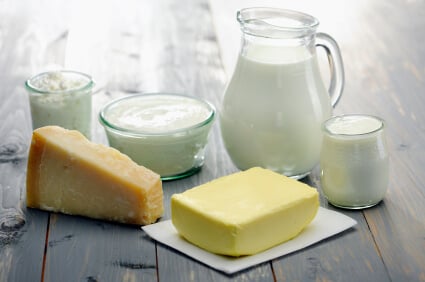
So, you or someone you love is dairy free. Now what? Some individuals who are lactose intolerant may still be able to consume dairy by using a product such as lactaid. This product is said to help break down the lactose found in dairy products such as milk and cheese to allow digestion without stomach discomfort. But for those with a dairy allergy or for whom this type of product is not effective, eliminating dairy may be the only option. That was the case for my husband who, in addition to being gluten free like I mentioned in my last post, is also dairy free. He has personally chosen to simply eliminate dairy from his diet and add very few dairy alternatives in its place. The number one dairy free item we use is almond milk. I have found it to be a great replacement in pancakes, waffles and baking, as well as for smoothies. I always recommend using the plain, unsweetened variety. Or, better yet, you can make it yourself as I have recently started doing after reading several articles about some questionable ingredients used in the name brand products. I have included the recipe below if you’d like to give it a try.
We also use rice milk (again, look for ones made from brown rice and unsweetened), but, much less often. I find rice milk to be better for cooking as opposed to baking, such as for making dairy free mashed potatoes.
And, finally, I’m sure you’re wondering about butter. Luckily, my husband has not had a problem with butter and, as such has not eliminated it from his diet. I couldn’t figure out why that was, but, according to Wikipedia, the butter making process separates the majority of milk’s water components from the fat components and, as such, lactose, being a water soluble component, is largely removed from the butter. Clarified butter (a.k.a. Ghee) has an even lower amount of lactose and may be an even better alternative.
Living with a dairy allergy or intolerance, especially if diagnosed later in life, does require some adjusting. But just like everything else, it can be done and still allow you to enjoy a variety of foods. To help you along the path, I’d like to leave you with a few recipes that are both gluten-free and dairy-free, as well as the recipe for the almond milk. I hope you will enjoy them.
-
RECIPES THAT ARE BOTH DAIRY-FREE AND GLUTEN-FREE...

Almond Milk
Ingredients
- 2 cups almonds (blanched)
- 4 cups water (filtered)
- 1 teaspoon pure vanilla extract
Instructions
- Soak almonds overnight.
- Discard soaking water and rinse almonds until water runs clear.
- Place almonds, 4 cups water and vanilla extract in blender.
- Blend for approximately 90 seconds.
- Line fine mesh strainer with a few layers of cheese cloth. Pour blended milk through cheese cloth. Squeeze remaining milk through cheese cloth.
Don’t discard the almond mixture. You can dry it out in a low oven (around 200 degrees) to make almond flour (which is gluten free).
Notes
Nutrition Facts
Buckwheat Pancakes
Ingredients
- ½ cup buckwheat flour
- ½ cup oats (rolled, gluten-free)
- ½ cup whole-grain cornmeal
- 1 teaspoon baking powder
- ½ teaspoon baking soda
- 1 banana (ripe)
- 2 tablespoons vinegar
- 3 tablespoons pure maple syrup (optional)
- 2 cups almond milk
Instructions
- Mix buckwheat flour, oats, cornmeal, baking powder, and baking soda in a bowl.
- Mash the banana in another bowl, and add vinegar, maple syrup, and milk. Stir and add to the dry ingredients.
- Cook over medium heat until bubbles form. Flip, cook another few minutes on the other side.
- Enjoy plain or with fruit and maple syrup.
Notes
Nutrition Facts
Fruit Crisp
Ingredients
- 4 cups fruit ((I try and use what's in season, but apples and peaches are the ones I use most often))
- 4 tablespoons almond flour
- 4 tablespoons butter (if you can not tolerate butter you can use a non-dairy alternative such as coconut oil)
- ¼ cup oats (rolled, gluten-free)
- ½ cup pecans
- 1 pinch salt
- 2 tablespoons muscovado sugar
- 2 tablespoons sugar
- 1 teaspoon pure vanilla extract
Instructions
- Preheat oven to 375 degrees.
- Peel and cut fruit. Toss with 1 tablespoon almond flour and dot with 1 tablespoon of the butter.
- In a food processor, combine oats, pecans, remaining 3 tablespoons almond flour, salt, muscovado sugar, granulated sugar, remaining 3 tablespoons melted butter and vanilla. Process until crumbs form.
- Sprinkle topping over fruit and bake for 20 minutes, or until crispy and golden brown on top (note: I usually bake the apple crisp a bit longer to get the apples to soften more).
- Serve warm. You can also serve with vanilla ice cream for those that can have dairy.
Notes
Nutrition Facts
Almond Butter Brownies
From www.foodbabe.com
Lisa has been raving about these brownies to me and I have yet to try them (although I plan to). Here is the link to the recipe if you’d like to give them a try: http://foodbabe.com/2012/03/04/almond-butter-brownies/. They are both gluten and dairy free.


stacie mcgregor says
Do you have a recommendation for brands of almond milk? Everything I see always has so many extra ingredients in it. Would love some suggestions for my son with allergies!
Amy Taylor (comment moderator) says
Hi there. I know that Silk and Whole Foods 365 are carrageenan free but it is tough to find a short ingredient almond milk. Here's a recipe for one you can make: https://www.100daysofrealfood.com/food-allergies-dairy/.
stacie mcgregor says
Thank you!
Ericka Bonilla says
Do you have a recommendation for a dairy free cheese? I have tried a couple dairy free ones and it either tasted like plastic or didn’t was not tasty.
100 Days Admin says
Hi Ericka, It would depend on the recipe but Amy goes with vegan nut cheeses and loves them: http://www.onegreenplanet.org/vegan-recipe/10-vegan-cheeses-that-will-knock-your-socks-off/1. :) - Nicole
Pat Callaham says
Have you discovered Califia? Toasted coconut/almond is my favorite
Jill says
My husband and I are trying a gluten free diet in order to combat the joint inflammation that we both have. We have limited our food to Real Food for the past three years. Eliminating gluten has made a real food diet much more difficult. One of the biggest challenge is to find a snack cracker. Prior to Gluten Free, we had eaten and enjoyed Ak-Mak crackers. We also occasionally bought Triscuits. Is there a good gluten free cracker that is not full of preservatives and artificial flavors?
Amy Taylor (comment moderator) says
Hi there. Lisa sometimes buys the Crunch Master brand of crackers. They are a staple in my home where two of us are gluten free.
Leslie says
We loooove avocados! My children have fallen in love with avocadoes and homemade guacamole since we have tried to cut out dairy.
I need to make a homemade pizza for my son's Valentine's Day party at school next Friday. He is allergic to wheat and eggs, so I have to cook it from scratch. Do you think I could just sprinkle nutritional yeast on top or leave the cheese off completely? I have thought about finely grating carrots to give the appearance of cheese on the pizza and add some nutrition (he likes carrots). Any thoughts?
Amy Taylor (comment moderator) says
Hi again Leslie. While I do not think I've ever had carrots on pizza, I don't see why they would be a bad idea. ;) I like nutritional yeast on pizza but I go pretty lightly on it.
Leslie says
I have heard a lot of good things about nut cheeses. Unfortunately my son is allergic to peanuts and tree nuts, so it is not an option for us. :(. The only real food substitute that we have for cheese is nutritional yeast.
I was buying my son some of the vegan cheeses but when I read the ingredients, it grossed me out so I guess we are just going to do without cheese for now. Homemade pizza won't be the same anymore! :(
Amy Taylor (comment moderator) says
Yes, nut cheeses make it a little easier but honestly most of the time I just go cheese-less. I've looked for "better alternatives". Example: I've found that with Mexican, an avocado is a great replacement for cheese. I also use nutritional yeast where I once would have used Parmesan. It is good on pizza.
Leslie tutty says
What do you use as a substitute for cheese?
Amy Taylor (comment moderator) says
Hi Leslie. It would depend on the recipe but I've just entered the world of vegan nut cheeses and am loving them: http://www.onegreenplanet.org/vegan-recipe/10-vegan-cheeses-that-will-knock-your-socks-off/1. :)
Leslie says
My son is now able to eat almonds! I am going to try the almond Parmesan recipe in the link above. Thanks!
Nicole says
How long can the almond milk keep for? And approximately how much almond milk does the recipe make?
It sounds really easy so I'm eager to try to it but want to make sure I can use it all without it going bad.
Thanks.
Amy Taylor (comment moderator) says
Hi Nicole. I can usually squeeze most of the liquid out of the cheese cloth and end up with about 3 3/4 cups of almond milk. We go through that amount pretty quickly but it should be good in the fridge for 3-5 days. ~Amy
Tracy says
I just received Lisa's book and I love it. My son has egg and dairy allergy. I use earth balance butter and I read in the book why it was bad. My question is what can I use in place of earth balance butter. He loves it on his pasta and toast.
Amy Taylor (comment moderator) says
Hi Tracy. I would experiment with olive oil and/or coconut oil and nut butters or fruit spreads are always an option for toast. Pastas are very good tossed in olive oil. It may take some trial and error to find the right combo and a bit of taste bud adjustment, too. If you continue to use Earth Balance, try phasing it out by using less of it less often (maybe combined with other oils) and choose the organic version. ~Amy
Michele says
Are the almonds in the Milk recipe whole or sliced?
Amy Taylor (comment moderator) says
Hi Michele. They are whole but sliced is fine, too. ~Amy
Joann Rosenbaum says
what is the difference between blanched almonds and raw almonds?
Thanks
Assistant to 100 Days (Amy) says
Hi Joann. So, a raw almond can be blanched but a blanched almond is not necessarily raw. :) This will help explain: http://toriavey.com/how-to/2012/10/how-to-blanch-almonds/. ~Amy
michelle says
(The comment above is in reference to the fruit crisp.)
Also, not sure what size pan the recipe is intended for...guessing an 8x8?
Lastly, I'm using ripe but firm peaches, so guessing I'll cook longer since apples take longer...
Michelle
michelle says
Hello,
If I do not have almond flour on hand, may I substitute whole wheat pastry flour instead? And if so, in what amount?
Thanks,
Michelle
Assistant to 100 Days (Amy) says
Hello Michelle. We haven't tried, so it would be a bit of an experiment for you. :)
Megan says
I'm a little confused why there is sugar in most of the desserts? I thought the rules mentioned to cut out refined sugar and only use honey and syrup. Thanks.
Assistant to 100 Days (Amy) says
Hi Megan. Lisa uses refined sugar in just a handful of recipes. Most of her sweet recipes are made with honey and maple syrup. ~Amy
Roxy says
Loved this recipe! Check out my blog at http://healthyandhappywellness.blogspot.com :)
rachel says
So... What alternatives other than nutmeg could be used when you are allergic to cinnamon... I notice more and more recipes are using it now days and substituting nutmeg just doesn't cut it.
shelley hopkins says
My husband has a lactaid allergy that causes him to have serious migraines. For years doctors didn't believe him, but we eliminated milk and the frequency of the migraines went way down. He has cluster migraines which are horrible. He did finally visit with an allergist that said milk allergies may start mild with tummy problems but can evolve to more serious issues such as the headaches. We love almond milk, lactaid free, and soy, but I am excited to try making our own almond milk. He also has tomato allergies, he can't eat red ones, but the yellow are fine, and heritage ones seem fine. Happily we like to garden and can, so we just serve yellow spaghetti and pizza!
Cindy Hornickel says
I came to find this recipe via your email that you sent me. How long does this Almond milk stay good for? Thanks!
rachel says
bummer ... I made the almond butter brownies and was so unbelievably psyched to eat them. I followed the recipe to a "T". They were such a disappointment and barely edible at first (we got used to them) - and they were totally crumbly (couldn't cut them into squared, just a bunch of crumbs we had to eat with a spoon) but not because they were dry, they were actually pretty moist. We did choke them down over the course of a couple of weeks because I did not want to simply waste all of those good, expensive ingredients! (on a positive note and to give props, Food Babe's Kale tacos are-to-die-for!!!).
Judy says
In my research, I have read that you cannot use too much almond flour/meal in a recipe because it won't hold together as you experienced. In my experience, if more than HALF of the "flour" in a recipe is almond meal, you will end up with crumbly, but moist results. I find using it half & half with another flour works very well, and yields "normal" results. :) I love it in baked goods & pancakes! I hope you have better luck in the future!
Sara says
How do you make the almond flour from the milk left overs?
Adrianne says
We are dairy-free, too. It's not just the lactose that bothers myself and my kids, but the casein, which is often found in dairy-free cheeses, etc. We just cook foods that normally wouldn't require cheese anyway, and we do use butter as that doesn't bother any of us. For our mashed potatoes, they are really good if you put a good amount (2-3T) of butter in them and then add in some of the cooking water. I prefer that to using any type of milk alternative. Olive oil would be a good substitute for someone who couldn't do butter/ghee (which is easy to make - just google it!)
Michelle says
Hi I can not find where anyone replied to say the amount of almond milk this makes and how long is it good for? Thanks
Sarah says
How much almond milk does the recipe make? How long does it last?
Danielle says
This sounds awesome! How much does this make? And, how long does it last for?
Emily says
My son is allergic to Milk so the whole family switched to Almond milk... I noticed that you mentioned butter was different - could yogurt possibly be okay for him to eat as well...?
Stephanie says
My mother has a lactose intolerance and eats yogurt just fine! There are also cheeses which are naturally lactose free (usually whiter cheese, and block forms are better. Check the back of the package). However, if it is a dairy allergy instead of a lactose allergy this would be different.
Tamara says
Hello, I was recently DX'd with food protein allergies. Which means I can basically eat nothing but pork, chicken and some vegetables and fruit. How do I go about forming a plan as to meal planning and grocery shopping? Please help!
Teresa says
I would suggest meeting with a dietician.
Kelly says
I just got a bread maker and was wondering if you had any suggestions or recipes to suggest? Also, what is a brand of butter that you can recommend when baking bread? Thanks in advance :)
Kelly says
This question may have already been asked and answered but just wondering how many servings the recipe for almond milk makes? Also, how long will it keep?
Kevin says
Hello,
I am allergic to dairy. I have been doing without it for the past 10 years, in all forms and I honestly don't miss it at all anymore. Tennessee strawberries make some of the best sorbet around this time of year...just mess them up and a blender and freeze them...nothing else. Anyway, I find when I eat out in a restaurant, the least complicated things on the menu are usually the best things to try. I have a little "conference" with the waiter, advise him of the situation and ask what might be the least trouble. It seems if something sounds good and it impacts the kitchen less, it's a win/win situation. I think restaurants are becoming more savvy about food allegies so when you mention it, it's not such a big deal anymore. Just my observation and experience. Hope this helps someone out. It's all entirely manageable with just a little forethought.
Lainie says
My granddaughter is allergic to milk, almonds, and soy, so after 1 year of breadfeeding she went on rice milk. But when a study in Consumers Report about toxins in rice suggested that children not drink rice milk, we looked for an alternative....First thing we tried was goat milk. She took a taste of it from her sippy cup, cried "YUCK!" and threw the cup across the room. My daughter said that the milk tasted like a goat smelled. The baby would never even drink from that cup again...We now give her a smoothy of 1/2 banana, hemp mik (just enough to cover the banana) and vanilla extract.
Jasmine says
How many servings does that recipe for almond milk make?
Heidi says
Where do you get your almonds from? Does it matter? My son has terrible eczema, and the dr suggested soy milk. Nope, won't do that to him, but I'm ready to try almond milk! Here is hoping it clears up when we get him off dairy.
kim says
Hello,
I am new to this way of eating and I am also trying to eliminate dairy from my diet because of joint pain. When one of your recipes uses cheese can I substitute rice cheese or some other "cheese" product? Are these "cheese" products against the rules of not eating processes foods?
Thanks for your help!
Sheena says
I'm chasing a lab test to a series of doctors- a functional med chiropractor did an anti gliadin IGG test at Labcorp and diagnosed me with "non celiac gluten sensitivity", then he ordered an independent lab "cross reactive food sensitivities" test which told me to eliminate dairy. I visited a nutritionist who wants to run tests at another independent lab. He told me if I don't eliminate gluten that I'll give myself celiac disease. Also both of these doctors used the term "leaky gut" as being a problem.
All of these tests are expensive, and insurance often doesn't cover these "natural" doctors. Have you ever heard anything about the validity of IGG or food sensitivity testing?. non celiac gluten sensitivity, or leaky gut? Or I tried gluten free dairy (casein) free for a stint, and I'm wondering if those foods are the problem, or if its going GFCF is just forcing me into more real foods and less processed and THAT is what makes me feel better. I womder if i do homemade organic sprouted wheat bread if im still "going to give myself celiac disease"! Im seeing a celiac doc this week to ask him for his thoughts. Anyway, just wondering if there's any validity to these tests or if I'm wasting time/money, or if anyone has any insight at all.
Thanks!!