
The timing for this post is perfect because my freezer has never been so beautifully stocked in my life. I’ve actually been wanting to share that my husband and I are lucky enough to be going on the trip of a lifetime tomorrow.
While our children stay home with the grandparents, we will spend the next 15 days exploring Singapore, Thailand, Indonesia, and China. I absolutely love to travel and desperately want to see as much of the world as possible, so this trip is honestly a dream come true for us!

Want to Save this Recipe?
Enter your email below & we'll send it straight to your inbox. Plus you'll get great new recipes from us every week!
So what does this have to do with my freezer one might ask? Since we have two different sets of grandparents who are generous enough to fly here and baby-sit, I decided to take it upon myself to hook them up.
Not only is my wine rack fuller than it’s ever been, but my freezer is stocked to the max with homemade soups, breads, tortillas, breakfast items, muffins, etc. I also bought and froze lots of locally and humanely raised meats like whole chickens, flank steaks, ground meat, bacon, and pork tenderloin. I even found some fresh North Carolina seafood that I threw in the freezer, too.
The idea is that they won’t have to worry about buying any food other than fresh fruit and veggies while we are gone. Oh, and this will also guarantee that my children will mainly be eating “real food” approved items in our absence…c’mon you know that has something to do with all this, too. :)
So without further ado, here are 21 “real food” freezer, pantry, and fridge essentials including pictures from my own kitchen (click images and then click again to zoom in)!
7 “Real Food” Freezer Essentials
I hope to keep it stocked so nicely for us to enjoy when we return! I also made a “freezer inventory list,” which would be nice to have on hand if we could keep up with it as well.
- Frozen organic berries for making smoothies or berry sauce
- Whole-grain flours like whole-wheat & masa harina and whole-wheat breadcrumbs
- Pre-made stored dishes like soups, sauces, stocks, raviolis, smoothie pops and other leftovers
- Pre-made baked goods like pancakes, waffles and muffins
- Extra whole-grain breads and tortillas for when you can’t make it to the bakery or don’t feel like making a fresh batch
- Locally & humanely raised meats and seafood that you stock up on when you find a good source and have the chance to buy it
- Frozen organic vegetables like peas and corn (frozen are more nutritious than canned)
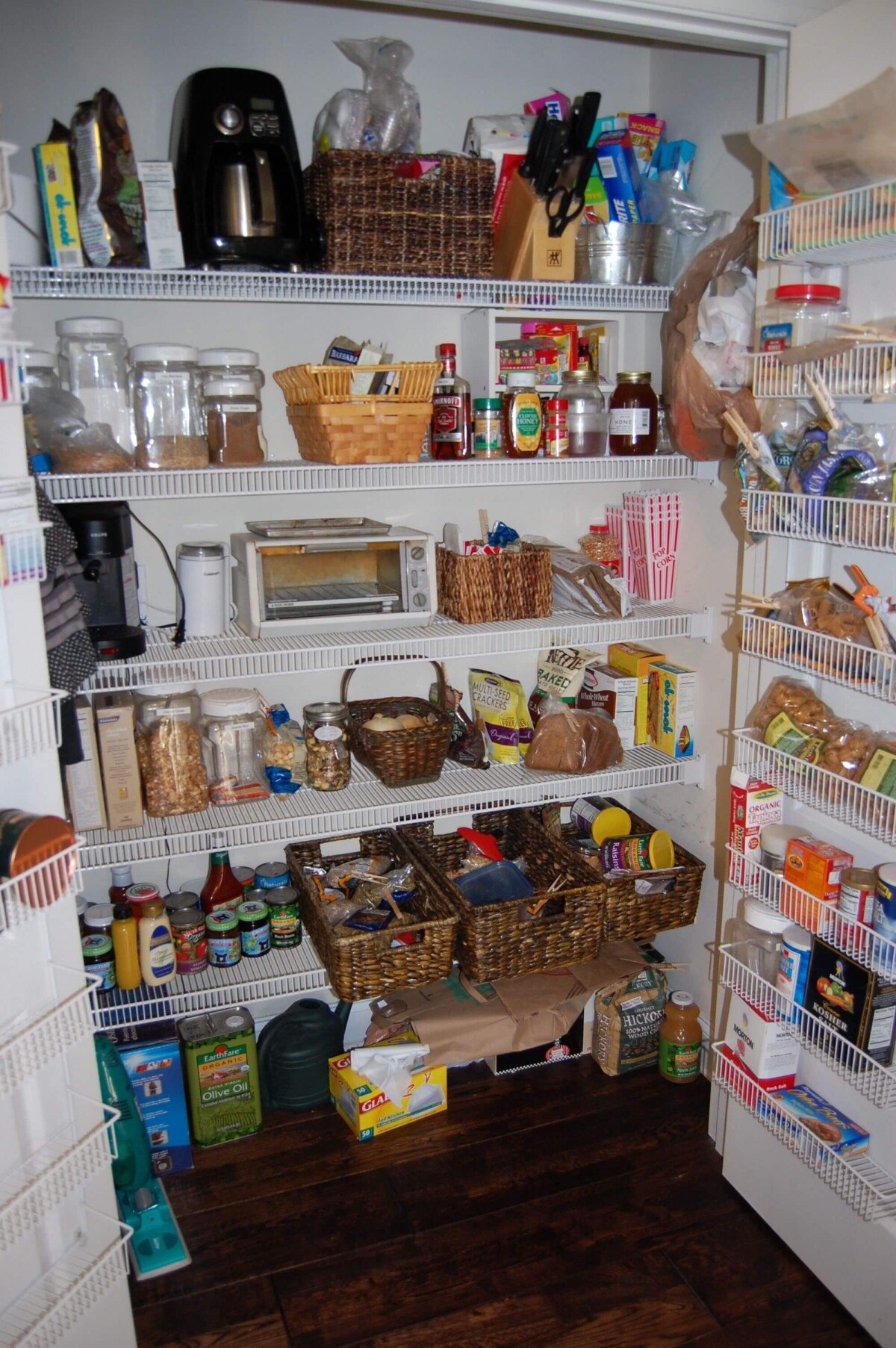
7 “Real Food” Pantry Essentials
- Nuts (like raw cashews, almonds, & pecans) and seeds (like raw pumpkin & sunflower). The pantry works for short-term storage, but if you don’t go through these items fairly quickly then store them in the freezer.
- Dried fruit like raisins, dried apricots, and dried apple rings. Also 1-ingredient organic applesauce is great to have on hand when you are out of fresh fruit.
- Baking ingredients like honey, vanilla extract, spices, oils, salt, and baking powder/soda.
- Whole-grain products like whole-grain sandwich bread, whole-wheat pasta, brown rice, quinoa, whole-wheat couscous, whole-wheat pretzels/crackers, etc.
- Whole grain cereals like raw oats (for oatmeal), homemade granola, shredded wheat, and whole-grain corn puffs.
- Fresh fruit that doesn’t need to be refrigerated like bananas, peaches, apples, pears, tomatoes, etc. We actually keep these items in a big fruit bowl on the kitchen table.
- Staples like potatoes, onions, garlic, dried/canned beans, and canned tomato products.
7 “Real Food” Fridge Essentials

- Dairy products like milk, cheese, cream cheese and plain yogurt
- Eggs
- Perishable fruits & vegetables
- 1-ingredient peanut butter & “all-fruit” type jelly
- Cooking fats like unsalted organic butter, clarified butter (ghee), and lard
- Snacks like olives and pickles
- Spread and sauces like hummus, tzatiki, soy sauce, maple syrup, mustard, and homemade salad dressings


C. Carrillo says
Watch out for the Horizon brand organic, it doesn't have a very good rating on the
EWG website.
100 Days Admin says
We'll have to check it out. Thanks for the heads up. - Nicole
D Robertson says
My ex-inlaws would cook anything from my freezer. My kids would get McDonalds at least one if not two of the meals. I'm jealous at how lucky you are.
Susan says
One idea for freezing single servings is to buy ramekins at your local restaurant supply store and fill them with soups, baked pasta, etc. and then freeze. Make one big batch and lunch is ready for the week.
Laura says
I'm in the Charlotte, NC area and am wondering where you are getting your local meat from.
Amy Taylor (comment moderator) says
Hello Laura. Lisa gets most of her meat from the Matthews Farmer's Market.
Joshua M says
That's interesting to know. I actually made a trip out there last saturday and was kinda overwhelmed trying to figure things out. I think I ended up getting some pork and fig leaf tea from middle ground. Is there a specific vendor she recommends for getting meat from?
100 Days Admin says
Any of them will have great choices!
Mercy says
Thanks a million for this great sites. I just stumbled on it and I have been glued to it since them. I really appreciate your good works,motivation and encouragement to make all us get back to real food and at a budget. I am trying the meals and will surely get back to let you know how I am doing.
Lisa says
Do you ever make your own hummus? I saw hummus on your list, but wasn't sure if you are making it from scratch. I was surprised at how easy and inexpensive it was! Just made some today.
Amy Taylor (comment moderator) says
Hi there. Lisa does make her own hummus. ;)
Mina says
How about frozen vegetables. Are they good to use? Thanks, new to your website and don't know if question was answered already.
Amy Taylor (comment moderator) says
Hi Mina. Sure, frozen veggies are great! :)
Barbara James says
are the frozen veggies at a regular store ok? do they have to say organic or is any brand ok? like birds eye, stuff you would buy at Wal-Mart.
can frozen veggies be considered processed? what about pesticides and such?
Amy Taylor (comment moderator) says
If you are trying to avoid pesticides, you would want to look for organic labels. The only ingredient should be the frozen veggies. :)
Val says
Hi, I am referring to the picture of your freezer :) It looks as it is not as high as regular freestanding freezer, but more of an under the counter height ... is it? I am looking for freezer that can be incorporated under the counter same as dishwasher etc so If yours is like that, would you mind sharing the brand? thx so much!
Amy Taylor (comment moderator) says
Hi Val. No, it is larger than counter height. Sorry.
liz roads says
what do you have stored in the mason jars in the freezer?
Amy Taylor (comment moderator) says
Hi Liz. Soups, chicken broth, and various leftovers. You can freeze just about anything that is liquid or soupy in consistency in mason jars. ~Amy
Kathy says
Any ideas for where to buy whole wheat pretzels. Trader Joes stopped carrying them and Whole Foods doesn't carry any which shocked me!
Thanks
Amy Taylor (comment moderator) says
Hi Kathy. Here is an online resource: http://www.uniquesplits.com/store/. I think Lisa finds these at Earth Fare. ~AMy
Darcy says
Would you mind sharing what whole wheat pretzels you buy? I haven't found any that don't have other questionable ingredients. I buy whole foods brand organic pretzels but I'd like a better option if you can share.
Assistant to 100 Days (Amy) says
Hi Darcy. Lisa usually buys them at Trader Joe's. :)
Masala Girl says
i also buy whole grain pretzels, the only ones i could find were Whole Spelt! they taste exactly the same! i find them at whole foods :)
sara says
what brand of one nut butter and all fruit jelly do you recommend and where would i be able to buy it?
Assistant to 100 Days (Amy) says
Hi Sara. Crofters is a widely available brand of all fruit spread that I usually get at Whole Foods. Regarding peanut butter, look for an organic variety that has only peanuts (and maybe salt) as the ingredients. Most conventional grocery stores carry at least one and you can find several, usually, at stores like Earth Fare, Trader Joes, and Whole Foods. ~Amy
Cheramie says
I would like to know what type of storage container you use for your homemade bread? I have not been able to find one that accommodates a loaf of homemade bread.
Thanks.
Assistant to 100 Days (Amy) says
Hi Cheramie. I have a linen bread bag that I bought on ETSY. You can also find reusable bread bags on amazon as well as several different versions of bread boxes that work well for homemade variously shaped loaves. :) ~Amy
Tee says
Great info, thanks! Where did you find those over the door storage shelves?
Assistant to 100 Days (Amy) says
Hi Tee. Do you mean on the pantry? Those aren't hung over the door. Those are drilled in. You can find them at Loews or similar stores. ~Amy
Roz L says
To Lisa D: The best all-fruit spread I have ever eaten is FiordiFrutta from Italy. It is expensive, but made only of organic fruit, organic apple juice, and pectin. I buy it at a specialty food store for about $6, but I've seen it online for $4.89. It is quite yummy and worth the price.
Marlana says
When freezing soups in glass mason jars, what is the process? I seem to hear a lot about the jars potentially breaking. Do you just let the soup completely cool and leave some room for expansion? Is it that simple? Thanks!
Assistant to 100 Days (Amy) says
Hi Marlana. It really is that simple. Lisa freezes a lot of individual portions in small jelly jars. I've broken a couple larger jars but only because they fell over, I didn't correct them and then threw something heavy in on top. Just be aware of how you have your freezer packed. :) I was careless. I love freezing in jars!
Kristen says
Hi! Other than coconut oil, what oil(s) can I use for baking/cooking? Thanks :)
Assistant to 100 Days (Amy) says
Hello Kristen. This will guide you: https://www.100daysofrealfood.com/2011/05/14/mini-pledge-week-10-no-refined-oils/. ~Amy