By 100 Days of Real Food, on May 16th, 2012 I love offering my readers special deals and this one today is no exception. In case you haven’t heard of eMeals they are an online meal planning service that creates weekly dinner plans along with corresponding shopping lists…so you don’t have to! I know most of you love meal planning services, which is why I am excited to share that eMeals just added a brand new “Clean Eating” track to their line up. They also already have a “Natural & Organic” track as well. And with just a few tweaks – like always buying the whole-grain version of the suggested breads/rice/etc. and also purchasing organic and/or local meats whenever possible – you have yourself a weekly “real food” meal plan.
Plus as a bonus there is no way to get in a dinner rut if someone else is planning the recipes for you!
Continue Reading »
By 100 Days of Real Food, on May 14th, 2012 As I shared on facebook last week we’ve been working on a project where we record and photograph every single thing our family eats for a week. I’ve been posting a lot of our kids’ lunches lately, and it’s provoked some readers to ask…”Well, what do you eat?” So it was a lot of work and sometimes hard to delay taking that first bite until we took the picture, but we figured we would just share it all! And what we ended up with were a ton of photos so I am breaking up the results into four posts: breakfast, lunch, snacks, and dinner/dessert.
Now, based on some of the feedback I’ve gotten when I share school lunches on facebook I feel as though I need to preface these posts with a disclaimer:
These meals are just a brief snapshot of our lives, and while I am sure some will feel we ate too much of X and not enough of Y, please know that we do not claim to be perfect (who is?). We simply do our best to eat a wide variety of satisfying whole foods while also only eating enough in order to feel full. In most cases we took pictures of our plates before we started eating and sometimes it was the right amount of food, but other times it was too much or too little. We didn’t prepare a special meal plan for the project, we just captured what happened. And I’d also like to add that it’s much easier to make judgments about one’s eating habits when you see their meal photos all laid out on one page like this (while you are NOT simultaneously trying to race out the door to school or work or after school activities)!
So in summary, this is a typical week at our house and while we are always open to suggestions and feedback we ask that you please be respectful in the comments as we put ourselves out there like this. As always, our mission is to share our personal experiences to hopefully inspire other busy families to eat more real food.
I would also like to mention that most of what we buy is organic including everything from produce to grains to dairy so rather than me saying “organic” over and over a hundred times please just assume that most everything you see is organic.
Continue Reading »
By 100 Days of Real Food, on May 10th, 2012 I hope this will be my first of several posts about how to “can” and preserve fresh foods when they are in season. I am a beginner canner myself, but have always been intrigued by and interested in the whole process. So I recently took a “Canning Class” (led by Ashley Eller at Poplar Ridge Farm) and have also been reading through some other resources including the Ball Blue Book Guide to Preserving. Prior to my class I knew absolutely nothing about canning except that I thought it sounded confusing, complicated, and like something that would take an entire day to do (not true!).
From one beginner to another, a few key points:
- In simple terms, canning food is cooking recipes (which most of us already know how to do) and then “processing” the results by putting them in sterilized canning jars and boiling or pressure “cooking” them for a designated amount of time. It really isn’t as complicated as I originally thought.
- It is important to use canning recipes from reliable sources. Especially as a beginner these are not recipes you want to modify or adapt in any way because each ingredient as well as both the length of time and temperature at which the jars are processed can be key components to ensuring food safety.
- You must use jars that are in fact suitable for “canning” with two-piece metal lids, which does not include old washed out Ragu spaghetti sauce jars. The most widely used brands of jars for canning are Ball and Kerr, and while the jars and bands (that go around the lid) are reusable you must always use brand new lids to properly can foods. Now I know why I see those packs of lids for sale. Continue Reading »
By 100 Days of Real Food, on May 8th, 2012 We love teriyaki sauce at our house and find that it’s great in stir-fry, on fish like sea bass and salmon, and on meat like chicken or pork tenderloin. This particular teriyaki sauce was inspired by a sea bass recipe my mother-n-law emailed to my husband back in 1998…and I still have a copy of it! We were both in college at the time so looking back I am impressed we were even contemplating homemade teriyaki, but I have to say I am equally impressed that I still have the print out (and that it was easy to locate) in my recipe collection. I personally think a long-running collection of favorite recipes is just invaluable. What old recipes have you been holding onto for years?
-
-
-
-
Continue Reading »
By 100 Days of Real Food, on May 3rd, 2012 When I give my “100 Days of Real Food” presentations I routinely bring along a grocery bag full of “tricky” food products to discuss. Here are a few the items I share:
-
1. Garden Veggie Sticks
Ingredients*(according to Amazon.com):
Potato Flour, Rice Flour, Expeller Pressed Sunflower Oil, Spinach Powder, Tomato Powder, Sea Salt, and Beet Powders
Reality Check:
I called the company myself to find out exactly how these “Veggie Sticks” are made, and what I learned is that they are deep-fried in oil. Last time I checked “French fries” are potatoes deep-fried in oil and if you look at the first three ingredients on the list above (which reflects what this product contains the most of*) these “veggie sticks” are basically potato flour (and rice flour) also deep-fried in oil. Yes, they also contain some spinach powder, tomato powder and beet powder, but let’s face it they contain more oil than any of these so-called veggie “powders.”
Keep enjoying Veggie Sticks if you’d like, but please don’t be fooled into thinking that they are a replacement for real vegetables. I think they are perfectly fine as an occasional treat, and I would personally classify them as a couple small steps above French fries.
Real Food Alternatives:
If you are looking for a crunchy replacement snack try Continue Reading »
By 100 Days of Real Food, on April 30th, 2012 Maybe I used to be living under a rock, but before our switch to “real food” I had never before purchased or cooked with dates. And I am just being honest here, but it’s possible I didn’t even know what dates were. Believe it or not Medjool dates are one of the oldest cultivated fruits in the world, which means they are also a whole food, of course. And even here in North Carolina you can easily find fresh Natural Delights Medjool dates at several local grocery stores including Harris Teeter, some Lowe’s locations and soon Earth Fare as well.
The great thing about Medjool dates is that they are so sweet so they can basically act as a sweetener in recipes. And when you are avoiding refined sugar you start to get creative when it comes to satisfying your sweet tooth. A few weeks after starting our “100 Days of Real Food” pledge a reader actually suggested a “chocolate torte/truffle” recipe to me (pictured) using Medjool dates, and looking back I honestly don’t think I would have survived our pledge without them!
 Chocolate Truffles Sweetened with Dates
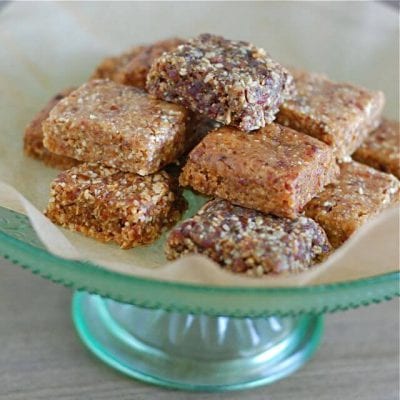
So today, I’d like to share three more recipes using Medjool dates in case you are new to this versatile sweet fruit as well. I do want to caution you though that even though the date seeds look like little pecans they are hard as a rock (pictured), so whatever you do be extra careful to remove the seeds first! Continue Reading »
|
|